Vision Based Humanoid Dribbles to Perfection in Simulation
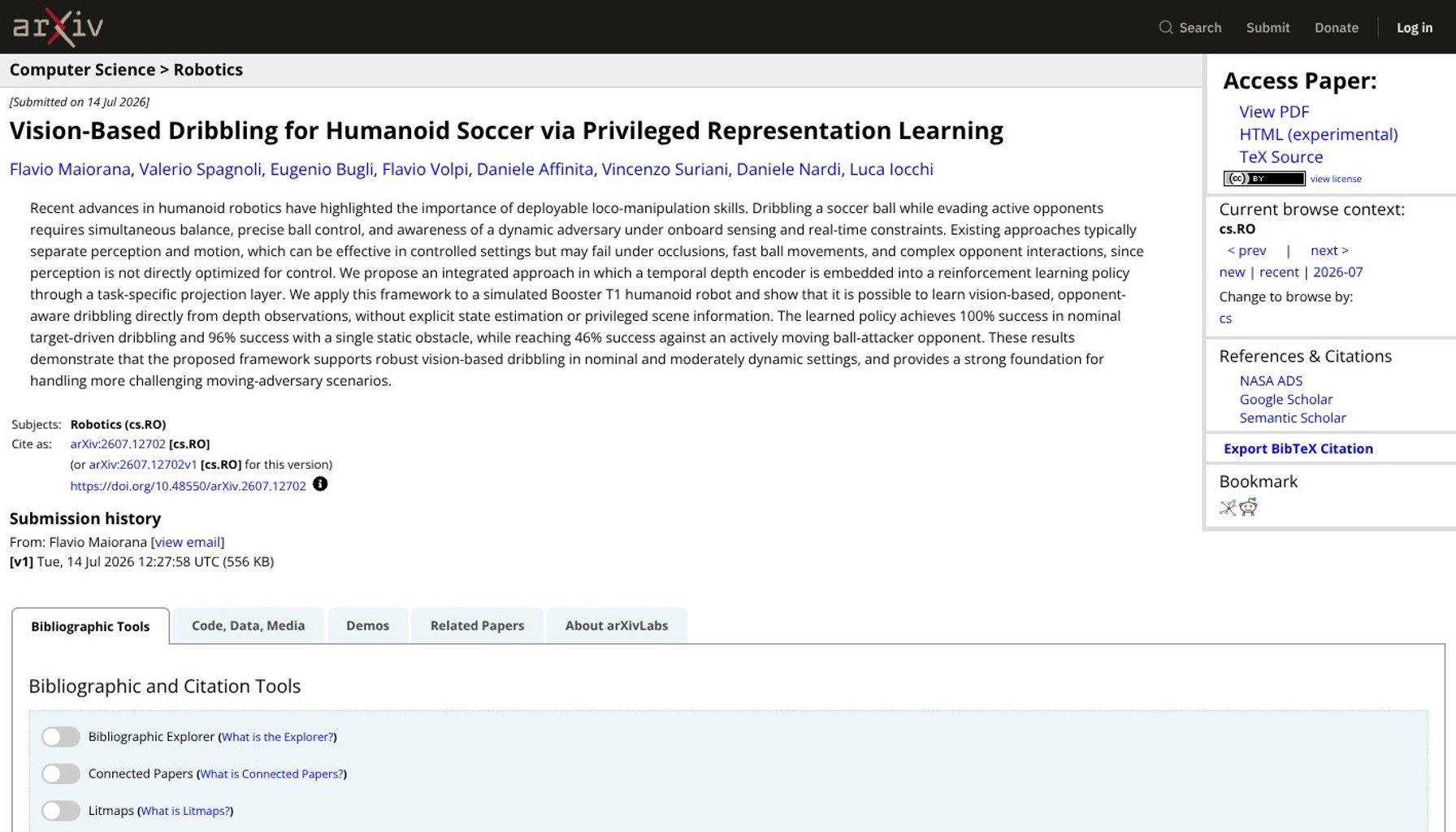
Image / arXiv Humanoid/Bipedal Query
A humanoid robot dribbled a soccer ball in a simulator with 100 percent success.
In a focused study of loco-manipulation for humanoids, researchers trained a vision-driven control policy that fuses a temporal depth encoder directly into a reinforcement learning framework. The key twist is an integrated, end-to-end approach that foregoes explicit state estimation or privileged scene reconstructions. Instead, the policy uses a depth-based representation persuaded by a task-specific projection layer, allowing the robot to see the ball, judge its speed, and respond to opposing pressure all at once. The team applied this framework to a simulated Booster T1 humanoid and reported striking results: 100 percent success in nominal target-driven dribbling, 96 percent success with a single static obstacle, and 46 percent success against an actively moving ball-attacker opponent.
That combination of perception and control marks a clear shift from the conventional separation of sensing and motion planning. In the package described by the authors, perception is tuned not for a full world model but for control relevance. The depth encoder distills what the robot needs to know to keep the ball under contact while dodging an obstacle and, in tougher tests, deflecting an active attacker. The numbers are not just badges of capability; they reveal how robust vision-based control can survive occlusions and rapid ball motions when the policy has direct access to depth cues that matter for leg and hand coordination. The work emphasizes an important lesson for the field: when perception is trained with the downstream control task in mind, the robot can adapt its maneuvers in ways that a separate perception pipeline might miss.
For practitioners in robots-on-the-floor, the paper’s setup is a lab proof of concept rather than production deployment. The Booster T1 is a research platform, and the reported results come from a simulated environment rather than real hardware trials. That distinction matters for investors and operators who weigh the step from simulation to real-world use. The study is a necessary step on the bridge from controlled demonstrations to real-time, on-board autonomy in dynamic environments. It also highlights a pragmatic constraint common across loco-manipulation tasks: as tasks become more adversarial, the gap between nominal success and moving-opponent performance widens. The authors’ 46 percent success against a moving ball-attacker signals that even well-tuned vision-to-action pipelines must grapple with rapid opponent dynamics and occlusion realistically present in play.
From a practitioner's lens, two to four concrete takeaways matter. First, end-to-end depth-based control reduces the compute and data fragility that can plague modular sensing-and-planning stacks, but real-world workloads will demand careful on-board compute budgeting and sensor calibration to maintain latency. Second, the strength against a static obstacle suggests the system handles static scene geometry effectively; expanding to dynamic obstacles will require robust temporal reasoning and possibly faster sensing updates. Third, the sim-to-real transition will hinge on transferring depth cues, lighting variations, and hardware noise from virtual to physical robotics, a hurdle that many deploy-and-scale programs encounter. Fourth, safety and reliability will depend on predictable failure modes; the team’s results imply that near-term real-world demos should start with constrained, well-lit arenas before attempting crowded, unpredictable play.
If investors and operators want to chart a path forward, the next milestones look clear: validate the approach on real hardware with onboard depth sensing, quantify real-time compute budgets, and test against progressively more dynamic adversaries to close the sim-to-real loop. As the field moves from isolated behaviors to robust, joint perception-control capabilities, this work provides a concrete blueprint for how to stack perception directly into control with depth-aware representations. The core idea remains simple and compelling: give the robot a depth-aware view, optimize for the task, and let the controller learn how to move the ball under pressure.
- Vision-Based Dribbling for Humanoid Soccer via Privileged Representation LearningarXiv Humanoid/Bipedal Query / Primary source / Published JUL 14, 2026 / Accessed JUL 15, 2026