AI translations of novels are fine, readers still prefer humans
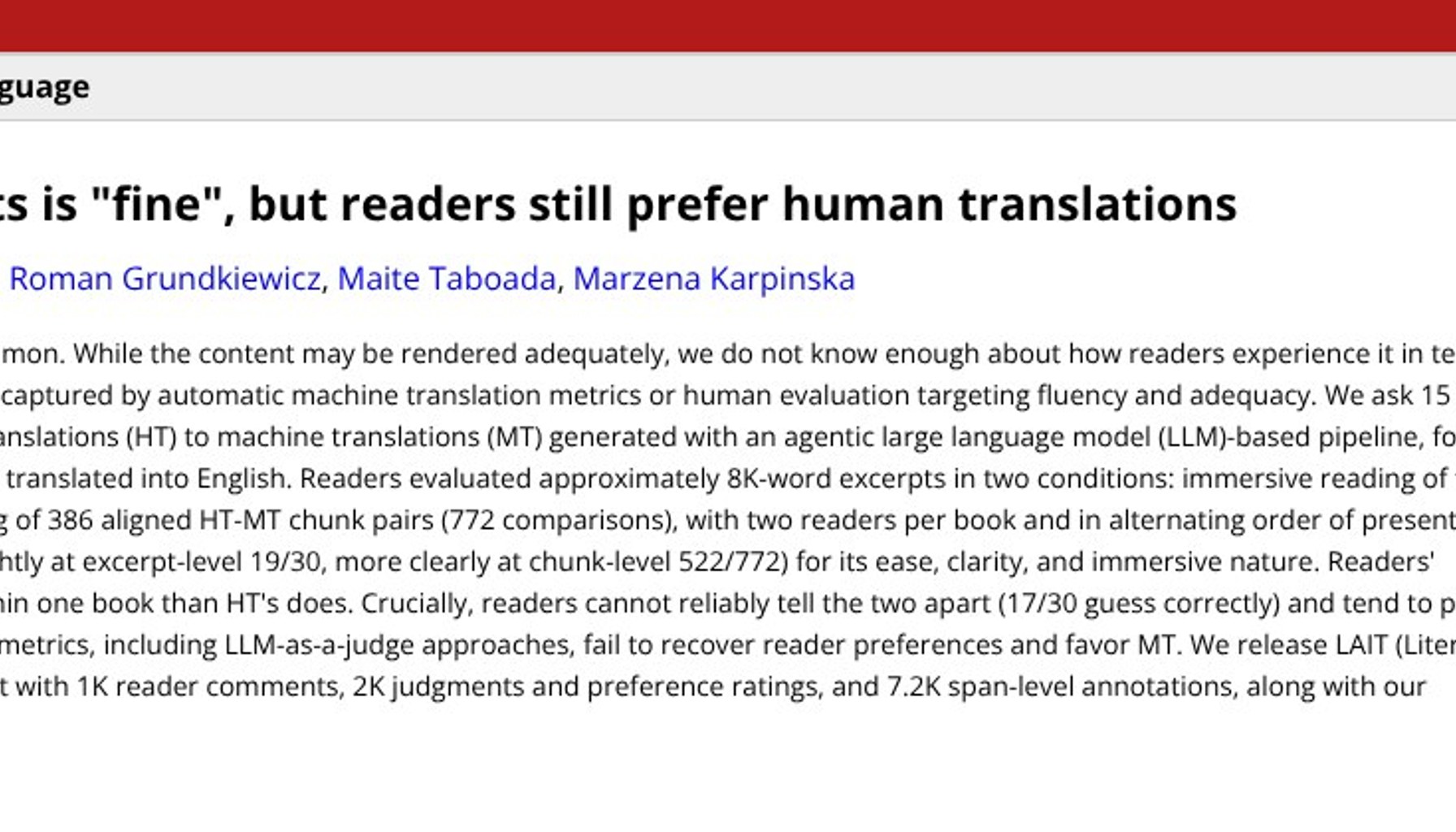
Image / arXiv LLM/Foundation Query
Readers call AI translations fine, but they still crave humanity.
A new study on literary translation asks a blunt question: can machine pipelines ever replace human translators in the hands of serious readers? The authors tested 15 novels in French, Polish, and Japanese translated into English, with 15 avid readers evaluating about 8,000 words per book under two conditions: immersive reading of whole excerpts and a fine grained, chunk level comparison of HT (human translation) versus MT (machine translation) produced by an agentic LLM based pipeline. The work, described in an arXiv paper, is as much about how we measure translation quality as it is about what readers actually feel when they turn the page.
The paper shows that readers judge AI translation as "fine," but they clearly prefer human translations for ease, clarity, and the sense of immersion that literature demands. The team reports a striking split in the numbers: at the excerpt level, HT won in 19 of 30 comparisons, and at the chunk level, HT won 522 of 772. More importantly, readers’ verdicts on the two versions were not entirely reliable as a blind test, 17 out of 30 readers could not reliably tell which translation was human. Yet readers tended to favor whatever version they believed to be human, a subtle bias that highlights the difficulty of disentangling linguistic quality from perceived provenance.
Benchmarks indicate a deeper misalignment between automatic metrics and reader experience. The study emphasizes that traditional evaluation targets, fluency and adequacy, do not consistently capture what makes a literary reading satisfying. In other words, a translator could pass standard checks and still fail to deliver the immersive, interpretive experience that literature invites. The paper notes that automatic metrics, including those that attempt to use LLMs as judges, fail to recover reader preferences demonstrated in real reading sessions.
The LAIT dataset, launched with the study, offers a reader centered resource for future work: 1,000 reader comments, 2,000 judgments and preference ratings, and 7,200 span level annotations, plus the evaluation protocol and a supporting interface. For practitioners, this is not just a dataset; it is a pressure test for ML translation systems aimed at literary texts, a domain where nuance matters as much as correctness.
From an engineering perspective, several concrete takeaways emerge. First, the heaviest constraint for publishers is user experience, not raw fluency. Immersion and interpretive nuance remain the frontier that MT struggles to cross consistently. Second, there is a clear tradeoff between speed and perceived quality; even with human like fluency, readers prize the sense that a human translator made intentional interpretive choices. Third, the quality variation within a single book is a warning sign: MT quality can swing dramatically from scene to scene, making a consistent reading experience difficult to guarantee. Finally, the results argue for hybrid workflows, where MT handles draft translation and human post editing preserves literary effects, or where human translators remain the default for long form fiction while MT serves as a first pass in quicker turnaround contexts.
What to watch next? Expect industry attention to shift toward evaluation protocols that prioritize reader experience and toward models that better separate fluency from literary effect. The LAIT dataset gives teams a concrete benchmark to test new evaluation metrics and hybrid pipelines, while reminding builders to guard against overreliance on automated judgments that miss immersion, mood, and voice.
- AI translation of literary texts is "fine", but readers still prefer human translationsarXiv LLM/Foundation Query / Primary source / Published JUN 24, 2026 / Accessed JUN 25, 2026