Software defined automation cuts deployment to days
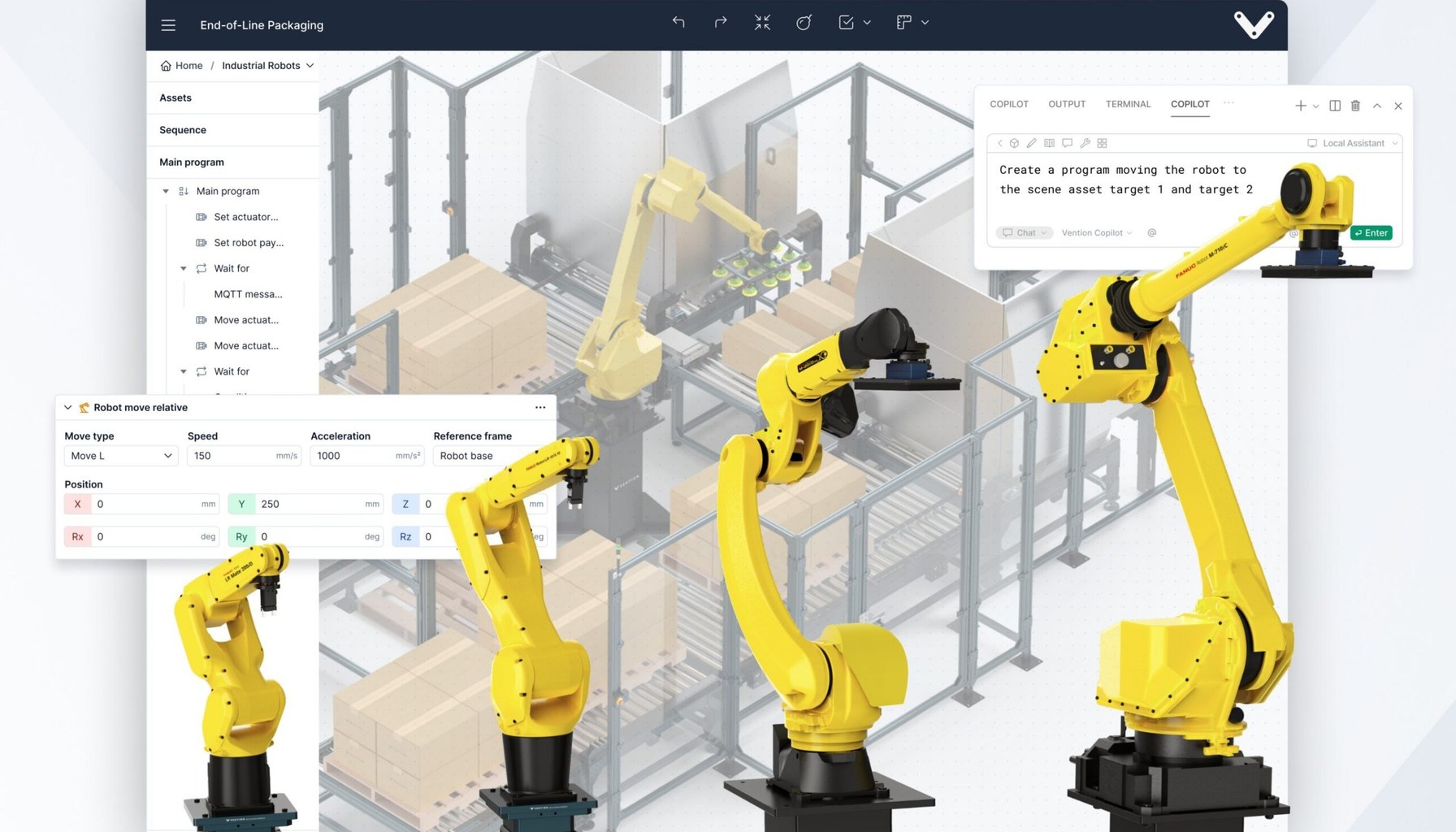
Image / The Robot Report
Automation goes live in days, not months.
At Automate in Chicago, Vention unveiled a software defined automation push built around AI powered path planning that pairs FANUC industrial robots with Universal Robots collaborative arms. The aim is simple and bold: reduce the friction that slows automation from pilots to production lines. Vention's MachineMotion AI and MachineLogic ecosystem promise to generate collision free motion paths, while integrated monitoring and remote support help keep lines up and running once they’re online. The collaboration with FANUC America and the optimized digital twin platform for UR deployments show a clear bet on software over bespoke rewiring, a move the company says responds directly to labor challenges that have long throttled robotics projects.
Deployment data shows manufacturers want automation that’s easier to deploy, faster to bring online, and less complex to sustain. Dick Motley of FANUC America described the trend: many companies want automation that delivers reliable performance without weeks of programming and debugging. That sentiment underpins Vention’s full stack approach, which unifies modular hardware, software, and physical AI to let customers design, program, deploy, and operate turnkey or custom automation in days rather than months. The numbers behind the platform reinforce the ambition: Vention has already deployed more than 25,000 machines across over 4,000 factories and has raised about 110 million dollars since its founding in 2016.
What makes the push credible in practical terms is the way the platform changes the work of getting a line up and running. Instead of manually wiring a path waypoint by waypoint, operators can lean on AI to chart safe, collision free routes for both industrial robots and collaborative arms. The digital twin enhancement for UR deployments enables a more seamless test and validation cycle in a virtual environment before touching real hardware, reducing the risk of costly missteps on the shop floor. In effect, the software layer is doing a lot of the heavy lifting that typically consumed weeks of programming time, retooling, and on site debugging.
This is not a claim of effortless magic; it is a forecast grounded in deployment data and the realities of shop floor constraints. On one hand, the promise of rapid go live translates into a shorter deployment cycle time, the days referenced by Vention's communications. It also raises questions about integration with existing control architectures, IT policy, and cybersecurity. On the other hand, the integration with FANUC industrial robots and UR collaborative robots represents a concrete path to scalable automation across different cell types. Deployment that once required bespoke software tends toward standardized, repeatable templates, which can accelerate rollout while demanding tighter governance on change management and data flows.
From a practitioner's lens, there are clear incentives and meaningful constraints to watch. First is integration requirements: bringing FANUC and UR assets under a single software defined umbrella implies compatibility across hardware generations, network topology, and remote monitoring interfaces. For plant managers, this promises a cleaner operator experience and faster troubleshooting, but it hinges on robust IT readiness, data connectivity, and cybersecurity hygiene. Second is the impact on skilled trades. Automation platforms that lower the programming burden can free technicians to focus on line optimization and preventive maintenance, yet they still require skilled oversight during commissioning, validation, and qualified path verification. Third is momentum versus risk: the speed to deploy is compelling, but every plant's line is unique, with existing fixtures, safety interlocks, and maintenance routines that must align with the new digital twin and AI driven workflows. And finally, the business case hinges on demonstrated throughput gains and cycle time improvements once live; the current narrative emphasizes deployment speed and scale, with 25,000 machines and 4,000 factories, over a single plant's granular metrics.
In the end, the industry is watching a pragmatic shift: software defined automation that promises faster time to value, ongoing remote support, and a scalable path to bring more robots into everyday production. It's an evolution of operations, not a miracle cure, with ROI measured in deployment cadence and reduced complexity as much as in units per hour.
- Vention collaborates with FANUC and Universal Robots on software-defined automationThe Robot Report / Trade / Published JUN 23, 2026 / Accessed JUN 24, 2026