Multimodal Signals Beat LEDs in Robot Communication
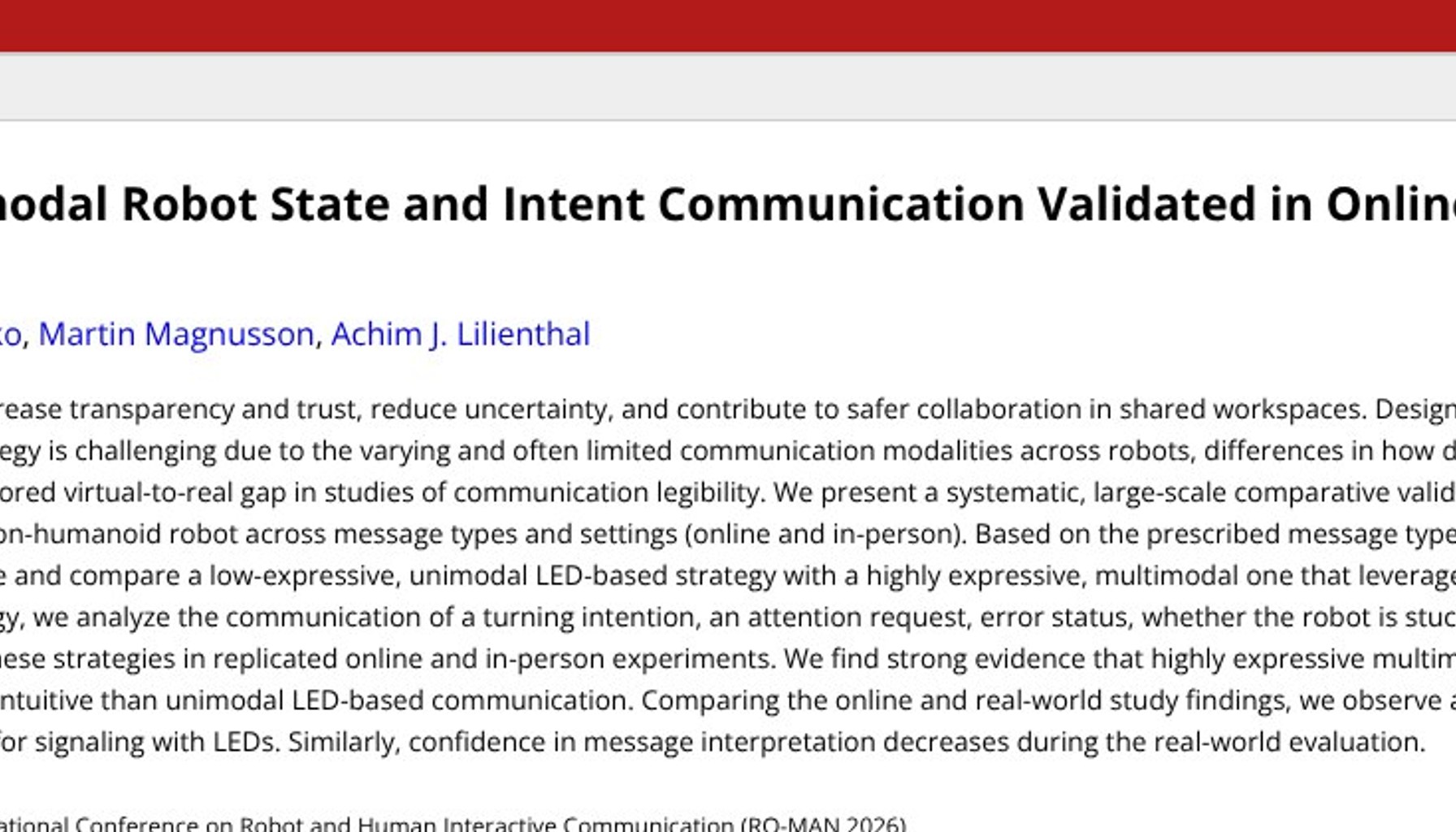
Image / arXiv Humanoid/Bipedal Query
Expressive robot signals beat LEDs in real world tests. That is the takeaway from a large scale validation that compares a low expressive, LED based signaling scheme against a highly expressive multimodal system using gaze, gestures, and voice to convey five key states: turning intention, an attention request, error status, whether the robot is stuck, and whether it is functioning normally. The studies, conducted online and in real environments, show that when the stakes are real, people crane their necks toward the robot’s cues and interpret its intent more quickly and with greater confidence when those cues move beyond simple LEDs. Testing shows the multimodal approach is perceived as more legible and intuitive, a finding that matters for safety and collaboration in shared workspaces.
The work centers on a mobile non-humanoid robot and asks a practical question: which language should a robot use when it needs a human to act, pause, or adjust to a task? LEDs are cheap and robust in some contexts, but the study’s real world data exposes a critical gap. In virtual simulations, LED signals can register as legible enough; in in person, day to day settings with noise, lighting variation, and human attention being pulled in many directions, LEDs lose clarity. The same five messages, turning directions, attention requests, error alerts, I am stuck, and I am operating normally, are easier to interpret when the robot can point, look, and speak in a coordinated fashion. The researchers replicated sessions online and in real rooms to compare the two signaling strategies, and the contrast was stark: multimodal signaling consistently outperformed LED signaling in legibility and interpretive confidence, especially for complex or urgent states.
For engineers and operators, the result translates into a concrete feasibility shift. The spec that changes feasibility is not a machinery metric like speed or payload but a communication spec: the robot must be capable of expressive state signaling that maps clearly to human expectations. In practice, that means equipping a mobile unit with actuators for controlled gaze, articulated gestures, and a voice channel, plus the software to coordinate message timing with task context. The payoff, as the study suggests, is more transparent collaboration and reduced uncertainty, an outcome that can lower the risk of missteps in crowded or dynamic workplaces. Yet the data also underscore a deployment reality: the benefits of multimodal signaling can erode in the wild if one modality flares out of sync or competes with ambient noise, lighting, or line of sight obstructions.
From a practitioner’s viewpoint, several concrete implications emerge. First, the tradeoff between cost and clarity is real: multimodal signaling requires more hardware, more sensing, and more processing. Second, interpretation is not universal; different recipients may parse gaze, posture, or voice cues differently, so standardization of semantics and careful user testing across roles and environments are essential. Third, failure modes multiply; if the robot’s gaze is blocked, if a gesture is misread, or if the voice channel is overwhelmed, the system should gracefully fall back to a simpler signal or a clear LED cue. Finally, a staged rollout from lab validation to pilot deployments in real work zones will help surface context specific quirks, such as lighting conditions or acoustic environments, before committing to production scale use.
The study’s takeaway is crisp: in practical robot to human communication, richer, multimodal signaling makes intent legible where LEDs do not. The result is a roadmap for next generation shared space robotics, where the hardware and software must be designed in tandem to deliver clear signals, even when the environment fights back.
- Legible and Intuitive Multi-modal Robot State and Intent Communication Validated in Online and Real-world StudiesarXiv Humanoid/Bipedal Query / Primary source / Published JUN 23, 2026 / Accessed JUN 24, 2026