AWS Positions Amazon Quick as a Sales AI Assistant for Research, CRM Work, and Lead Prioritization
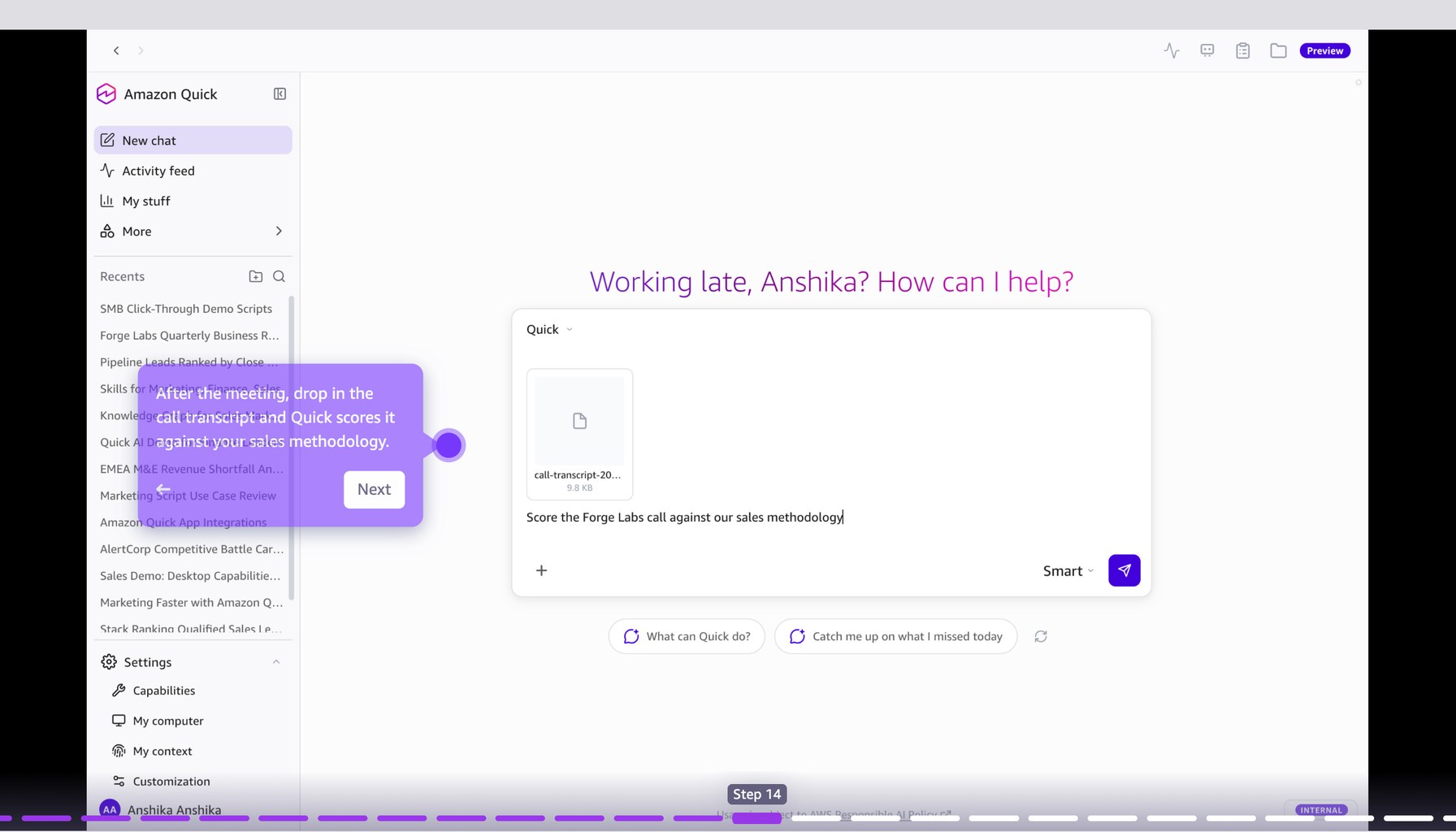
Image / aws.amazon.com
The company says 3M, AWS Global Sales, and Amazon are using the workplace assistant, but it has not provided independent productivity results or adoption details.
AWS has published a sales-focused pitch for Amazon Quick, its AI assistant for work, saying the product can reduce the time sales representatives spend on prospect research, CRM updates, email drafting, and switching between business applications.
Amazon Quick is available in a browser and desktop application, and AWS says it can also operate within Microsoft 365, Outlook, and other workplace tools. The company is positioning the assistant as a layer across the sales workflow, from identifying promising accounts to keeping opportunity records current after customer interactions.
AWS says sales representatives spend an average of 40% of their time selling, with the balance going to administrative and coordination work. That figure, and the company’s claims that Quick can help teams cover more territory and close deals faster, have not been independently verified in the material AWS published.
The product’s sales workflow begins with connecting Quick to a CRM system. AWS says documentation provides integration instructions for Salesforce, HubSpot, ServiceNow, and other systems. Once connected to CRM, email, web analytics, and support data, Quick can analyze engagement signals and rank prospects by apparent buying intent, according to AWS.
A sales manager could use Quick to assess a dashboard built with Amazon Quick Sight, AWS’s business-intelligence service within Quick, and ask the assistant to identify higher-priority leads. AWS also says custom chat agents can pull account history, internal documents, and opportunity details into responses, potentially reducing the manual work required to assemble pre-call or account-planning context.
The company named 3M, AWS Global Sales, and Amazon as organizations already using Quick. AWS also said Amazon has deployed Quick Suite across thousands of users, though it did not specify the rollout geography, the number of sales users, the duration of deployments, or measured outcomes such as CRM data-quality improvements, pipeline conversion, revenue gains, or hours saved per representative.
For revenue-operations buyers, the practical distinction is not whether an assistant can draft a follow-up email. Many AI products can do that. The operational question is whether it can retrieve trustworthy data from a company’s CRM and connected systems, apply the right access controls, and take actions without creating more review work for sellers and managers.
AWS’s description suggests Quick is designed to work as a connected enterprise assistant rather than a standalone sales chatbot. That can be useful where teams already run significant workloads on AWS or need an assistant that spans CRM, email, internal documents, analytics, and support systems. It also means implementation will depend heavily on connector setup, data quality, permissions, and the definition of sales workflows the assistant is allowed to automate.
There are no model parameter counts, benchmark scores, pricing details, or task-level accuracy figures in AWS’s announcement. AWS also did not publish comparisons against competing sales assistants or disclose error rates for lead ranking, research summaries, CRM updates, or agent-driven actions.
The uncertainty matters because lead prioritization is a high-impact workflow. A system that ranks prospects incorrectly can direct scarce sales time toward weak opportunities, while an assistant that writes incomplete CRM updates can degrade forecasting and account records. Teams evaluating Quick should ask for evidence from their own data: retrieval accuracy, action approval rates, time saved per workflow, and whether recommendations improve conversion or seller capacity after human review.
- Transform your sales organization with Amazon Quick: your new agentic AI teammate | Amazon Web Servicesaws.amazon.com / Primary / Published JUL 17, 2026 / Accessed JUL 18, 2026