UC San Diego Study Tests Humanoid Teleoperation for Laparoscopic Surgery in Porcine Models
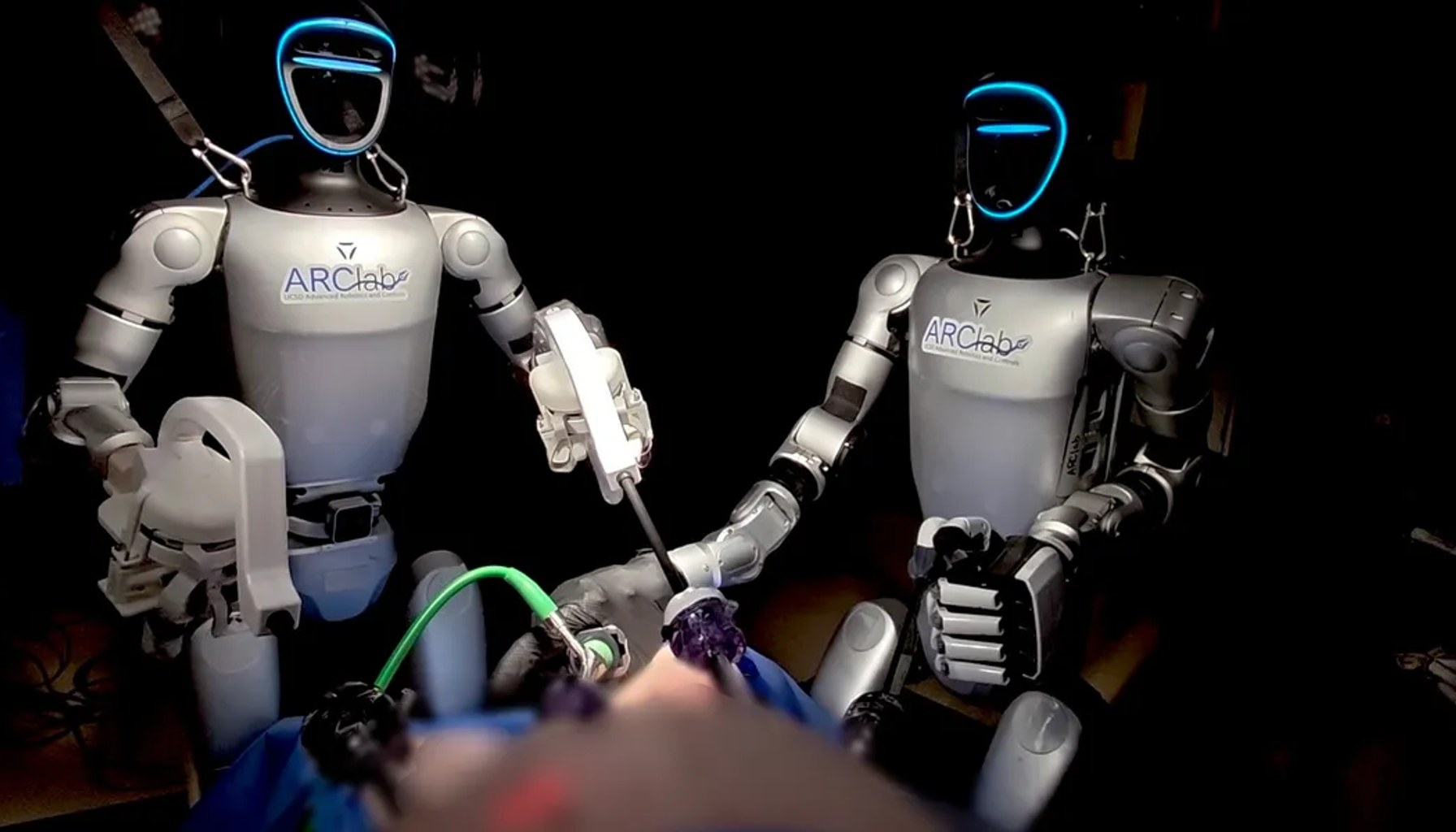
Image / spectrum.ieee.org
The work moves beyond laboratory demos with benchtop, user-study, and live-animal evaluation, but provides no evidence yet of clinical use in human patients.
IEEE Spectrum has highlighted a UC San Diego study that systematically evaluates humanoid technology for laparoscopic surgical tasks, testing a humanoid-based teleoperation framework across benchtop experiments, dry-lab user studies, and in vivo porcine procedures.
The researchers built the system around general-purpose laparoscopic instruments rather than a dedicated surgical robot platform. Their evaluation measured technical feasibility, task performance, and clinical readiness against established surgical systems, UC San Diego said.
That testing sequence matters because it places the work beyond a single proof-of-concept demonstration. Benchtop characterization can establish whether a robot can position instruments, transmit operator commands, and complete constrained tasks under controlled conditions. Dry-lab studies with users of different surgical experience levels begin to test whether the interface can be operated consistently by people with varying levels of training. Porcine testing adds an in vivo environment, where tissue interaction, anatomy, visualization, and procedural workflow are more realistic than a dry simulator.
The study remains preclinical. The reported work does not establish that a humanoid system is ready for human surgery, regulatory review, or routine hospital deployment. UC San Diego explicitly characterized the results as identifying both promise and technical challenges that must be resolved before clinical deployment.
The practical opportunity is not necessarily to replace established surgical robots with a humanoid in an operating room. A humanoid form factor could eventually support teleoperation in environments designed for human clinicians, potentially using common tools and workspaces without requiring every task to be rebuilt around a fixed surgical cart. But that proposition depends on performance that has not been specified in the available material, including instrument precision, force control, latency, reliability, operator workload, sterilization strategy, safety systems, and failure recovery.
No technical specifications were disclosed for the humanoid platform, including its degrees of freedom, payload, actuation method, sensing suite, runtime, or the number of participants and animal procedures in the evaluation. Those details will be necessary to judge how the system compares with purpose-built laparoscopic platforms.
The study also does not establish whether the work has been peer reviewed or formally published, and it does not identify the authors, laboratory, or journal venue. What is confirmed is narrower but meaningful: UC San Diego has taken humanoid surgical teleoperation through benchtop, dry-lab, and porcine testing, producing an evidence-based assessment rather than relying solely on promotional task videos.
For surgical robotics operators and investors, the result is a sign that humanoid-assisted teleoperation is entering more rigorous preclinical validation. Clinical readiness remains an open question, and the engineering burden remains substantial.
- Videos: Robotic Surgery, Quadruped Locomotion, and Morespectrum.ieee.org / Research / Published JUL 17, 2026 / Accessed JUL 18, 2026