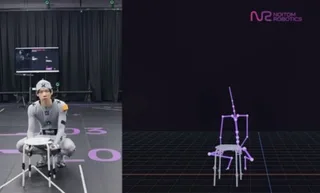
A sponsored Wiley and IEEE white paper describes a 617.5-hour dataset, including object interactions, and reports testing on a Unitree G1.
The HiPHI dataset aims to give humanoid robots better examples of how bodies move while handling objects. The white paper says it captures whole-body human motion with optical motion capture at sub-millimeter accuracy.
That matters because ordinary video shows what people do, but not the precise body and object movements needed to reproduce an action. HiPHI includes 245.7 hours of human-object interaction, with synchronized paths and three-dimensional object shapes, according to the white paper.
Those paired records could help a robot learn actions such as carrying, pushing, and pulling. The dataset organizes its coverage with FrameNet, a language framework that links descriptions of actions to the roles involved. In practical terms, that gives researchers a way to connect “push the box” with the person, object, and movement in the recorded example.
The paper also proposes benchmarks for measuring motion variety and how well a learned movement connects to an object interaction. It reports that reinforcement-learning policies—software that improves through repeated trial and error—were trained with the data and deployed on a physical Unitree G1 humanoid robot.
That is a reported physical-robot demonstration, not evidence of broad deployment. The extract does not identify the G1’s specific tasks, test scores, operating site, or whether researchers can access HiPHI and its benchmarks.
The white paper is sponsored by Noitom Robotics and presented by Wiley and IEEE. For operators, the useful next question is whether the dataset and evaluation tools are available, and whether the reported skills transfer beyond this robot and test setting.