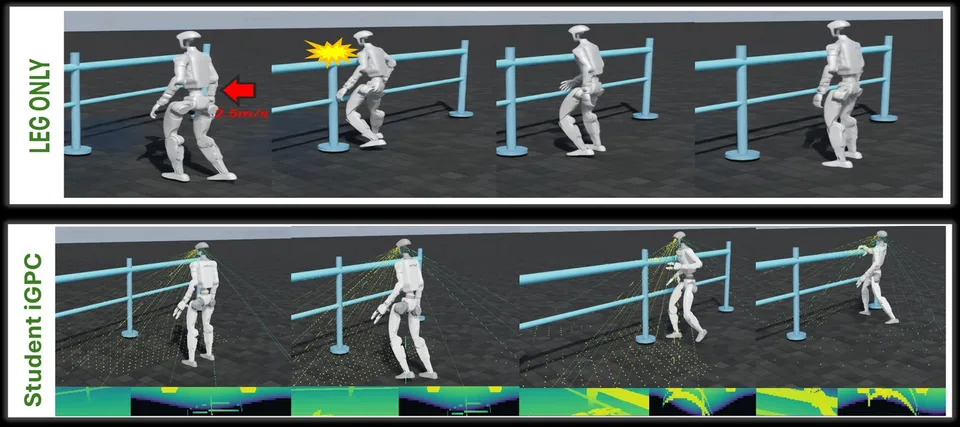
The paper combines a pretrained motion controller with task-specific learning and onboard sensing; its key success rates come from simulation, not hardware.
Researchers from Mohamed bin Zayed University of Artificial Intelligence, MIT, and Minerva Humanoids describe iGPC, a research framework for object interaction on the Unitree G1. It is a paper-stage system with selected robot demonstrations, not a product available to buy.
How the transfer works
iGPC retains a pretrained controller based on human-motion data. Researchers then add task-specific “interaction experts” that use scene affordances—information about object geometry, possible contact, and robot stability—to learn reaching, support-assisted balance, and pushing.
Those experts also receive privileged simulator information during training. Task-specific reinforcement learning further adapts the controller for each behavior. This means the reported capability comes from both the retained motion prior and newly learned interaction and affordance modules, not from the prior alone.
A sensor-based student then learns to reconstruct the needed interaction and body-state information from depth, LiDAR, and proprioception, or measurements of the robot’s own joints and motion. It does not use simulator-only object poses, body velocities, or contact-force labels as learned-policy inputs.
Demo versus deployment
In simulation, the authors report 99.32% success for commanded rail contact. The sensor-based student reached 95.95%, compared with 46.53% for a student that discarded the motion prior. Hardware tests used depth at 30 hertz, LiDAR at 10 hertz, and policy updates above 50 hertz.
The G1 reached for a rail, pushed a box for 10 seconds, grabbed a rail after an external push, and used hand support while sitting and standing. The box-pushing comparison used different simulators and each method’s native robot and control interface, so it is not a clean head-to-head deployment test.
The paper identifies broader testing of unseen conditions and contact safety as future work. These demonstrations do not establish safe operation around people.