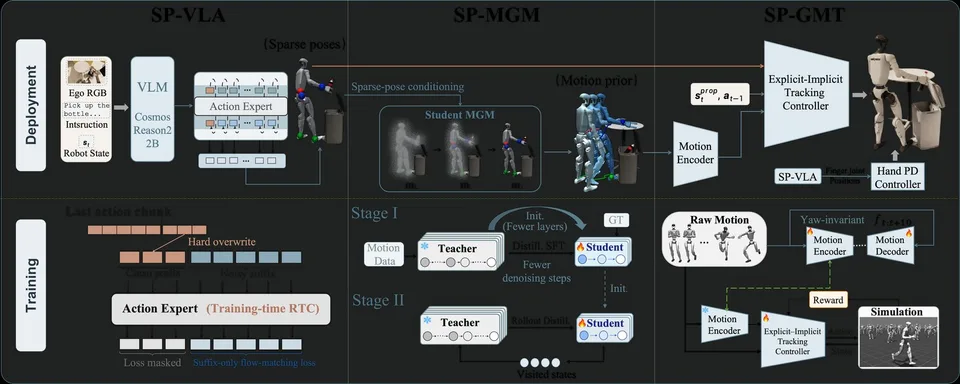
SP-HLM combines sparse task instructions with a learned motion prior, then tests the approach in simulation and on a Unitree G1.
SP-HLM is a research framework proposed by teams from Shanghai Jiao Tong University, Moore Threads, and the University of Hong Kong. It gives a humanoid five important body targets instead of specifying every joint: the pelvis, both wrists, and both ankles.
Each target includes a position and orientation. A learned motion prior—a compact model of coordinated body movement—fills in how the rest of the robot should move around those constraints.
The system has three main parts. SP-VLA uses camera images, robot state, and language instructions to predict the five body poses and finger-joint targets. SP-MGM converts those sparse targets into a full-body motion trajectory. SP-GMT then combines that trajectory with the explicit targets and produces joint-position commands for control.
This division matters because a high-level policy can focus on task intent, such as reaching, stepping, or opening something. Downstream models handle the detailed coordination needed to move the body consistently with those targets.
According to the authors’ paper on arXiv, SP-HLM achieved a 52.75% overall success rate across eight simulated tasks. In real-world tests, the system ran on a Unitree G1 fitted with a ZED 2i stereo camera and completed 20 trials per task.
The authors report success rates above 50% for object placement and shelf transfer, but 25% for cabinet opening and 40% for trash-bin opening. They link the harder failures to precise contact and demanding balance conditions.
This is a research demonstration, not a consumer product release. No independent evaluation or replication is reported; testing on other robots, objects, and workplaces is the next step for judging how broadly the interface transfers.