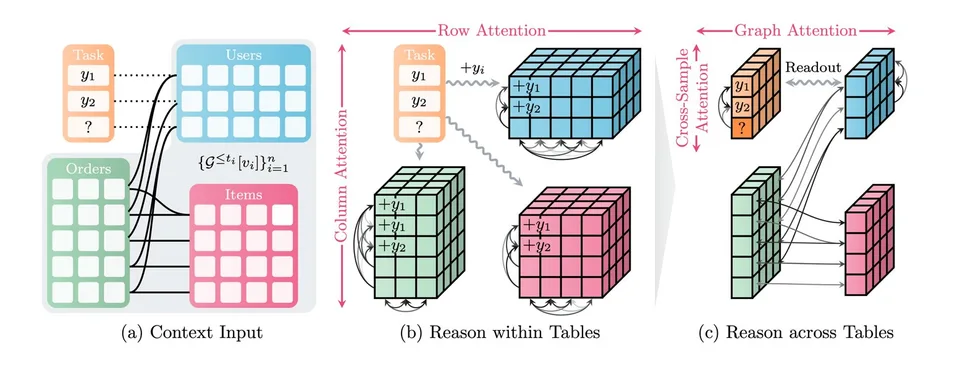
The announced model uses database relationships and historical examples instead of a separate training pipeline for every prediction task.
NVIDIA says Kumo Relational can predict outcomes directly from enterprise databases, including customer churn, demand, and fraud. It is an artificial intelligence model for structured data, where information is stored across connected tables rather than one large spreadsheet.
Its main appeal is reducing setup work. Developers describe a prediction in Predictive Query Language, which states what to predict instead of how to calculate it. The model then gathers up to 10,000 historical examples at prediction time, without task-specific training, manual feature engineering, or flattening tables.
NVIDIA says the system preserves tables, foreign-key links between records, and timestamps. For a time-based prediction, it replays earlier database states and provides only information available before the prediction point. That is intended to prevent later information from leaking into the answer.
The model was pre-trained on synthetic relational data, then adapted to each task through in-context learning. NVIDIA says teams can fine-tune it on a specific dataset when maximum accuracy matters.
NVIDIA reports tests across 41 benchmarks and 15 relational databases. On the SAP SALT enterprise benchmark, it says Kumo Relational beat large AutoGluon ensembles by 8% in mean reciprocal rank, a measure of ranking quality. In a separate leaderboard comparison, NVIDIA reports similar accuracy with roughly 430 times less inference time than the highest-scoring entry.
Kumo Relational is available today through NVIDIA’s open-source structured-data-models library or as an NVIDIA NIM service. NVIDIA says the code uses the Apache 2.0 license, while the model weights use the OpenMDW License Agreement, version 1.1.
The results are company-reported, not independent production evidence. Teams should compare cost, speed, access controls, and accuracy against their existing database pipeline before adopting it.