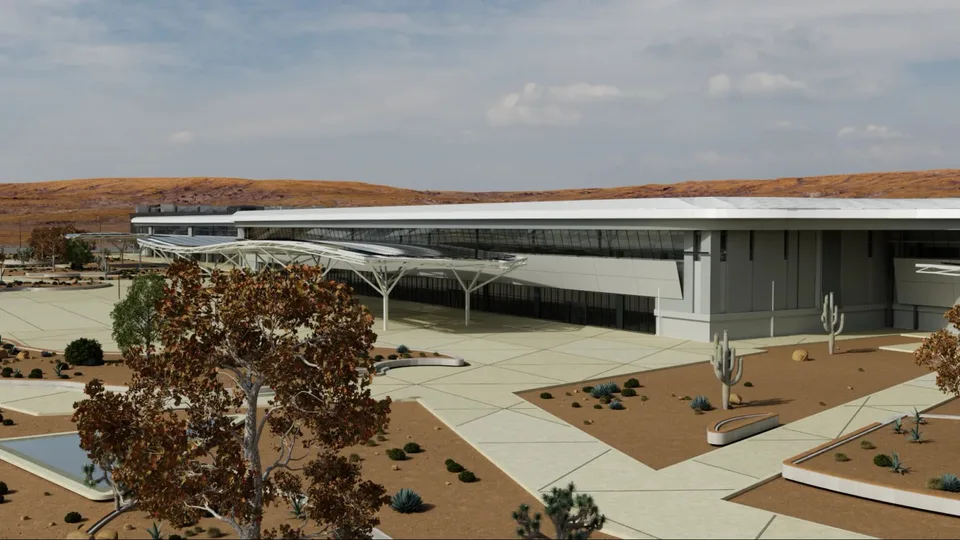
NVIDIA’s demonstration turns site plans, equipment data and requirements into an editable OpenUSD campus model. Engineers still must verify the design before engineering simulation.
NVIDIA has demonstrated an agent-assisted workflow for building an editable digital model of an AI-factory campus. The demonstration shows how software agents can organize design inputs, revise layouts and prepare a model for engineering review.
The practical goal is straightforward: help teams change a complex facility while keeping track of the drawings, equipment data and requirements behind each decision.
The workflow uses the NVIDIA Omniverse DSX Blueprint. It provides reference digital-twin assets, sample scripts and workflows for developing AI-factory models with OpenUSD and NVIDIA Omniverse libraries.
OpenUSD is a format for combining 3D scenes with related information across software tools. In this workflow, it provides a shared, editable scene for buildings, equipment and design changes. Associated attributes and schemas can also preserve links to engineering records and requirements, although that does not mean every engineering detail appeared in the demonstrated campus model.
What the agent actually does
The workflow begins with several kinds of project material. Site plans describe the campus arrangement. Drawings and equipment information provide dimensions and placement details. Requirements documents define conditions the design must satisfy. Geographic data adds terrain and surrounding site context.
Existing 3D buildings and equipment provide reusable geometry. Architectural references can guide the appearance of roofs, facades and landscaping.
An AI agent then works inside an “agent harness,” software that manages instructions, context and tool calls. Developers connect the agent to modeling and analysis tools, then decide which changes it may suggest or apply.
In the demonstration, the agent helps assemble and revise OpenUSD scenes. It can bring together reference assets, apply design requirements and help inspect the result. Developers remain involved in connecting tools and guiding changes.
The team used reference buildings and equipment from the DSX design, along with architectural inspiration from NVIDIA’s Voyager campus. The resulting campus model included existing facility assets and a conceptual solar canopy.
The canopy could be reviewed in the larger scene and refined as a separate, editable design element. It still required checks for dimensions, structural properties and suitability for simulation.
The model also uses additive USD layers, which keep new changes separate from original assets. That approach can make edits easier to review while preserving the underlying design sources.
The agent’s useful role is therefore narrower than “design the factory.” It can help assemble a design revision and expose the inputs behind it. Engineers remain responsible for deciding whether the revision is physically and operationally sound.
How it could help with a fixed power budget
The fixed-power question gives the workflow a more concrete purpose: How should an AI-factory hall be configured when available power is limited?
Changing the compute configuration can affect equipment quantity, placement, electrical distribution and cooling. A useful design process must consider those dependencies together rather than treating each rack as an isolated object.
NVIDIA proposes extending the campus model for this kind of capacity-planning study. The proposed extension would connect the modeled layout with compute, electrical and cooling requirements so teams could evaluate alternative configurations.
Engineers would assess complete racks, including their placement, electrical distribution, cooling connections and network resources. If one proposed change affects several requirements, connected engineering tools could help identify those dependencies for review.
NVIDIA also describes an illustrative comparison between DSX MaxLPS and a MaxP baseline. MaxP refers to the highest static GPU-level power setting in the comparison. DSX MaxLPS is described as an AI-factory design and operating framework focused on facility design, dynamic power allocation and performance per watt.
Normalized to a 1-megawatt power basis and assuming a power usage effectiveness value of 1.1, the illustrative DSX MaxLPS scenario shows capacity for 400 GPUs and aggregate token throughput of 1.35 times the MaxP baseline.
Those numbers are reference assumptions for the proposed capacity study. They are not results generated by the campus model, and they do not specify a deployable rack layout.
That distinction matters for planning. The comparison may help set a question about capacity, but the answer still depends on the actual racks, power systems, cooling equipment, network design and operating conditions.
What engineers still need to validate
A model can look convincing while containing incorrect measurements. NVIDIA says dimensional accuracy depends on checking the model against applicable drawings, specifications and site constraints.
Engineers would need to verify several parts of a proposed revision:
- Geometry: Are buildings, racks, roads and equipment placed at the correct size and location?
- Equipment data: Do the assets include the properties needed for power and cooling analysis?
- System connections: Are electrical, cooling and network relationships represented correctly?
- Study conditions: Does the simulation use the right operating assumptions and boundary conditions?
OpenUSD can provide the shared scene. SimReady guidance can help teams determine whether assets contain the geometry, properties and connection data needed for a particular simulation.
But these tools support engineering validation rather than replacing it. A missing property, incorrect connection or wrong assumption could change the result of a study.
The proposed workflow would connect requirements software, drawings, equipment catalogs and simulation tools. If those systems expose suitable interfaces, an agent could query requirements, flag potentially affected dependencies, prepare a revised scene and collect study reports.
Engineers would still review the assumptions and results. Preparing a scene for a specific simulation also requires additional checks for geometry, equipment properties, system connections and boundary conditions.
The practical takeaway
For engineers, the near-term value is not an autonomous factory designer. It is a way to organize scattered project information and keep design revisions editable and traceable.
A sensible starting point would be one narrow question, such as how a proposed rack arrangement affects power and cooling. The team could connect the needed data and tools, inspect the generated revision, and validate the relevant dimensions and system properties.
If that handoff proves reliable, the same OpenUSD model could support later simulations and further design iterations. For now, the agent is best treated as a design assistant: useful for assembling options and surfacing affected requirements, but not the final authority on whether an AI factory is ready for engineering simulation.