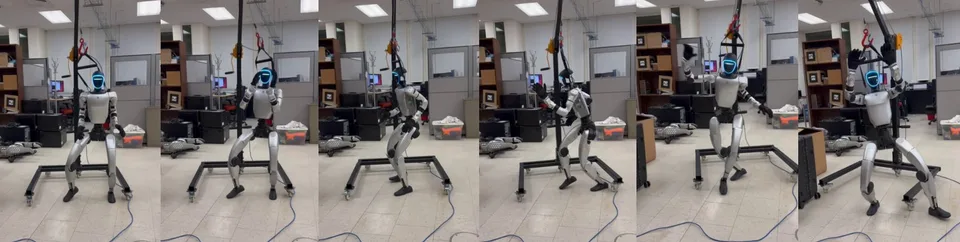
A University of Massachusetts Amherst paper reports fast simulation retargeting and a zero-shot Unitree G1 demonstration—not a deployable product.
Human motion-capture data describes what people do, but a robot has different limbs, joints, limits, and balance needs. FRDV, presented in an arXiv paper by University of Massachusetts Amherst researchers, converts those recordings into robot joint movements.
Its main stage solves a constrained inverse-kinematics problem: it searches for robot poses that match key human points, such as hands, feet, and pelvis, while respecting joint limits and avoiding the ground or self-collisions. The researchers combine a custom Sequential Quadratic Programming solver, a warm-start method called Real-Time Iteration, and parallel processing of motion chunks.
In the paper’s LAFAN1 benchmark, FRDV processed an average 9,156 frames per second using 20 workers. On the larger AMASS dataset, the authors report retargeting 13,662 clips in about one hour with 20 workers. Those timing results cover kinematic conversion only; they exclude the optional physics-validation stage.
That second stage uses contact-implicit iterative Linear Quadratic Regulator control in the MuJoCo simulator. In plain terms, it checks whether the robot can physically follow the planned movement while obeying actuator limits, and can reduce problems such as floating or sliding feet.
The authors trained motion-tracking reinforcement-learning policies on FRDV outputs and reported comparable or better tracking errors than two other pipelines. They also report retargeting motions across 12 humanoid robot models without additional parameter tuning.
The hardware result was a research demonstration: a policy trained in simulation ran selected FRDV-retargeted motions on a Unitree G1 without hardware-specific fine-tuning. It is not a consumer product or a paid deployment. For operators, the immediate value is faster dataset preparation, while careful users should run physics validation selectively and inspect chunk-boundary smoothness.