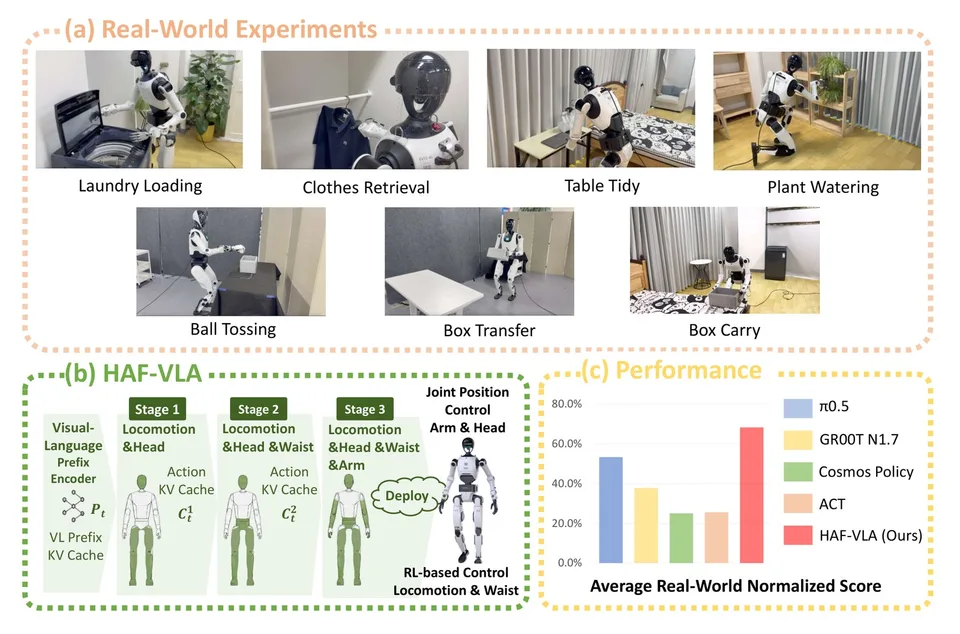
A research demo coordinates walking, gaze, posture and hand actions across two humanoid platforms, with reported gains on six real-world tasks.
The HAF-VLA paper from Peking University and the Beijing Innovation Center of Humanoid Robotics proposes a control system for humanoids that handles whole-body actions in sequence rather than all at once.
First, the model plans locomotion, skill mode and head movement. Next, it adds waist commands to refine posture and reach. Finally, it generates arm and hand actions for manipulation. This order matters because a poor base or waist position can force the upper body into unstable compensating movements.
The system also uses cross-stage “key-value” cache conditioning. In plain terms, each later stage receives a compact representation of the earlier motion plan, then can refine it instead of starting over. The final stage produces the action chunk sent to the robot; lower-level controllers handle walking and waist motion, while position controls operate the arms, hands and head.
The authors evaluated HAF-VLA on Tian Gong 3.0 and Tian Gong 2.0 using teleoperated training demonstrations. Across six main tasks—including laundry loading, table tidying, plant watering and box transfer—the paper reports a best or tied-best normalized score on every task. Its average was 68.3%, compared with 53.3% for the strongest baseline, π₀.₅, based on 10 real-robot rollouts per method and setting.
The reported deployment setup executed 40 action steps before requesting the next plan. Three-stage inference took about 0.12 seconds on one RTX 5090 GPU, according to the authors.
This is a real-robot research demonstration, not a humanoid product people can buy. The results come from one paper and two platforms; independent testing and broader environments remain the next practical check.