A Caltech-led paper reports a Unitree G1 navigating without a map, while a separate safety filter handles unfamiliar obstacles in testing.
A humanoid robot can walk across a room and still struggle to decide how to reach a goal on another floor. Stairs, ramps, falls, and long routes turn navigation into more than simply avoiding objects.
RoM-Nav tackles that problem by splitting navigation training into two stages. The approach, proposed in a paper published on arXiv by researchers at the California Institute of Technology, was demonstrated on a Unitree G1. It is a research demonstration, not a product available for purchase or a production deployment.
Why ordinary navigation training breaks down
The robot needs to answer two different questions at once: “Which way is the goal?” and “How should my body move across this terrain?”
Those questions become tightly linked on stairs. A navigation system may choose a good direction, but the humanoid still has to balance, lift its feet, and avoid falling. Training the full robot to solve everything at once can make learning slow and unstable, especially when the route is long or the goal sits on another floor.
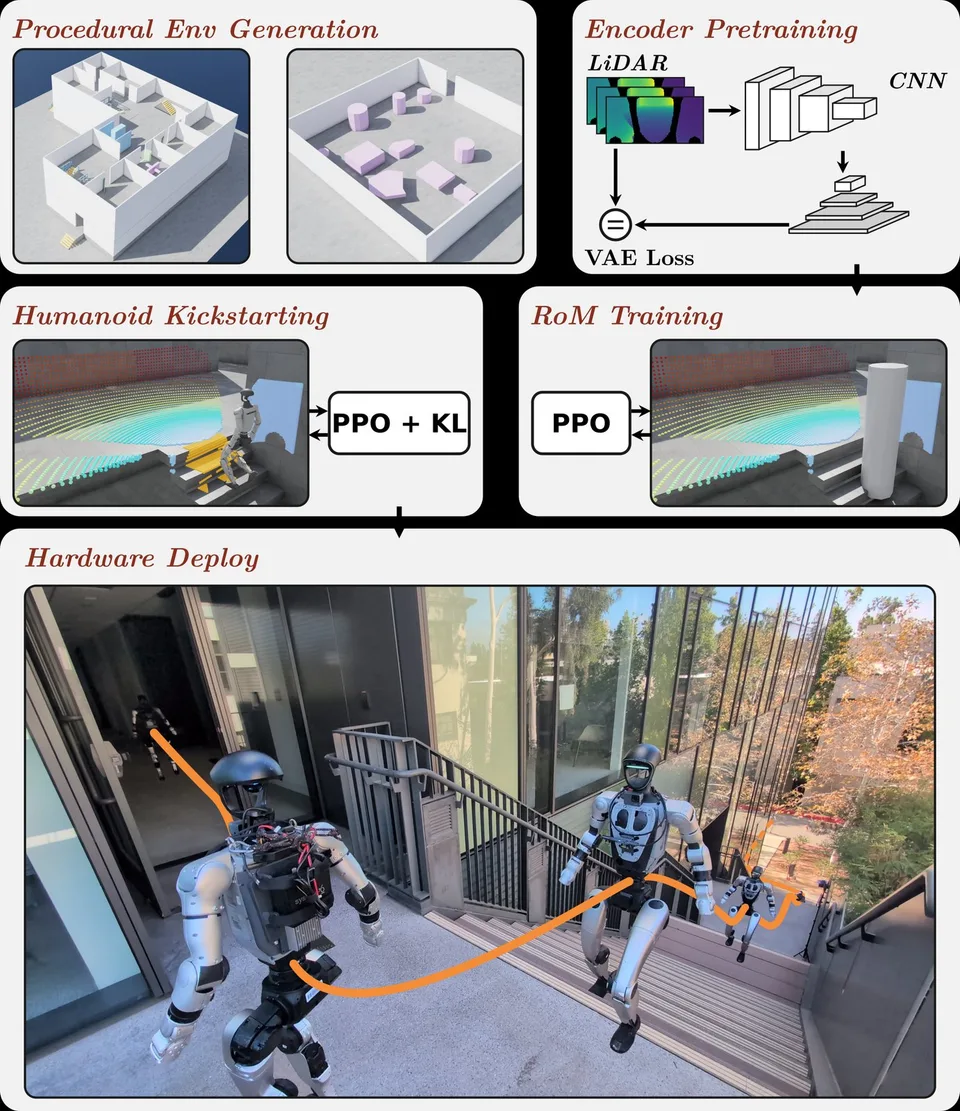
RoM-Nav separates the easier planning problem from the harder body-control problem. “Reduced order” means a simplified model of the robot. Instead of simulating every joint and contact, the first training stage treats the robot more like a moving point with position and heading.
That simpler model learns how to navigate using three-dimensional LiDAR. LiDAR measures distance with light, allowing the system to recognize surrounding structure without first building a conventional map. The researchers then transfer that navigation behavior to a policy operating on the full humanoid dynamics.
The second policy still has to deal with the robot’s real movement and terrain. It works alongside a frozen locomotion policy—the part already trained to make the robot walk. In plain English, one system chooses a useful velocity and the other turns that command into footsteps and balance corrections.
This transfer matters most when the robot must change height. The paper reports that the reduced-order kickstart recovered much of the performance lost by direct, single-stage training on cross-floor tasks. The authors also found fewer falls in those trials.
What hardware was actually tested
The deployed system used a Unitree G1 equipped with a Mid-360 LiDAR and a downward-facing ZED Mini depth camera. The navigation policy ran at 5 hertz, while the frozen locomotion controller ran at 50 hertz.
The researchers showed four hardware trials. They included a two-story stairwell climb, an outdoor climb into a building, a cluttered laboratory route, and a longer outdoor route. The trials reached up to 10 meters of vertical travel and 100 meters of path length. None of those four trials included a collision, according to the paper.
The robot navigated stairwells with thin railings, outdoor stairs, ramps, tables, chairs, and other clutter. It did not use a map for the navigation policy during these demonstrations. The researchers did use mapping and relocalization tools to align starting points and goals for a separate obstacle experiment, but that map was not provided to RoM-Nav.
That distinction is important. “Mapless” here means the navigation policy acts from onboard sensing and its goal, rather than consulting a prebuilt map of the building. It does not mean every part of the test setup operated without external tools.
The demonstrations show that a humanoid can connect long-range route choice with learned stair and ramp behavior. They do not show a robot ready to roam unattended through any building.
The safety filter is a second control layer
The navigation policy can make mistakes when it sees an obstacle unlike those used during training. To address that, the researchers added a Poisson safety filter between navigation and locomotion.
The filter receives the desired planar velocity and checks the current obstacle boundary. If the command would move the robot toward danger, it changes the velocity by the smallest amount needed to satisfy its safety constraint. This is similar to placing an automatic guardrail between a route planner and the walking controller.
In hardware tests with familiar obstacles, both filtered and unfiltered systems had no collisions. With unfamiliar obstacles, the unfiltered RoM-Nav system collided twice with ladders and four times with hanging tubes. The filtered system had no collisions on those tested obstacles, though it took longer to reach the goals.
That result is useful, but narrow. It covers the obstacle arrangements tested by the authors, not every object or failure mode a humanoid might encounter. The filter also controls planar movement; it is not a complete guarantee of whole-body safety around people, shelves, glass, or moving objects.
Where deployment reality shows through
Transparent obstacles are a clear weakness. The paper says LiDAR is not sufficient for navigating glass, and researchers blocked a glass door and window with cardboard during one trial. Without that change, the robot might have tried to move through them.
The system also assumes an accurate goal expressed relative to the robot. Someone or something must provide a coherent target location. That is different from asking the robot to understand a vague instruction such as “find the conference room.”
The next useful step is not simply a longer demo. Engineers need to test the system across more buildings, obstacle types, lighting conditions, and human activity, while measuring failures and recovery behavior. RoM-Nav shows a promising way to reduce the training burden: teach route planning on a simpler model, then transfer it to the full body. It does not yet establish that the approach can safely operate as an unsupervised service robot.