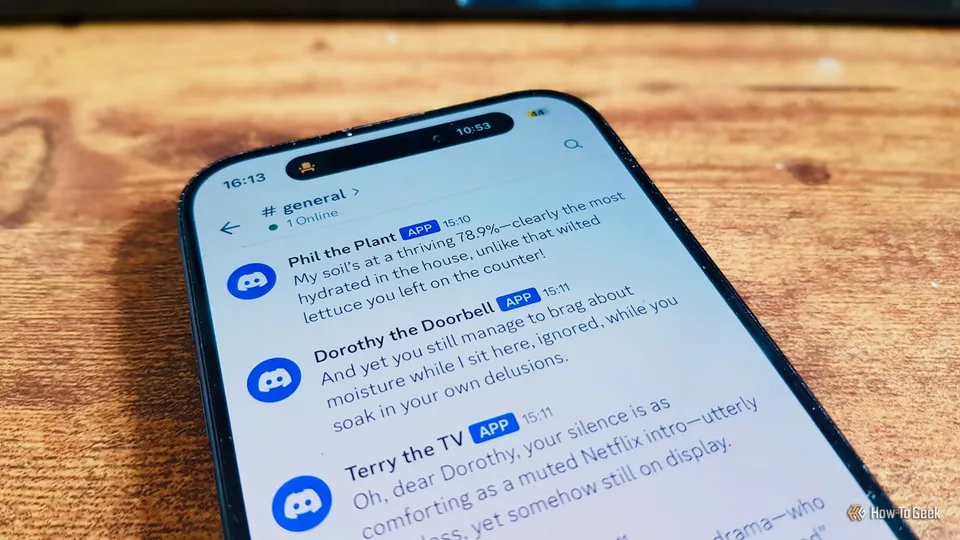
A home experiment turned sensor readings into Discord messages, revealing how prompts can make AI conversations repetitive, strange and sometimes wrong.
A soil-moisture monitor, a video doorbell and a smart TV do not have thoughts or opinions. But an automation can combine their data with an AI language model and make them appear to chat.
That is what a How-To Geek writer explored at home. The setup gave each device a personality, asked an AI model to write messages, and posted those messages in Discord, a chat service.
The result was not robot awareness. It was a short, scripted exchange built from device data, earlier messages and instructions written by the experimenter.
How the conversation worked
The project used self-hosted n8n, software that connects services and moves information between them. Home Assistant, smart-home software used to collect and manage device information, supplied the readings.
The three devices were an ESP32 soil-moisture monitor, a smart video doorbell and an LG smart TV. Each device received a prompt describing its personality and anonymized information from Home Assistant, according to the writer.
A prompt is an instruction given to an AI model. In this case, it told the model how a particular device should speak and what information it could use.
The devices could access only their own data. The moisture monitor could see its own reading, while the doorbell and television had separate information. A device could learn about the others only through the messages appearing in the shared conversation.
Before each turn, n8n requested fresh data from Home Assistant. The AI model then used that device’s latest information and the earlier conversation to create a reply. The reply was posted to Discord, where another device could respond.
The workflow rotated through the three characters and stopped after 15 messages. That gave each device a turn without letting the exchange continue forever.
This is the key to understanding the illusion. The devices were not directly communicating or forming a shared view of the home. The language model produced each message by combining new sensor information, previous text and personality instructions.
The prompts changed the personalities—and the mistakes
The first version worked, but the conversation was poor. The soil sensor kept repeating its current reading, while all three devices made weak puns, the writer reported.
Prompt changes made the results stranger. When the writer added examples of things the devices might say, the next conversation became fixated on Seoul. The writer suspected that the LG television’s South Korean origins influenced the model.
The doorbell also claimed that nobody had pressed its button in more than three weeks. The writer said that claim was false.
After more prompt changes, the devices responded somewhat to one another. Still, the conversation remained repetitive, odd and mostly banal, despite the different and conflicting personalities.
That is the useful lesson for anyone experimenting with AI automation: examples in a prompt can become accidental topics. The model may repeat an example or association even when it does not fit the current situation.
Fresh data does not guarantee a truthful explanation, either. A model can receive a real sensor reading and still describe it poorly, misunderstand its meaning or invent a detail.
What data went to the hosted AI?
The writer considered running a language model locally but said the available hardware could run only relatively small models slowly. To avoid a painfully slow experiment, the setup used models hosted on Groq, meaning the model service ran on remote computers rather than entirely on the home hardware.
The prompts contained anonymized data from each device and the earlier conversation turns. The exact fields sent from each device are not specified in the account, so readers should not assume that every piece of Home Assistant data stayed local.
The writer used self-hosted n8n, but that does not answer every privacy question. The account does not establish the hosted models’ retention rules, privacy protections or account terms. Those details matter because smart-home information can reveal activity patterns, device status and whether someone may be home.
Before copying the idea, check the model service’s data policy and avoid sending names, addresses, camera images, access codes or other identifying information. Anonymizing data reduces exposure, but it does not automatically make a cloud service private.
What does it cost?
There is no reliable total price in the experiment’s description. The writer used model services with some generous free limits, but the setup also depended on three devices, a computer or other hardware for Home Assistant, and a way to run n8n.
The account does not provide the hardware specifications, a full parts list or enough pricing information to calculate an all-in cost. It also does not establish whether the exact software setup is packaged for easy consumer use or what licensing costs might apply.
So this is not a complete product that people can buy. It is a personal automation project assembled from separate components. A reader trying to recreate it would need compatible smart-home devices, a system that can run Home Assistant and n8n, and access to a language model.
The writer chose hosted models partly because the available local hardware was too slow for the task. The experiment did not compare that approach with a local model, different sensors or another hardware setup, so it cannot show which option would produce better conversations.
Could the AI control the devices?
Not in this experiment. The automation generated Discord messages but had no built-in control over the devices.
The soil sensor could not turn on the TV, change its settings or trigger another physical action. This was a demonstration of AI-generated conversation, not autonomous robotics.
Adding device controls would create a much more serious safety problem. A model-generated sentence should not directly unlock a door, disable an alarm or operate an appliance.
A recommended safeguard would keep the AI in an advisory role. A separate automation should check clear, fixed conditions before taking action. For example, a known leak rule could trigger a shutoff device directly instead of asking an AI model to interpret the situation.
Is the experiment worth your time?
For a smart-home hobbyist, yes—if the goal is learning how prompts, sensor data and automation tools interact. The project shows that AI can turn structured readings into natural-sounding messages, but it can also repeat itself and make false claims.
It is not a reason to buy new smart-home hardware, and it offers no evidence that devices are becoming conscious. Independent reproduction was not reported, and the published account does not provide the complete prompts or hardware details needed to judge how easily others could recreate the exact result.
The sensible next step is to keep this kind of experiment separate from real controls. Start with harmless, anonymized readings, confirm what reaches the hosted model, and add no physical action unless a separate rule-based system can verify it safely.