The open-source integration is designed to let teams fine-tune Diffusers-format image and video models at scale without converting checkpoints or rewriting model code.
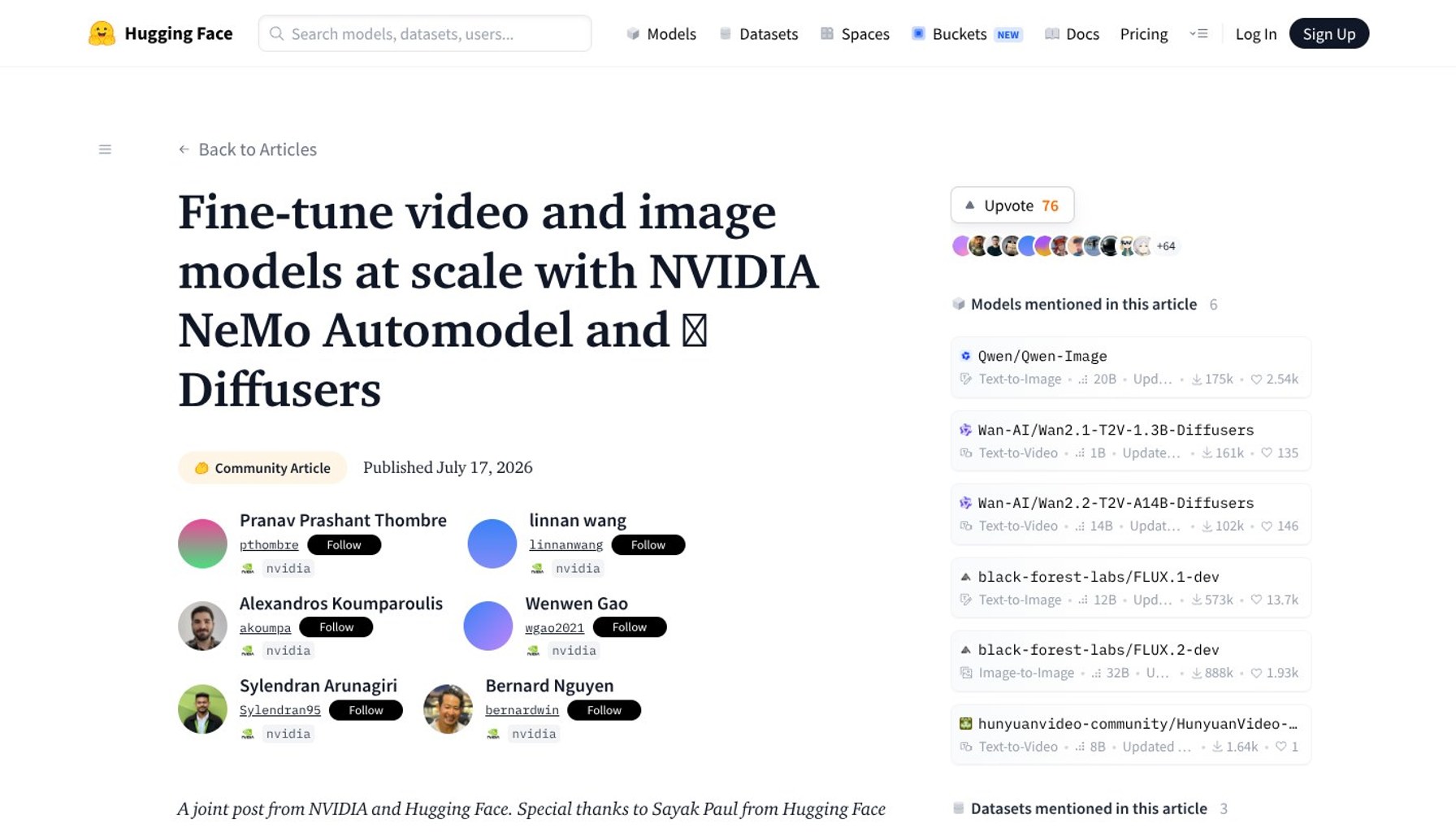
Hugging Face and NVIDIA have published an integration connecting NVIDIA NeMo Automodel with the Hugging Face Diffusers ecosystem for distributed fine-tuning of image and video generation models.
The companies say users can train Diffusers-format models from the Hugging Face Hub with NeMo Automodel without checkpoint conversion or model rewrites. The integration is documented in the Diffusers training guide and is available as open-source software under the Apache 2.0 license.
The announcement is aimed at teams that use Diffusers as an interface for inference, adaptation, and pipeline composition but need training utilities that can scale beyond smaller runs. NVIDIA and Hugging Face describe NeMo Automodel as providing distributed diffusion-training capabilities for Diffusers-format models, including memory-efficient sharding, latent caching and multiresolution bucketing.
Diffusion models highlighted in the announcement include FLUX.1-dev for text-to-image generation, alongside Wan 2.1 and HunyuanVideo for text-to-video generation. The companies position the integration as a way to retain Diffusers checkpoints and workflows while using NeMo Automodel for training.
The joint post outlines a fine-tuning workflow that begins with pre-encoding a dataset, followed by launching training with an existing FLUX YAML configuration and generating from the resulting fine-tuned checkpoint.
For ML engineers, the practical appeal is reducing the conversion and compatibility work that can accompany distributed fine-tuning. A workflow that uses Diffusers-format model identifiers and preserves compatibility with Diffusers generation pipelines could make it easier to evaluate distributed training without replacing existing inference tooling.
The announcement does not provide independent benchmark results, customer-adoption figures, pricing information or detailed performance comparisons with other distributed Diffusers training approaches. Teams will still need to validate the integration against their specific model, dataset, hardware configuration and fine-tuning requirements.