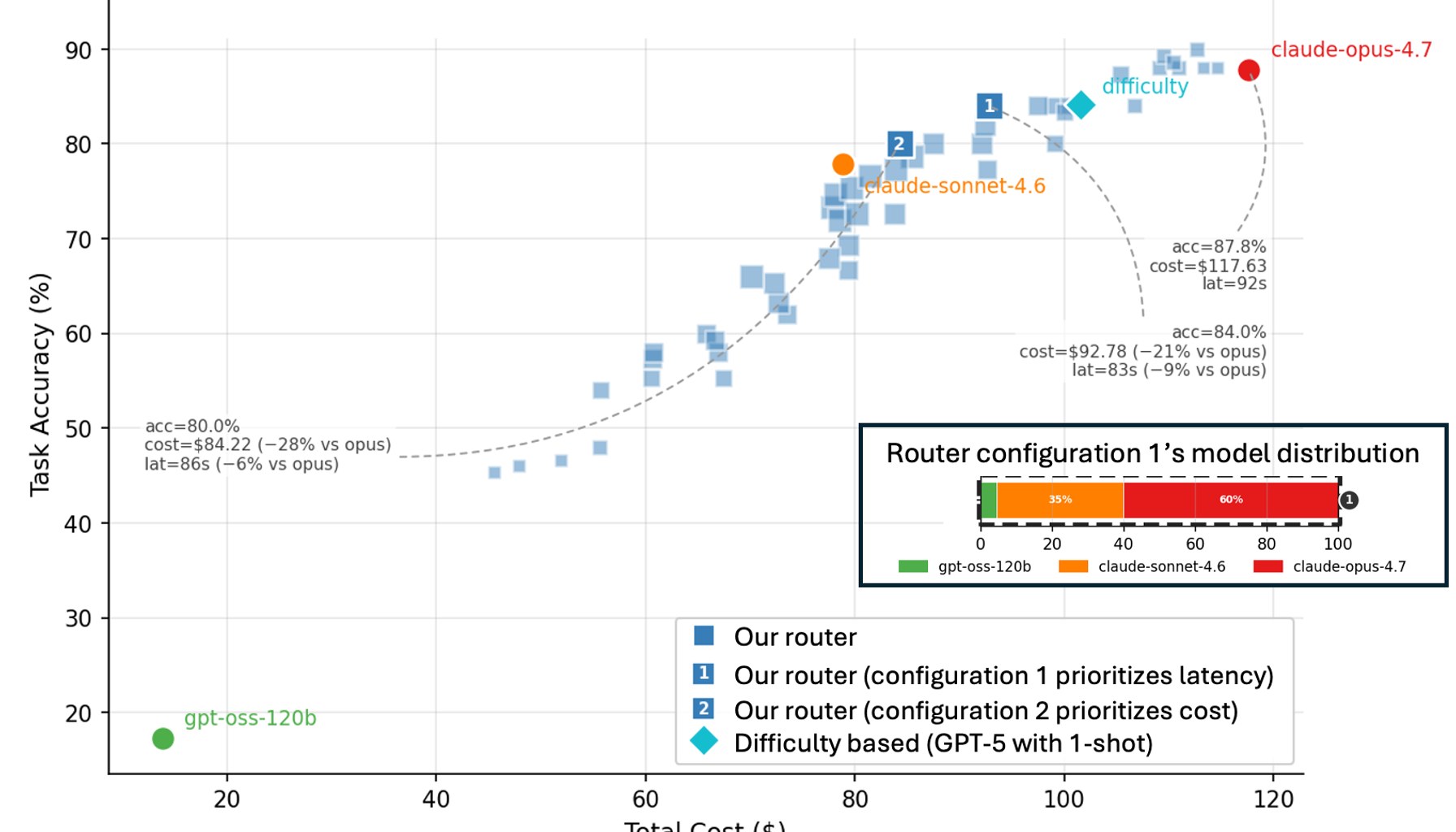
A 417-task comparison found that lower list pricing did not predict lower operating cost once an agent’s repeated context and cache-read rates entered the calculation.
Hugging Face is arguing that routing requests among models in an agentic system is not a simple task-classification exercise. The company says production routers must optimize for the behavior of the full system, including cache use, tool execution, latency, reliability and enterprise governance rules.
That is a more demanding problem than the common approach of identifying an easy prompt and sending it to a cheaper model, while reserving a more capable model for difficult work. In an agent, Hugging Face says, the apparent request is often only the beginning of an execution path that can include retrieval, compliance checks, tool calls and repeated refinements.
The company’s clearest example is cost. Across 417 tasks in the AppWorld Test Challenge, using the same CodeAct agent, Hugging Face found that Claude Sonnet 4.6 cost $79 in total, or $0.19 per task. GPT-4.1 cost $155, or $0.37 per task.
That result ran against the models’ nominal token prices. Hugging Face said GPT-4.1 had lower input and output pricing, while Sonnet took roughly three times as many reasoning steps on the same tasks. A router comparing only published token prices and step counts would therefore have expected GPT-4.1 to be the cheaper choice.
Caching changed the outcome. Agent workflows frequently resend or reuse substantial portions of their context from one step to the next. Hugging Face said Sonnet’s lower cache-read pricing reduced its effective input costs enough to offset both its higher base price and longer task trajectories.
For engineering teams, that means a routing table based on input and output token rates can produce the wrong economic decision. The relevant unit is not the advertised price for a million tokens. It is the cost of completing a representative task under a specific agent loop, with its own context size, cache-hit rate, tool pattern and serving setup.
Task difficulty is also an incomplete routing signal. A request to summarize a contract may appear lightweight when it reaches a router, but the resulting agent run could involve document retrieval, policy checks, tool use and multiple revisions. Conversely, a technical request may be well served by a smaller specialist model.
Hugging Face says the router must therefore weigh model specialization, reliability, latency and cost at the same time. Enterprise deployments add harder constraints: data residency requirements, privacy policies, compliance obligations and approved-model lists can rule out the model that would otherwise appear optimal.
This changes the architecture of the router itself. Rather than making a one-time classification decision from a prompt, a production system may need to route within a constrained set of eligible models and update decisions as execution reveals more about the task. A model chosen for an initial planning step may not be the right model for a later code-generation, retrieval or multimodal step.
Latency requires similar system-level treatment. Raw model generation speed is only one component of user-visible delay in an agent workflow. The routing decision also sits alongside context handling, repeated inference calls, tool execution and retries. A faster model can still produce a slower end-to-end workflow if it needs more calls or performs less reliably on the task at hand.
The practical implication is that teams evaluating routing should benchmark completed workflows, not just prompt-level accuracy. A useful test should hold the agent implementation constant, as Hugging Face did with CodeAct, while measuring success rate, total cost, completion time, retries and cache behavior across representative workloads. It should also record which routing options were unavailable because of policy or data-handling requirements.
Hugging Face’s AppWorld result is meaningful as a warning against sticker-price comparisons, but it is not a universal ranking of GPT-4.1 and Claude Sonnet 4.6. The reported totals depend on the 417-task benchmark, the CodeAct agent, the models’ behavior in that setup and the cache economics available to the system. Teams should expect different results with different prompts, agent frameworks, context reuse patterns and providers.
There is also no indication that the July 15 Hugging Face publication represents a broader product announcement or a new routing service. The confirmed takeaway is narrower but useful: in agentic systems, model routing should be treated as an operational optimization problem with policy constraints, not as a static classifier that maps easy prompts to cheap models and hard prompts to expensive ones.