IEEE Profiles Sarah Downs’ Antenna-Insertion Algorithm for Robotic Satellite Assembly
The Texas A&M electrical engineering Ph.D. student developed the work during a University of Tulsa master’s project with NASA and the U.S. Air Force, but no operational deployment has been identified.
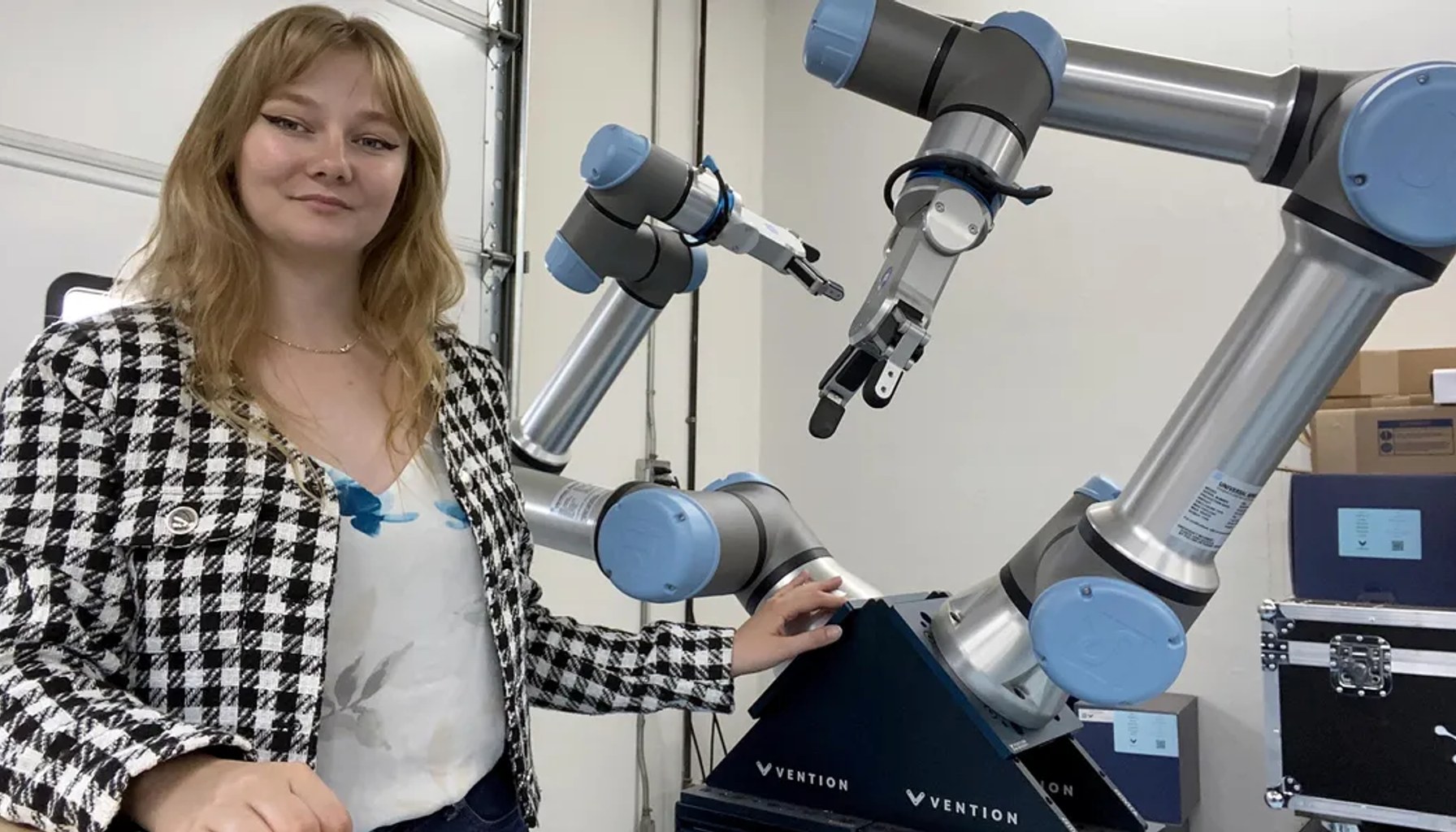
Image / spectrum.ieee.org
The Texas A&M electrical engineering Ph.D. student developed the work during a University of Tulsa master’s project with NASA and the U.S. Air Force, but no operational deployment has been identified.
IEEE has profiled Texas A&M University Ph.D. student Sarah Downs for an algorithm designed to help a space-based satellite-assembly robot insert an antenna into its intended location.
Downs developed the algorithm as the final project for her master’s degree in electrical engineering at the University of Tulsa, in collaboration with NASA and the U.S. Air Force, IEEE said. The work addresses a version of the peg-in-hole problem, a foundational robotics task in which a machine must align an object with a matching opening and complete insertion despite positioning error, contact forces, and limited sensing.
For satellite construction in orbit, antenna insertion is more than a simple pick-and-place step. A robot must bring a component into alignment without damaging the antenna, connector, mounting feature, or spacecraft structure. Systems that can reliably perform contact-rich assembly tasks could support future in-space servicing, satellite upgrades, and construction of larger spacecraft that cannot be launched as fully assembled hardware.
Downs is now pursuing a Ph.D. in electrical engineering at Texas A&M University in College Station. She told IEEE she is continuing research in satellite assembly and manipulation at a larger scale.
The profile tracks a path from student robotics programs in Tulsa, Oklahoma, through electrical engineering studies at the University of Tulsa and into doctoral work focused on orbital manipulation. Downs participated in First Lego League from 2014 through 2016 and later joined a First Robotics club in high school, where she became particularly interested in electrical systems.
The technical significance of the antenna work depends on the details that remain undisclosed. Peg-in-hole insertion can be handled with force and torque sensing, vision-based pose estimation, compliant control, specialized end effectors, or combinations of those methods. IEEE did not identify the satellite-assembly platform, the robot hardware, the sensing stack, the antenna design, insertion tolerances, task success rate, or whether the algorithm was tested in a laboratory environment, simulation, or a relevant spaceflight testbed.
That uncertainty matters because robotic assembly demonstrations often perform well on controlled fixtures but face substantially harder conditions when component variation, lighting, thermal changes, flexible structures, communication delays, and spacecraft safety constraints enter the system.
NASA and the U.S. Air Force collaboration indicates the work had relevance to government space robotics research, but neither agency’s operational use of the algorithm is confirmed. There is no identified mission, satellite program, or production deployment tied to Downs’ capstone project.
Still, the project reflects a practical direction for in-space robotics: moving beyond inspection and free-flying demonstrations toward repeatable manipulation tasks that require physical contact and precise alignment. Reliable antenna insertion would be one small subsystem capability, not a complete satellite-construction solution, but it is the kind of task that must work consistently before autonomous orbital assembly can become routine.
- Sarah Downs Equips NASA’s Robots With Assembly Skillsspectrum.ieee.org / Research / Published JUL 17, 2026 / Accessed JUL 17, 2026