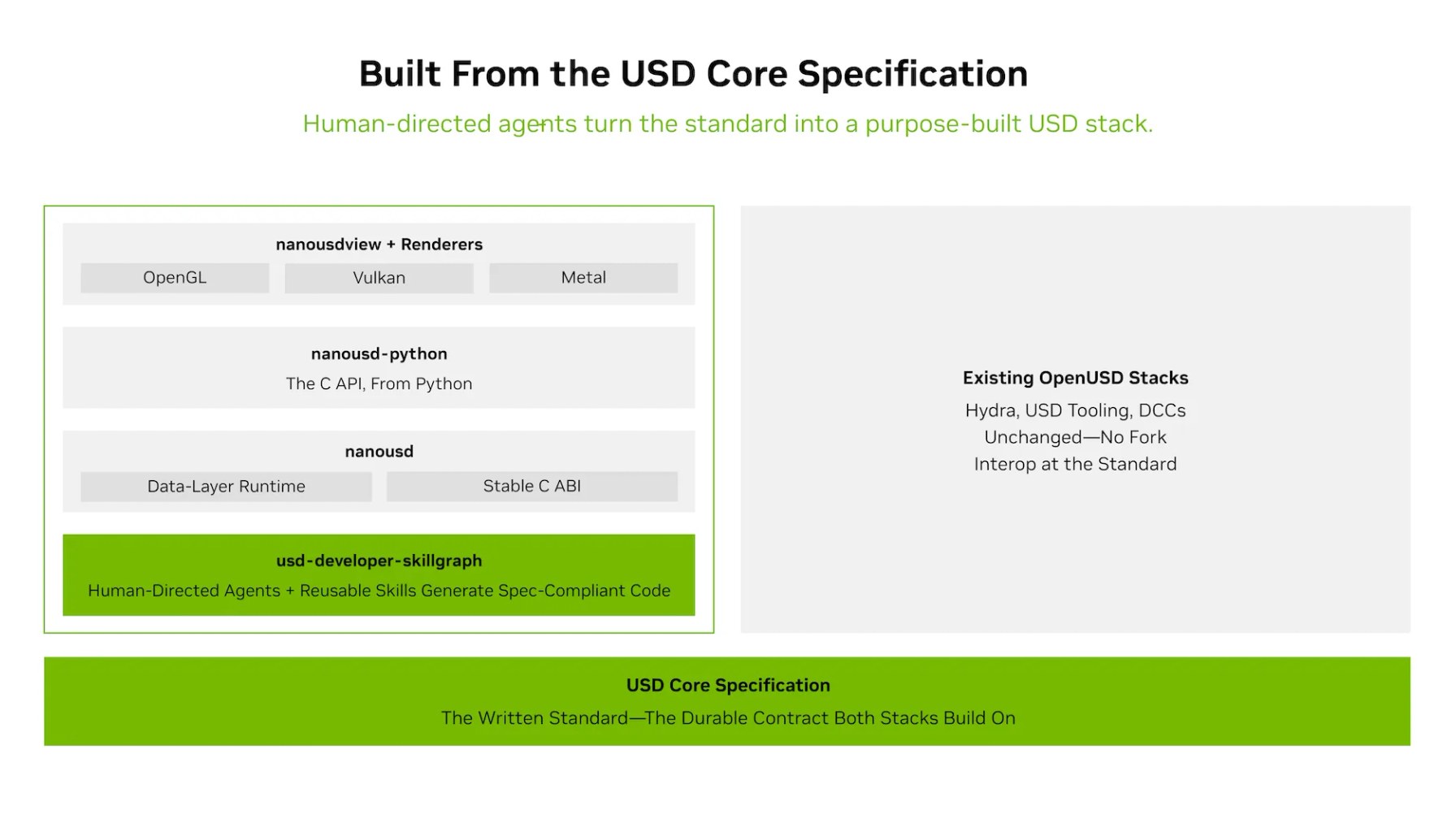
The Omniverse Labs experiment treats the OpenUSD standard as executable engineering guidance, with specification-derived tests intended to validate generated implementations.
NVIDIA has published nanousd-labs, an experimental Omniverse Labs project that uses AI agents to generate lightweight USD runtimes directly from the USD Core Specification rather than adapting a large existing codebase.
The project was built during an internal NVIDIA hackathon and is aimed at developers who need USD implementations tuned for particular deployment constraints, including memory footprint, application binary interface requirements, performance characteristics or programming language choices.
OpenUSD provides a common scene-description framework used in physical AI workflows, where teams combine CAD data, simulation assets and real-world telemetry into a shared representation of a physical environment. In practice, that can include warehouse scenes, robot simulations and other applications that need consistent handling of layered scene data.
NVIDIA’s approach starts from the premise that the USD Core Specification defines the behavior of a compliant runtime, not its internal implementation. The specification, developed by the Alliance for OpenUSD, is versioned and machine-readable. It defines how USD data models are composed and resolved across layer stacks.
Under the nanousd-labs methodology, an AI agent reads the specification section by section, writes code to implement the required behavior, then runs that code against tests derived from the same standard. The agent iterates until the implementation meets the specification’s requirements.
That distinction matters for teams that do not need every component of a general-purpose USD distribution. Traditionally, building a specialized runtime has meant modifying or embedding a larger existing codebase, or implementing parts of the standard manually. NVIDIA is positioning agent-generated code as a complementary route: developers can ask for an implementation shaped around a constrained target while retaining the specification as the compliance contract.
For physical AI developers, the practical appeal is not that an agent removes USD engineering work. It is that the standard could become a more direct input to that work. A team building a memory-constrained runtime for an embedded deployment, for example, could use the specification and its derived tests to define the required behavior before generating and reviewing a narrower implementation.
The testing model is also the more consequential part of NVIDIA’s proposal. Generated code is only useful if its behavior can be checked against a stable standard. NVIDIA says nanousd-labs validates implementations using a test suite derived from the USD Core Specification, covering rules for how scene data is structured, resolved and overridden. That could give developers a way to separate compliance testing from the particular codebase an agent generates.
There are important limits to the announcement. NVIDIA did not publish benchmark results for generated runtimes, including startup time, memory use, throughput or compatibility coverage. It also did not quantify how much engineering time the approach saves compared with adapting an existing USD implementation, nor did it identify production deployments or external adopters.
The company also did not disclose the models, parameter counts, inference costs or hardware requirements used by the agents. Those omissions make it impossible to judge whether nanousd-labs is economically practical for routine runtime development or primarily useful as a guided prototyping workflow.
For now, nanousd-labs is an open experimental project, not evidence that AI-generated USD runtimes outperform established implementations. Its useful contribution is narrower: NVIDIA has demonstrated a workflow in which a formal USD standard can guide code generation and provide the tests used to assess the result. Teams considering it should treat the generated runtime as reviewed engineering output, particularly where ABI stability, asset compatibility and predictable resource use matter.