The open-source platform uses named roles, SOP-based workflows, structured knowledge and feedback records to help enterprises move agent projects beyond chat interfaces and into controlled business processes.
OpenBMB and a group of Chinese research and industry collaborators have open-sourced StaffDeck, a platform designed to build and manage AI agents as “digital employees” with defined jobs, operating procedures, knowledge sources and performance records.
The project is available through a GitHub repository under the OpenBMB organization. QbitAI identified ModelBest, the Northeastern University-ModelBest Data Intelligence Joint Laboratory, Tsinghua University’s THUNLP laboratory, OpenBMB and AI9Stars as participants in the release.
StaffDeck aims to address a common deployment problem in enterprise agent projects: an agent may produce plausible responses in a demonstration but fail to follow a required sequence of approvals, cite the relevant internal policy, or improve after repeated user feedback.
The platform frames each agent as an organizational role rather than a general-purpose chatbot. Under that approach, an agent can be assigned a name, position, employee number, capability boundary, work record and performance data. Managers can inspect the standard operating procedures, knowledge and tools associated with an agent and adjust them using operational feedback.
Its workflow layer uses state-machine-driven “process skills.” Each SOP is mapped to a defined state machine, intended to keep agents on required process paths while allowing them to switch between different procedures and preserve context.
For example, a reimbursement workflow could collect invoices, route over-limit requests to a human reviewer and submit eligible requests directly. StaffDeck says a business user can describe such a procedure in natural language, after which the system converts it into a visual structured flow containing information-collection, conditional-branching, tool-calling and human-handoff nodes for review before publication.
The system is also intended to support multiple SOPs in a single conversation. In the company’s example, an employee asking to file a travel expense claim and check the remaining monthly allowance would trigger separate workflows while reusing information already collected in the interaction.
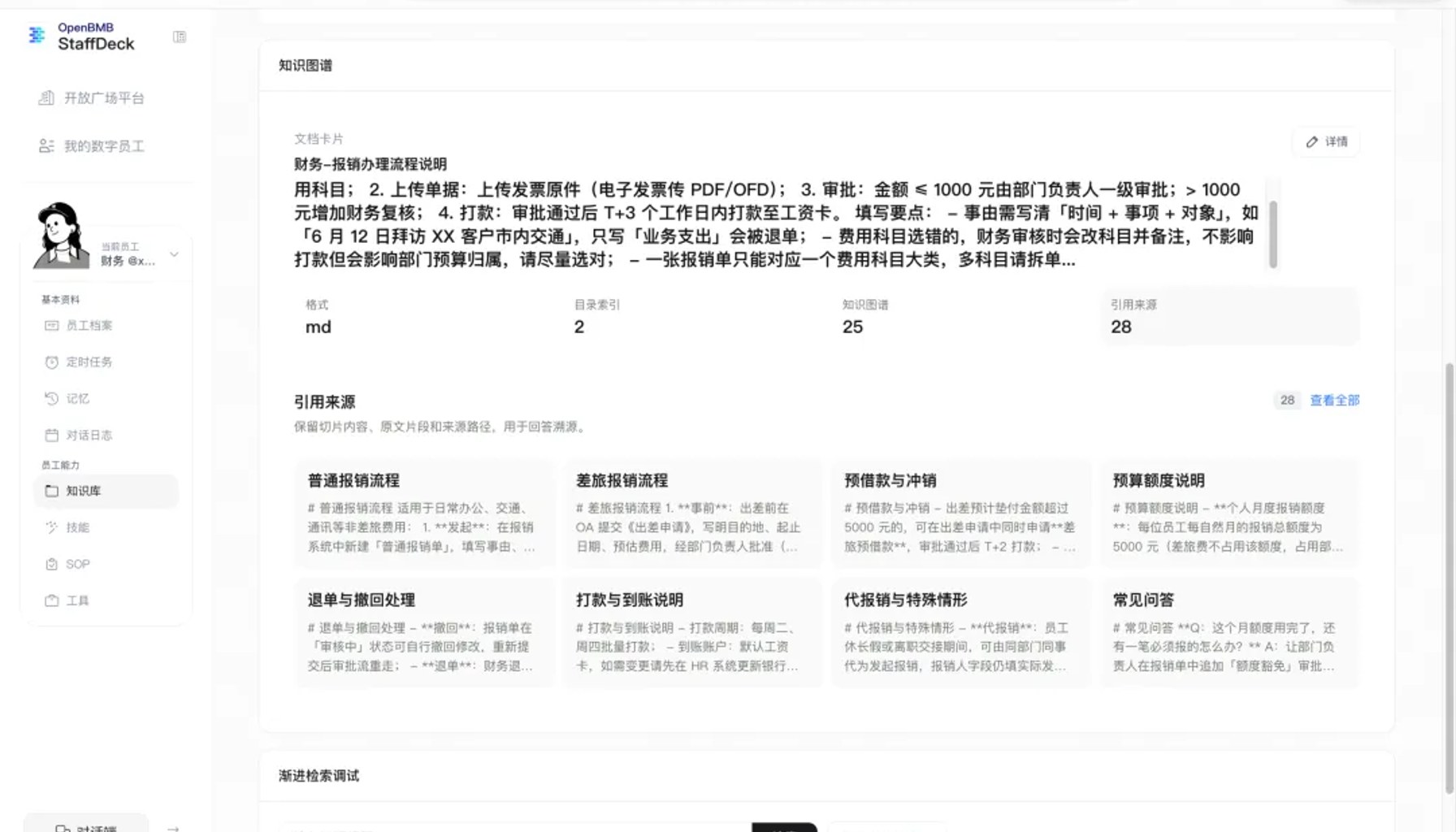
StaffDeck’s knowledge-management component is based on Open Knowledge Format, or OKF, a structured knowledge framework that classifies enterprise information rather than treating all retrieved document fragments as equivalent. The stated objective is to distinguish binding business rules from historical cases or reference material.
Administrators can use retrieval and debugging tools to see which document and section supported an answer, as well as its relevance score, according to the project description. That level of traceability matters in functions such as finance, customer support, procurement and human resources, where an agent’s answer may need to be linked back to a current internal rule.
The third pillar is an operational feedback loop. StaffDeck records agent responses and API calls in structured form, then combines traces, user feedback and human intervention. The platform says negative feedback can be categorized, such as a tool-call timeout, and used to direct administrators toward a relevant SOP adjustment.
For Chinese enterprise AI teams, the release could offer a practical framework for separating agent deployment from model selection. Many organizations are testing large-language-model agents, but production adoption depends as much on workflow governance, knowledge provenance, escalation rules and audit trails as on the underlying model’s benchmark performance.
The open-source structure may also make StaffDeck relevant for companies that want to deploy internally, adapt workflows to local business processes, or integrate an agent layer with existing enterprise systems. For global buyers with China operations, the project reflects demand for tools that can encode locally specific approvals, reimbursement policies, supplier procedures and customer-service scripts without reducing every business interaction to an unconstrained chat prompt.
There are important limits to what has been disclosed. The announcement does not specify a commercial launch schedule, pricing model or whether StaffDeck is ready for production deployment by external customers. It also does not provide independent verification of its workflow-control, knowledge-traceability or feedback-improvement claims.
The collaborator structure is similarly unclear. The announcement lists ModelBest, the university laboratories, OpenBMB and AI9Stars, while the public repository sits under OpenBMB. It does not establish whether every named party is a formal co-developer, a research contributor or a project partner.