Siemens Tests Humanoid Robot for Autonomous Logistics
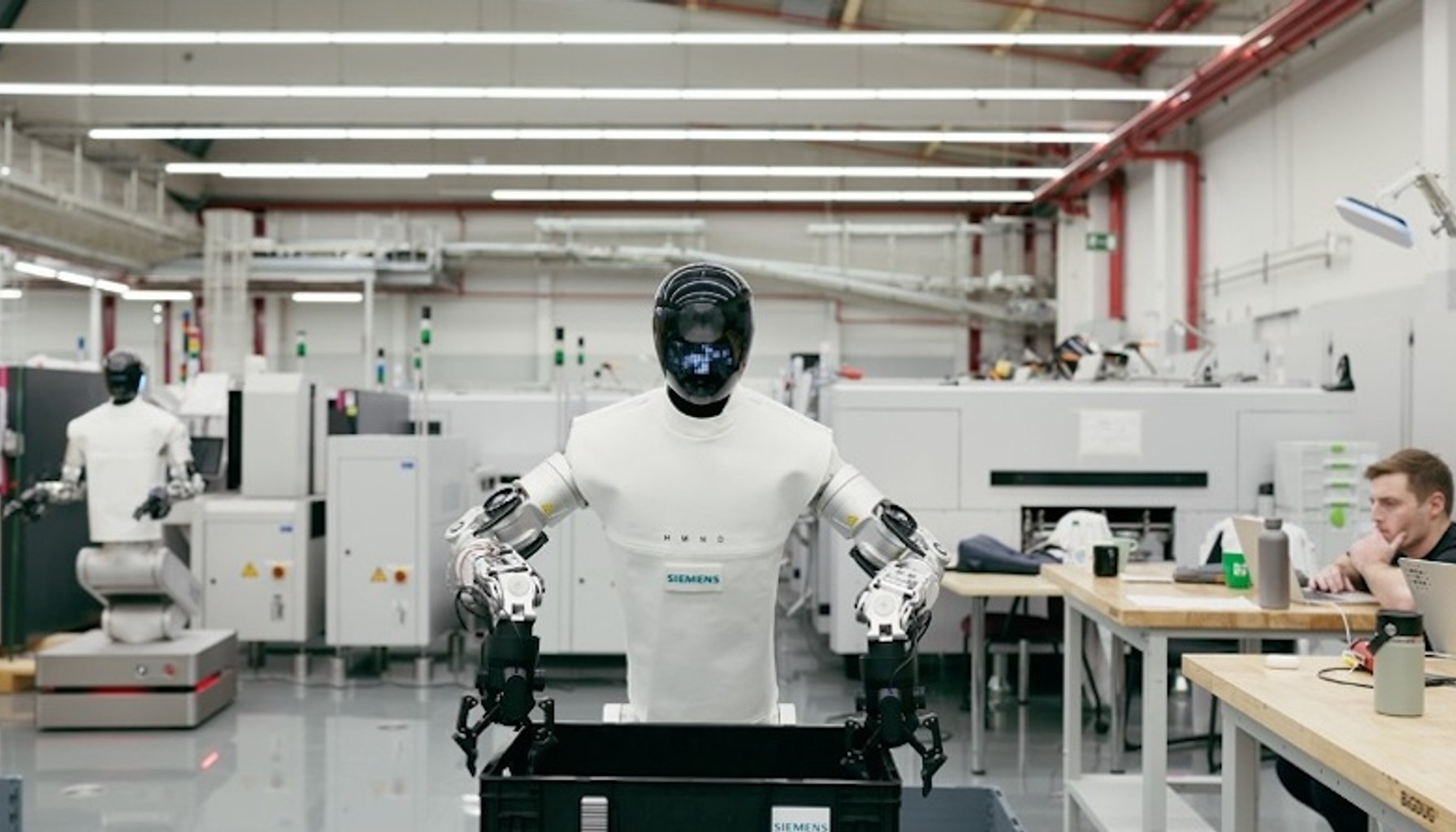
Siemens debuted a humanoid robot to run autonomous logistics.
At its Erlangen electronics plant, Siemens teamed with Nvidia and Humanoid to test the HMND 01 Alpha, a wheeled humanoid built on Nvidia’s physical AI stack that is now performing autonomous logistics tasks on the factory floor. The move signals a notable milestone in translating “physical AI” from vision demos into real-world automation inside a live manufacturing line.
Siemens calls the collaboration a landmark milestone in the journey from AI-driven perception to fully operable industrial logistics. Humanoid’s HMND-01 Alpha is designed to operate in dynamic environments, with Nvidia’s stack handling perception, planning, and control in concert with the robot’s onboard systems. Production data shows the robot autonomously navigates the plant area and executes logistics tasks within defined zones, illustrating a level of autonomy that previously relied on fixed automation or human supervision.
From the vendor side, the partnership underscores a broader pivot: moving away from scripted, choreographed choreographies to systems that can adapt in real time to shifting material flows. Integration teams report that the robot can operate as part of Siemens’ existing logistics workflow, interacting with the plant’s physical layout, product lanes, and inventory visibility systems. Floor supervisors confirm that the unit has completed multiple autonomous cycles in Erlangen’s factory environment, a setting that includes the usual clutter, personnel movement, and transient storage that challenge traditional automation.
Yet the breakthrough also exposes the realities behind the glossy demos. ROI documentation reveals no public, fixed payback figure yet, and integration remains a work-in-progress rather than a turnkey deployment. Industry observers say the promising test will be judged not by a single autonomous run but by how well the HMND-01 scales across multiple lines, shifts, and product families. In Erlangen, the system’s first proof point is more about capability—autonomy in navigation, task selection, and safe object handling—than about sweeping productivity gains.
Two practitioner takeaways jump out. First, the hardware-software stack demands careful integration: the HMND-01 relies on Nvidia’s physical AI stack and Humanoid’s platform, which means plants must allocate floor space for the robot, provide reliable power and charging infrastructure, and arrange dedicated network access for edge computing. Integration teams report that aligning the robot’s perception and action with Siemens’ MES/WMS workflows is as much about data hygiene and layout stability as it is about the robot’s sensors. Second, even with advanced autonomy, humans remain essential. Operators and engineers will still handle exception scenarios, complex assembly decisions, and maintenance—areas where a humanoid robot’s judgment today lags a human’s adaptability.
The Erlangen test also flags some hidden cost realities vendors don’t always publish upfront. Cybersecurity considerations, software updates, and ongoing staff training add layers of expense that show up only after a deployment begins to scale. There is also the risk of vendor lock-in: choosing a physical AI platform ties the plant to a particular robotics stack and roadmap, which can influence future modernization timelines and budgets.
What to watch next? The industry will want to see operational metrics over longer runs—cycle time impacts, throughput changes, and, crucially, confirmed cost-of-ownership as the system matures. If Siemens can demonstrate consistent autonomous performance with consistent safety and reliability, Erlangen could become a blueprint for broader rollouts across Siemens facilities and potentially inspire similar tests elsewhere in high-mix, high-variance environments.
In short, the Erlangen trial is less a finished product than a carefully watched proof point—one that tests whether a humanoid, powered by Nvidia’s AI stack, can shoulder routine logistics in a real factory without begging the entire line to stop every time the robot misreads a shelf label. If the data continues to trend positive, it could be the kind of incremental leap that finally moves ‘seamless integration’ from marketing to practice.
- Siemens, Nvidia and Humanoid partner to bring physical AI into factory operationsroboticsandautomationnews.com / Source role not classified / Published APR 16, 2026 / Accessed APR 17, 2026