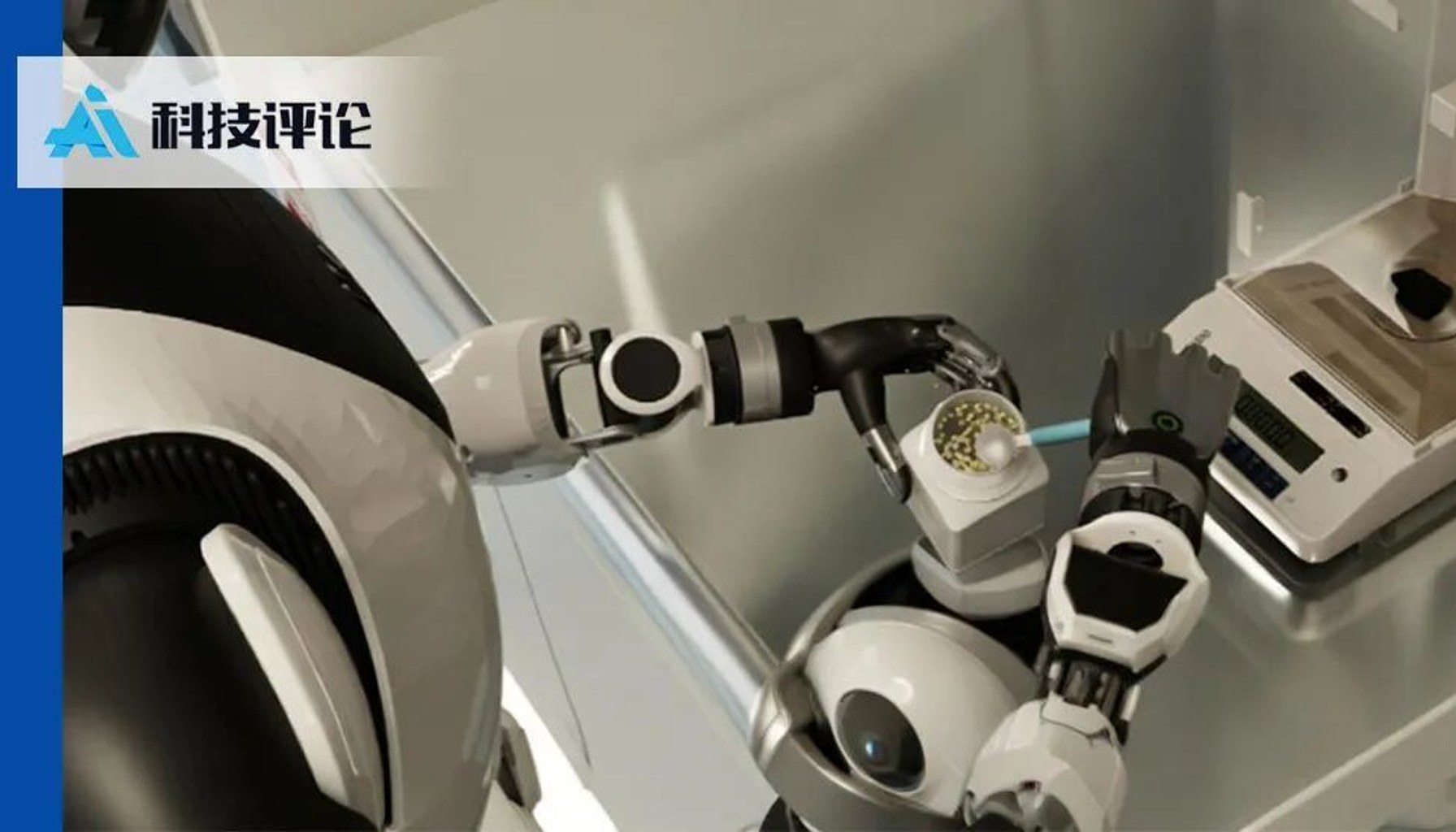
The simulation platform measures not only whether a robot completes a laboratory task, but whether it meets scientific tolerances and maintains performance through a multi-step workflow.
The University of Science and Technology of China and the Beijing Humanoid Robot Innovation Center have introduced Labimus, a simulation and evaluation platform designed to test humanoid robots performing precision manipulation in chemical laboratories.
Labimus targets a gap between conventional robotics benchmarks and the requirements of laboratory science. A robot may successfully transfer powder, open a balance door or press a button under a binary pass-fail measure, yet still fail a chemistry procedure if its weighing error exceeds the allowed tolerance.
The platform therefore evaluates robots at three levels: basic task completion, continuous precision metrics, and long-horizon performance across a complete workflow. It also tests robustness under four operating conditions: a standard layout, lighting changes, texture changes, and combined lighting and texture disturbances.
The researchers built Labimus from a real organic chemistry laboratory using a real-to-simulation approach. The environment includes more than 30 laboratory assets, including an analytical balance, beakers, measuring cylinders, round-bottom flasks and powder spoons.
Rather than treating laboratory equipment as static visual objects, the platform models their physical functions. A robot must grasp a handle and control force to slide open the glass draft shield on an analytical balance. The balance reading updates as material enters the weighing boat.
Powder handling is a central technical challenge. Labimus models individual powder particles as rigid bodies with mass and collision properties. As a robot scoops, carries and deposits powder, the system accumulates the mass of particles reaching the weighing vessel to generate a weighing result.
The team used large language models to parse standard operating procedure documents and generate laboratory scenes, object bindings and tasks. The resulting benchmark includes six atomic manipulation tasks, such as opening and closing a balance door, picking and placing objects, pressing a tare button, picking up tools, and scooping and weighing powder. It also includes a seven-step solid-weighing workflow.
Initial tests underline how sharply performance drops when laboratory work requires controlled contact and precision. Labimus evaluated three robot-learning approaches: ACT, Diffusion Policy and π0.
On the relatively coarse task of opening a balance door, ACT recorded the highest success rate at 56.7%. For closing the door, π0 led at 40.7%. Pressing the tare button proved substantially harder. ACT achieved 2.0%, while Diffusion Policy and π0 recorded zero success in the reported tests.
The tare operation requires a robot to make a brief, controlled contact with a button only a few millimeters wide. That is closer to the fine motor demands of laboratory work than broader grasping tasks, where a robot can tolerate more positional or force error.
Labimus also exposed the limits of binary task scores. In a pick-and-place test, ACT achieved a 5.3% task-completion rate under a conventional measurement. When the benchmark required placement error of no more than 15 mm, the qualifying rate fell to 3.3%. Nearly two-fifths of nominally successful episodes therefore failed the platform’s precision standard.
Combined environmental disturbances also mattered. In π0’s balance-door-opening test, changing lighting or texture individually had limited effect, but applying both reduced its success rate from 47.3% to 40.0%.
For laboratory automation buyers, the result is less a near-term case for replacing specialized automation than a clearer method for identifying where humanoid systems still fall short. Existing autonomous laboratories often use fixed robotic arms, purpose-built grippers and redesigned workspaces. Those systems can be efficient in repeatable workflows, but their hardware and layouts are tightly coupled to particular processes.
Labimus is aimed at the harder alternative: assessing whether humanoid robots and dexterous hands can operate in laboratories built for people. If such systems eventually become reliable, they could reduce the need to redesign laboratory infrastructure around each automation deployment and make workflows more transferable between sites.
The supply-chain implication is that precision laboratory robotics will depend on more than a humanoid body or a capable vision-language-action model. It will require repeatable dexterous hands, force control, reliable sensing, task-specific software validation and simulation environments that can capture granular materials and cumulative errors. Labimus provides a test layer for those components, particularly where a small error in one operation can invalidate a later result.
Important uncertainties remain. The teams have not disclosed a formal release date, a paper-publication status, or whether Labimus is available to outside researchers and commercial users. They also have not published a complete results table beyond the example outcomes reported for selected tasks and models.