Shanghai’s exhibition floor put AI agents, domestic compute clusters and embodied robotics at the center of the race to turn foundation models into operating systems for industry.
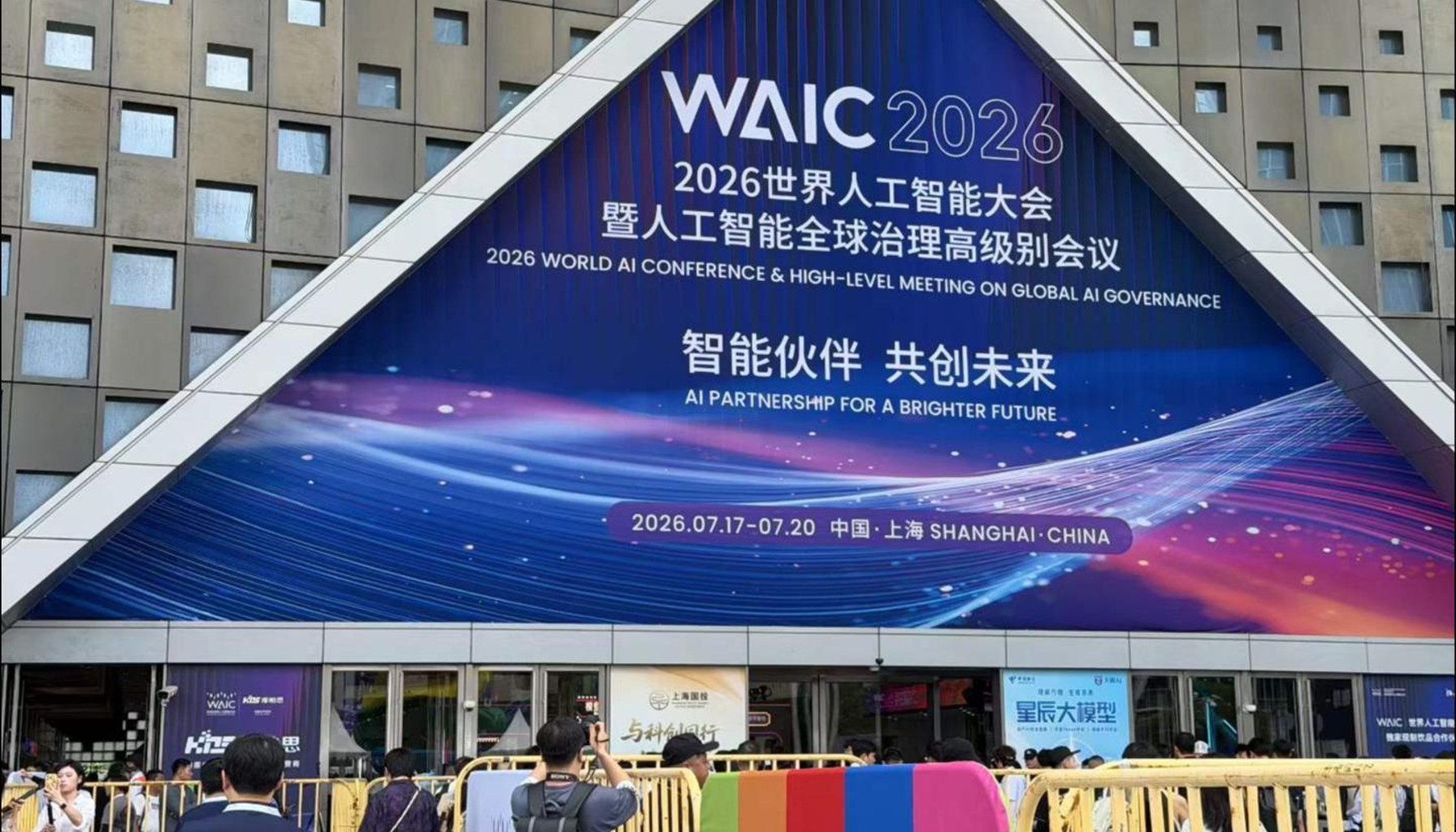
The first day of the 2026 World Artificial Intelligence Conference in Shanghai signaled a sharper shift in China’s AI market: vendors are increasingly selling AI as an execution layer for factories, logistics networks, offices and consumer devices, rather than as a chatbot demonstration.
The conference brought together exhibits across applications, compute infrastructure, robotics, embodied intelligence and AI hardware. The event spans four venues across Shanghai’s Expo, Zhangjiang and West Bund areas, with 100,000 square meters of exhibition space and more than 300 global product debuts, according to conference materials cited by exhibitors and participants.
The Expo Center’s halls were organized around applications, compute, robotics and embodied intelligence, and AI startups. More than 200 exhibitors each were focused on compute infrastructure and robotics, together accounting for more than one-third of exhibitors at the event.
That mix reflects the central commercial challenge for China’s AI sector. Domestic model developers need lower-cost, scalable compute. Hardware vendors need to prove their chips can be deployed in clusters, not only benchmarked as individual accelerators. Robot makers need more reliable models, data pipelines and deployment partners before they can move from staged demonstrations into repeatable commercial deliveries.
Alibaba Cloud used the event to present a stack spanning its Zhenwu chip, Panyue servers and Qwen cloud services. Alibaba’s Model Studio platform has served 5 million users, the company said. It also introduced a time-based token pricing model for Qwen services, with lower overnight pricing intended to shift flexible workloads away from peak demand periods.
Tencent concentrated on AI agents, displaying its Workbuddy product alongside Qclaw, ima and the Hunyuan Hy3 model. The company also demonstrated Marvis, an assistant positioned at the operating-system layer.
Baidu’s display centered on DuMate, its general-purpose AI agent. Baidu said the consumer version adds intelligent routing, shared memory across devices and presentation-generation tools, while the enterprise version lets organizations share and retain knowledge, skills and work outputs. Its Miaoda no-code development platform has served more than 35 million users, Baidu said.
The emphasis on agents matters because China’s large platforms are trying to move AI procurement from discretionary experiments toward embedded software spending. Enterprise buyers are being offered workflow tools that connect AI to internal data, customer-service operations, documentation, industrial procurement and employee productivity.
DingTalk, Alibaba’s workplace collaboration platform, demonstrated AI spreadsheets that it said can process tens of millions of rows with second-level responses, alongside an AI transcription tool supporting recognition in 118 languages and real-time translation in 79 languages. It also displayed meeting and access-control hardware, showing how Chinese enterprise software vendors are packaging models, workflow software and devices into a single deployment proposition.
JD.com framed its display around AI entering the physical world. The company showed retail, logistics, healthcare and industrial applications, including its logistics robot fleet, AI healthcare products and industrial procurement tools. It also displayed the JoyEgoCam wearable data-collection device, a sign that robotics companies and platform operators are investing in data capture as seriously as model development.
China’s domestic compute suppliers were also moving their marketing from individual chips toward system-scale infrastructure.
Huawei publicly displayed its Atlas 950 SuperPoD system, which it said supports 1,024 Ascend accelerator cards through its Lingqu interconnect protocol. Huawei said the system delivers 1 EFLOPS of FP8 compute, includes 256 TB of globally addressable memory and operates with 3-microsecond round-trip latency. The company also displayed the air-cooled Atlas 850E, designed for 96-card deployments in conventional data centers.
Kunlunxin showed 32-card and 64-card supernode systems that it said are already in volume delivery, with an architecture expandable to 512 cards. Its 256-card supernode is claimed to improve inference efficiency by 50%.
Suiyuan Technology displayed an ESL64-O supernode developed with ZTE. The companies said the system uses an orthogonal architecture to connect compute and switching nodes without cables inside a rack, supporting 64 accelerator cards per cabinet and expansion to clusters of up to 16,000 cards.
Moore Threads presented its Kuafu intelligent-compute cluster for deployments of 10,000 cards or more, while Sugon displayed its Dawning 8000 scaleX domestic AI cluster. Sugon said the system supports a 100,000-card configuration and has completed optimization work for more than 300 applications after connecting to China’s integrated national computing network.
ZTE presented an AI factory architecture and AIOS software, saying a single rack can support up to 128 GPUs and that its supernode design can scale to 16,000 cards. The company also said its AI data center design targets a power usage effectiveness level of 1.15 or below and can shorten delivery of a 20 MW campus to 4.5 months.
For supply-chain leaders, these claims show where the procurement battle is moving. The relevant unit is no longer simply an accelerator card. It is the rack, cooling system, high-speed interconnect, networking fabric, software stack and delivery capability required to build an operational cluster. Chinese suppliers are increasingly positioning domestic alternatives as integrated infrastructure packages, which can reduce exposure to imported accelerator restrictions but may increase dependence on a smaller group of locally integrated vendors.
The ownership and supplier-structure implication is equally important. China’s AI stack is being assembled through partnerships among internet platforms, chip designers, server makers, telecom equipment suppliers, cloud operators and robotics companies. That can speed local deployment because customers can buy a bundled system, but it can also make component substitution harder once a buyer adopts a particular interconnect protocol, software environment or data platform.
Biren Technology introduced a next-generation optical-interconnect supernode design that it said can scale to 1,024 cards in a single system. Its architecture physically separates GPU and switching nodes and connects them with optical fiber, using standard server forms for GPU nodes.
Optical interconnect is becoming more important as cluster size grows. The technology is intended to overcome the heat, power and distance limitations of copper-based connections, particularly when AI training and inference systems need to link hundreds or thousands of accelerators.
At the device edge, Houmo Intelligent displayed products using its M50 compute-in-memory chip, including a Lenovo AI host, a holographic personal-interaction device and an AI network-attached storage system. Houmo said the chip provides 160 TOPS at INT8 and 100 TFLOPS at bFP16, with up to 48 GB of memory, 153.6 GB/s of bandwidth and typical power consumption of 10 W. The company said it can run models ranging from 30 billion to 120 billion parameters offline.
That claim, if borne out in commercial products, points to another route for China’s AI sector: moving some inference workloads away from centralized cloud infrastructure and into local devices. For global buyers, that could matter in environments where data localization, network reliability, power costs or response time make edge AI preferable.
Uncertainty remains substantial. Product specifications, deployment scale, performance improvements and delivery timelines presented at the exhibition are company claims and were not independently verified. The first day of WAIC nonetheless made the market direction clear: China’s AI vendors are competing to own the full delivery chain from chips and interconnects to models, agents, robots and operational software.