Automation ROI Hinges on Readiness Not Prototypes
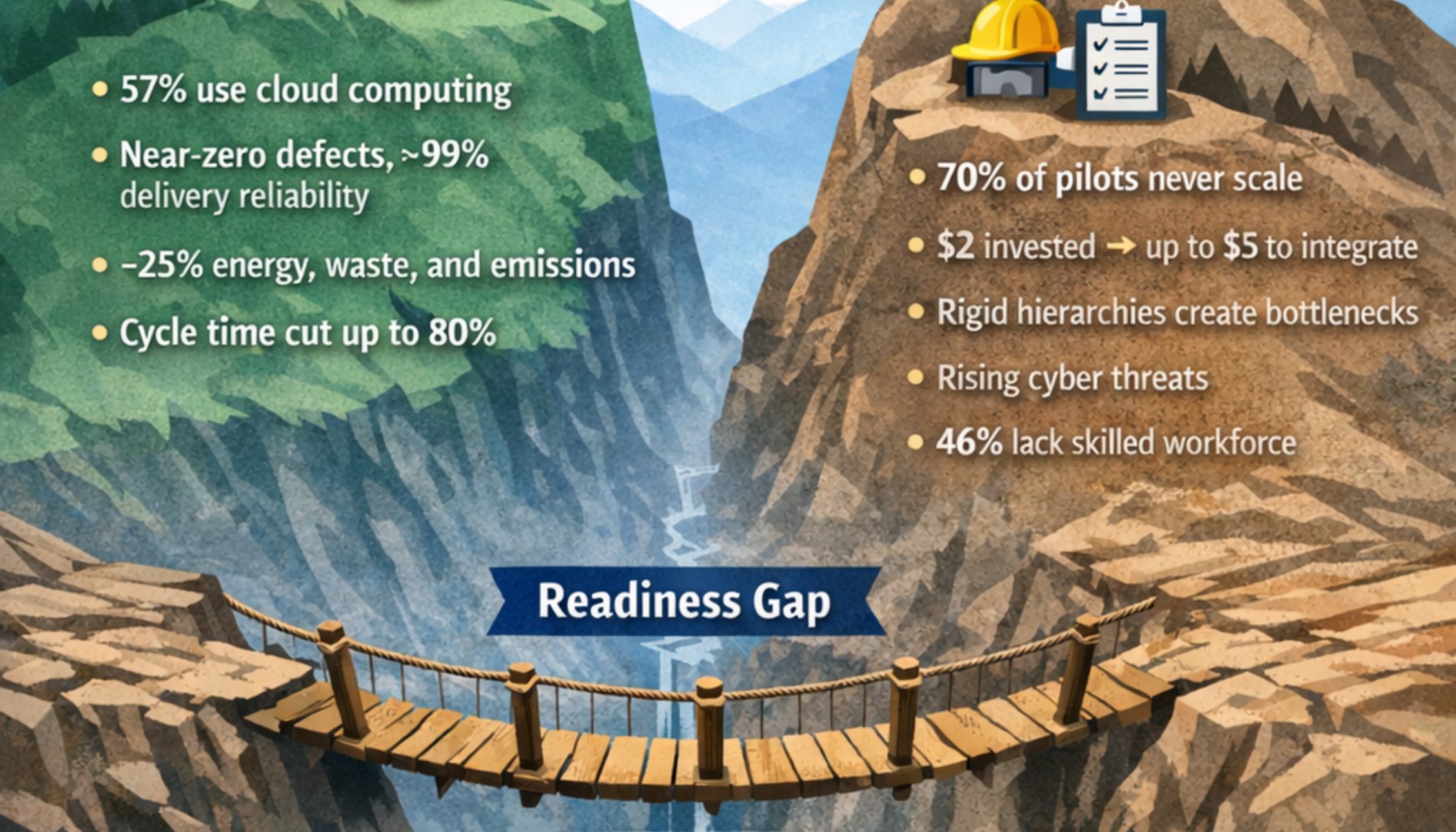
More than 70 percent of firms investing in automation never move past the pilot. That unsettling stat frames a hard truth: breakthrough technology is not a shortcut to efficiency unless a plant is structurally prepared to absorb it.
Designing for automation to make manufacturing operations resilient is no longer about the shiny new robot or a flashy control system. It is about aligning people, processes, and governance so the plant can sustain higher safety, uptime, and productivity over time. In practice, that means solving for the slow, stubborn forces that stall real world deployment: how automation plugs into existing equipment, data systems, and regulatory expectations; how teams adapt to new workflows; and how capital plans line up with a rational path to scale rather than a one off pilot.
Deployment data shows that the promise of digital tools often frays at the boundary between pilot lab conditions and day to day operations. The State of U.S. Manufacturing Report 2024 notes that more than 70 percent of firms investing in technologies like AI, advanced analytics, or 3D printing never move past the pilot stage. It is not that the tools fail; it is that the organization is not ready for what success requires. An ABB global survey of 3,600 industrial leaders reinforces that reality, finding that only 55 percent have a strategic, proactive plan to modernize their facilities, and even among those with plans, execution remains a hurdle. In facilities with weekly downtime, deployment struggles multiply: only about one in five had a modernization strategy in place despite recognizing the need.
For plant managers and CFOs, the takeaway is operational, not aspirational. The ROI conversation must start with readiness metrics: how quickly a plant can translate a pilot into repeatable, safe, and compliant production, and how cycle times and throughput respond when automation is embedded into the end to end network. The case, as deployment data shows, is not about declaring victory after a single install, but about designing systems that can absorb complexity. Resilience, in this framing, comes from architecture that anticipates the edge cases that pilots do not reveal, namely maintenance cadence, data governance, and the interplay of safety standards with digital tools.
Integration requirements emerge as a central gatekeeper. Automation does not operate in a vacuum. It must harmonize with existing controls, asset management, and enterprise systems, all while meeting evolving safety frameworks. The regulatory conversation is not abstract. OSHA and NFPA 70B are evolving to support digital safety strategies, signaling that future downtimes will hinge on how well a plant implements, documents, and audits automation driven safety practices. For the operations team, the question becomes not just can we automate a process, but can we orchestrate the workflow across controls, sensors, and maintenance routines without creating new bottlenecks.
From a practitioner standpoint, two to four concrete realities emerge. First, the modernization journey is a portfolio problem, not a single project. A strategic plan that links capital budgets to an explicit scaling path, with measurable milestones, tends to tilt outcomes toward resilience rather than backsliding into old inefficiencies. Second, the integration challenge is real and costly; without a robust data architecture and cross functional governance, automated lines may deliver peak throughput in tests but degrade quickly in production. Third, the workforce must be prepared for digital workflows. Automation often shifts craft labor from isolated, manual tasks to oversight, inspection, and preventive maintenance roles; success depends on re skilling and clear role design for technicians and operators. Fourth, ROI hinges on cadence, not just capability. Cycle times and throughput become the ongoing scoreboard after a project moves beyond the pilot, and those numbers improve only when the plant operates as an integrated system rather than a collection of isolated automation experiments.
The takeaway for executives is clear. Lead with the operational metric, not the marketing pitch. Start with the money, and insist on a design that anticipates scale, safety, and governance. The case study reports a sobering reality: success is less about cutting edge gear and more about resilience engineered into the plant's DNA, with a careful eye on integration, workforce readiness, and a realistic modernization plan that turns pilots into productive, repeatable output.
- Designing for automation to make manufacturing operations resilientPlant Engineering / Independent source / Published JUN 08, 2026 / Accessed JUN 10, 2026