STMicroelectronics Adds 3A Gate Drivers for High-Voltage Power Systems
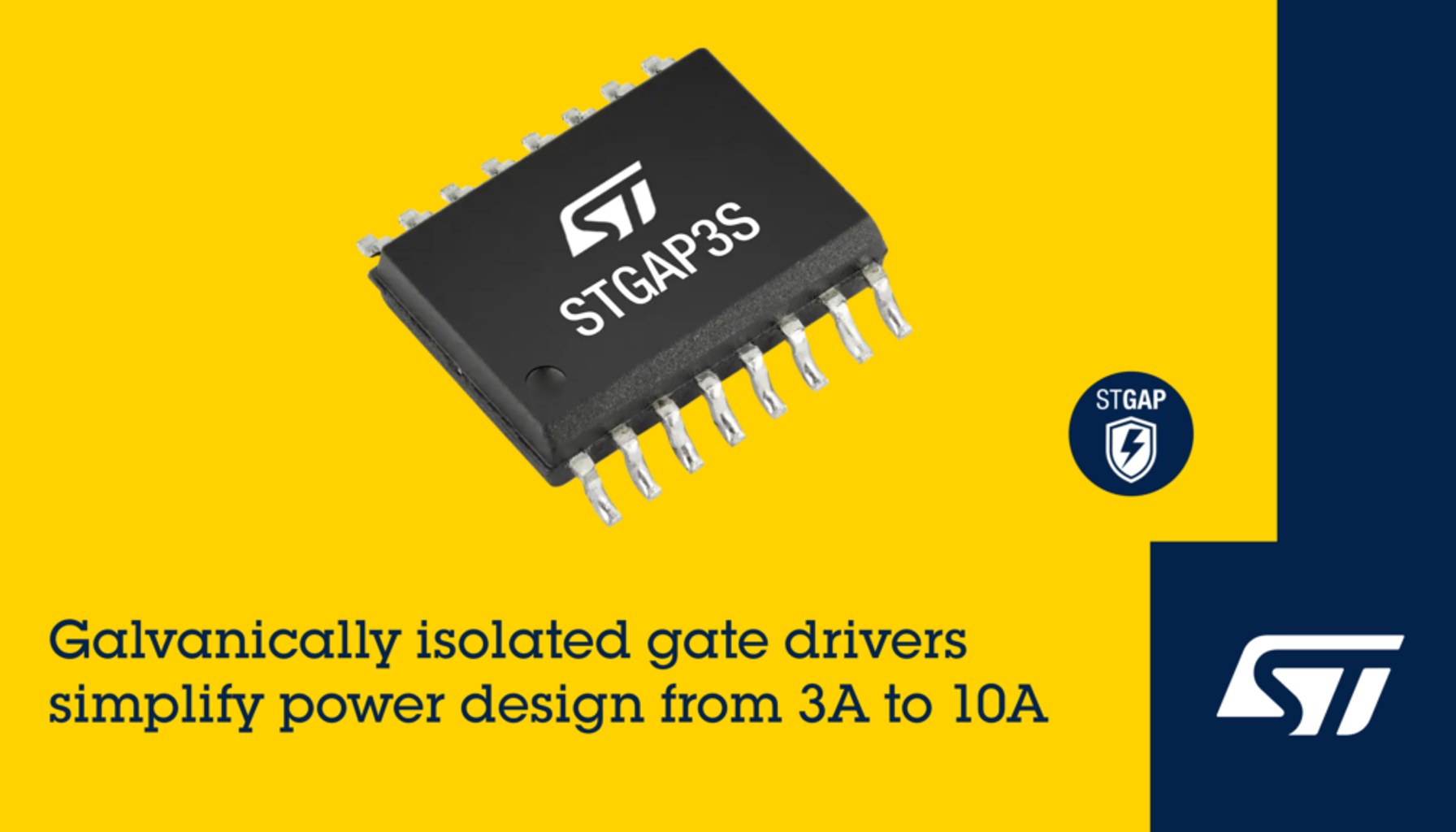
The new STGAP3S family targets lower-drive-current circuits in charging stations, energy storage, inverters, and industrial drives, with 1200V capability and built-in protection features aimed at reducing board space and simplifying power-stage design.
STMicroelectronics expands its isolated gate-driver lineup
STMicroelectronics has extended its STGAP3S family with a new 3A series of galvanically isolated gate drivers designed for power circuits that do not need the higher drive current of larger devices. According to the company, the new parts are intended to make high-voltage power design more compact and economical while maintaining the isolation and protection expected in demanding industrial and energy applications.
The new family includes the STGAP3S3S, optimized for silicon carbide MOSFETs, and the STGAP3S3IF, aimed at IGBTs. STMicroelectronics said the drivers are suitable for circuits operating on high-voltage rails up to 1200V, including power-factor correction, power supply units, DC/DC converters, and inverters.
For plant operators and equipment builders, that matters because the gate driver is not a headline component until it fails or forces extra design work. In practical terms, isolating the control side from the power side is what helps keep switching systems safer and more predictable. STMicroelectronics is positioning these parts for charging stations, energy-storage systems, solar inverters, industrial electric vehicles such as forklifts, induction heating equipment, pumps, fans, and general drives.
What the 3A series changes in the power stack
The main operational argument for the new 3A devices is right in the architecture: they integrate a complete active Miller clamp, including a clamping MOSFET, to help prevent unwanted turn-on of the power switch. In plain shop-floor terms, that is an attempt to stop a switch from turning on when it should be off, which can trigger shoot-through currents and damage hardware or interrupt production.
STMicroelectronics said integrating the MOSFET saves PCB space, simplifies circuit design, and reduces bill of materials count. That is the kind of change that can show up in engineering hours, cabinet footprint, and procurement line items before it shows up in a plant’s uptime statistics. It is not a promise of an immediate payback period, but it is the sort of design simplification that can improve total cost when multiplied across many power stages.
The company also said the 3A family is intended for circuits needing lower drive current. That matters because many industrial and energy systems do not need oversized gate-drive strength, and choosing a device closer to the application requirement can avoid unnecessary complexity. For facilities planning equipment refreshes, the practical test is whether the reduced component count and smaller board area offset any redesign effort or qualification work.
Protection features are the real deployment story
STMicroelectronics built multiple protection and diagnostic functions into the STGAP3S family. All models include desaturation detection with soft turn-off, which is meant to control voltage and current transitions during overload or short-circuit conditions. The devices also include diagnostic pins that indicate when desaturation protection, undervoltage lockout, or thermal shutdown is active.
That is the kind of information plant engineers want when they are trying to distinguish a control problem from a power-stage problem. A gate driver that can tell operators why it shut down is more useful than one that simply goes dark. In maintenance settings, those diagnostic signals can shorten troubleshooting and reduce the time equipment sits idle waiting for a root cause.
The drivers also allow negative gate voltage, which STMicroelectronics said strengthens prevention of unwanted turn-on and helps protect the device during fault turn-off. The company said this also supports robust switching without ringing during normal turn-off transitions.
For power electronics in continuous-duty operations, these features speak directly to failure modes: false turn-on, short-circuit stress, thermal shutdown, and undervoltage events. Those are the events that can turn a design win into a downtime problem. The new parts are aimed at reducing that risk at the component level, not by adding a separate protection box after the fact.
Fit for SiC and IGBT applications
The STGAP3S3S is optimized for SiC MOSFETs, while the STGAP3S3IF is tailored for IGBTs. STMicroelectronics said the broader STGAP3S lineup also includes 6A and 10A versions, which use a pre-driver for an external MOSFET and give designers flexibility to tune clamping speed in systems with higher gate-drive current.
That split matters because not every power platform is moving at the same pace. SiC devices are often selected where efficiency and switching performance matter, while IGBTs remain common in many established industrial systems. By offering variants aimed at both, STMicroelectronics is covering more of the installed-base reality that plant teams and OEMs face during upgrades.
The company also said the 6A and 10A versions, along with the new 3A drivers for SiC MOSFETs, allow an external resistor to optimize soft turn-off speed. That gives engineers another tuning point when they are balancing switching speed, protection, and electromagnetic behavior.
In operations terms, this is less about novelty than about control. A power stage that can be tuned to the load, the cabinet, and the duty cycle is easier to qualify and less likely to be overdesigned. For plants running charging equipment, drives, or inverter-based systems, that can affect both energy performance and downtime exposure.
Safety certifications and voltage ratings support industrial use
STMicroelectronics said all STGAP3S drivers work with high-voltage rails up to 1200V and carry safety and insulation certifications including UL 1577 and IEC 60747-17. The company said those certifications independently confirm robust isolation, safe operation, and reliable long-term performance at high voltage.
For buyers, certifications do not replace validation in the field, but they do reduce friction in procurement and qualification. If a plant or machine builder is standardizing a power module for charging stations, ESS, or industrial motors, documented isolation performance can matter as much as the electrical specs themselves.
The company’s announcement places the family in applications where power reliability drives operational continuity: charging infrastructure, renewable-energy conversion, industrial vehicles, induction heaters, drives, pumps, and fans. Those are not optional loads in many facilities. When they stop, lines slow, backup systems kick in, or energy costs rise.
The main question for deployment teams is not whether the features look good on paper. It is whether the reduced component count, built-in diagnostics, and protection functions lower integration risk enough to justify the design transition. STMicroelectronics is betting that for lower-drive-current high-voltage systems, the answer will be yes.
- STMicroelectronics’ New Galvanically Isolated Gate Drivers Aim To Simplify Power Design With Advanced Isolation - Manufacturing AUTOMATIONautomationmag.com / Independent source / Published JUL 29, 2026 / Accessed AUG 01, 2026