Gritt exits stealth with $32 million to automate solar-panel installation and infrastructure work
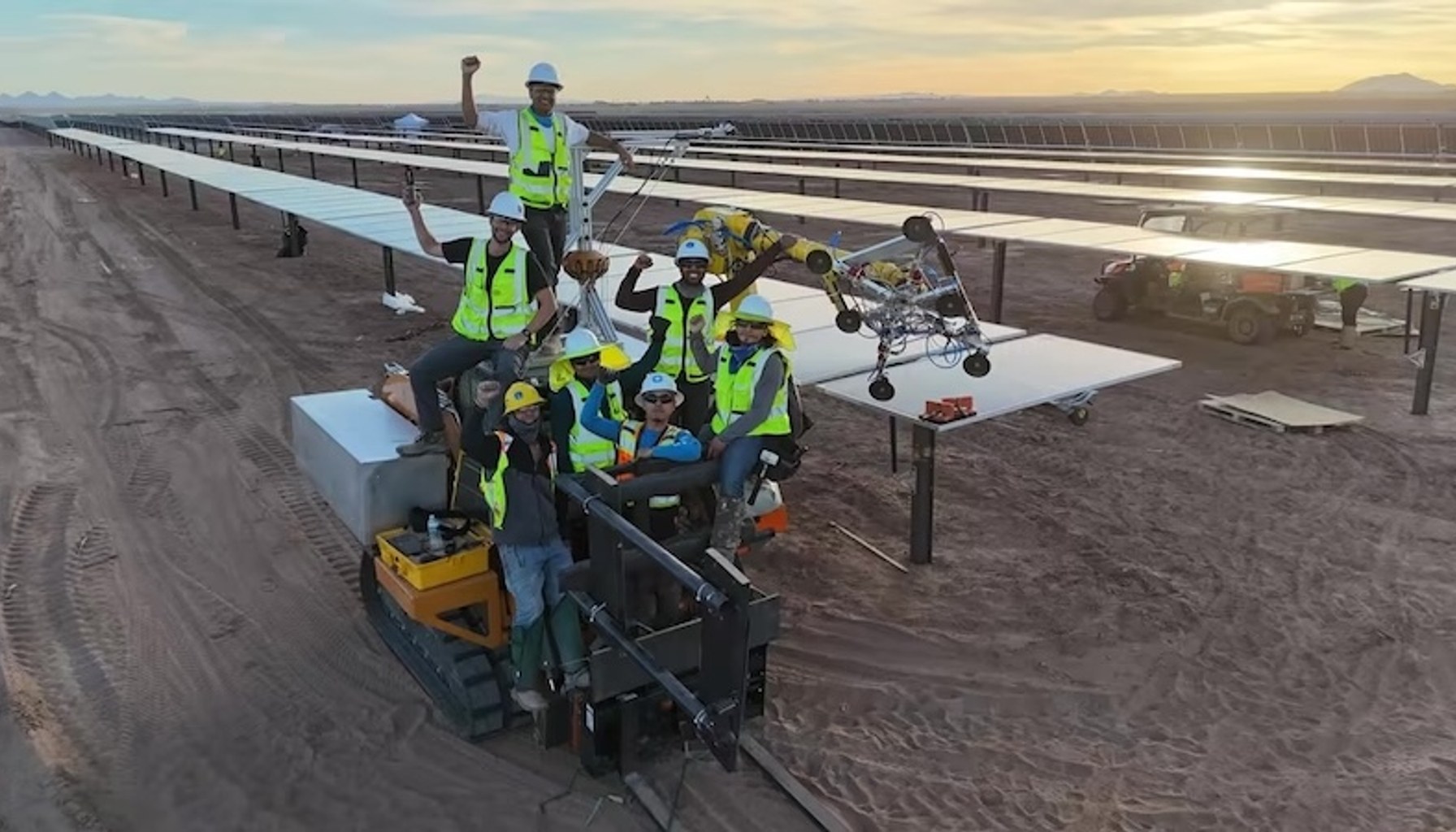
Image / roboticsandautomationnews.com
The company is starting with utility-scale solar sites, where it says its AI-controlled equipment can help eight-person crews install up to 4,000 panels a day.
Gritt has emerged from stealth with a $26 million Series A and roughly $32 million in total funding to automate repetitive material-handling and assembly work on outdoor construction sites.
Obvious Ventures led the Series A, with Union Square Ventures and Active Impact Investment participating. Earlier backers include First Round Capital, Climactic, Congruent Ventures, and VSC Ventures. Gritt was founded by CEO Puneet Puri and CTO Vishal Dugar, both Carnegie Mellon-trained roboticists.
The company’s first deployment targets utility-scale solar construction. Gritt says its systems unload large glass panels, carry them to mounting structures, and position them for workers to secure. The company uses rented and commercially available equipment, including skidders, skid steers, forklifts, and robotic arms from suppliers such as Kawasaki, rather than developing a proprietary vehicle platform from scratch.
That choice matters for construction operators. Outdoor automation usually fails not because a robot cannot repeat a motion in controlled conditions, but because it must work around changing ground conditions, weather, material placement, vehicle traffic, and crews. Gritt’s approach is to add an AI control layer to hardware that contractors already understand how to operate and maintain.
Gritt says its systems can place solar panels with millimeter-level precision, while TechCrunch reported the company describes the placement accuracy as sub-millimeter. The company also says its machines have autonomously placed tens of thousands of panels without breakage.
The startup has two systems deployed in the field, placing it beyond laboratory demonstration but still in an early commercial deployment phase. Gritt says it is contracted to support installation of 2.8 gigawatts of solar capacity over the next 18 months and expects to operate 48 systems within six months. It has not identified customers, project sites, or contract counterparties, though it says three of the 10 largest U.S. power-construction companies are customers.
Puri told TechCrunch that a typical eight-person solar crew installs about 800 panels per day. With Gritt’s systems, he said, the same crew can install 3,000 to 4,000 panels daily. Those figures are company claims, not independently verified productivity results, and panel output alone does not capture site preparation, racking availability, weather delays, inspection requirements, or downstream electrical work.
Still, the reported workflow is a practical target for automation. Solar-panel handling involves large, fragile modules and highly repetitive moves across wide, exposed sites. If Gritt can sustain its claimed throughput while avoiding damage and operating safely around workers, it could address a labor bottleneck in utility-scale construction without requiring contractors to replace their existing fleets.
Gritt plans to extend its system beyond solar arrays to data centers, bridges, roads, and other infrastructure projects. Its software is designed to learn from deployment data, including completed work, material movement, and site conditions. The company says tasks that initially required months of training can now be adapted in days, although it has not disclosed the task categories, operating conditions, or performance data behind that claim.
Funding totals remain slightly unclear. Gritt’s announcement was reported as $32 million in total funding, while another account put the combined pre-seed and Series A financing at $32.4 million. Both accounts agree on the $26 million Series A and its named investors.
- Gritt exits stealth with $32 million for robots to build solar plants — then, everything else | TechCrunchtechcrunch.com / Mainstream / Published JUL 21, 2026 / Accessed JUL 23, 2026
- Gritt launches with $32.4 million to build physical AI for infrastructureroboticsandautomationnews.com / Trade / Published JUL 22, 2026 / Accessed JUL 23, 2026