Humanoid Games Show Speed, Fragility
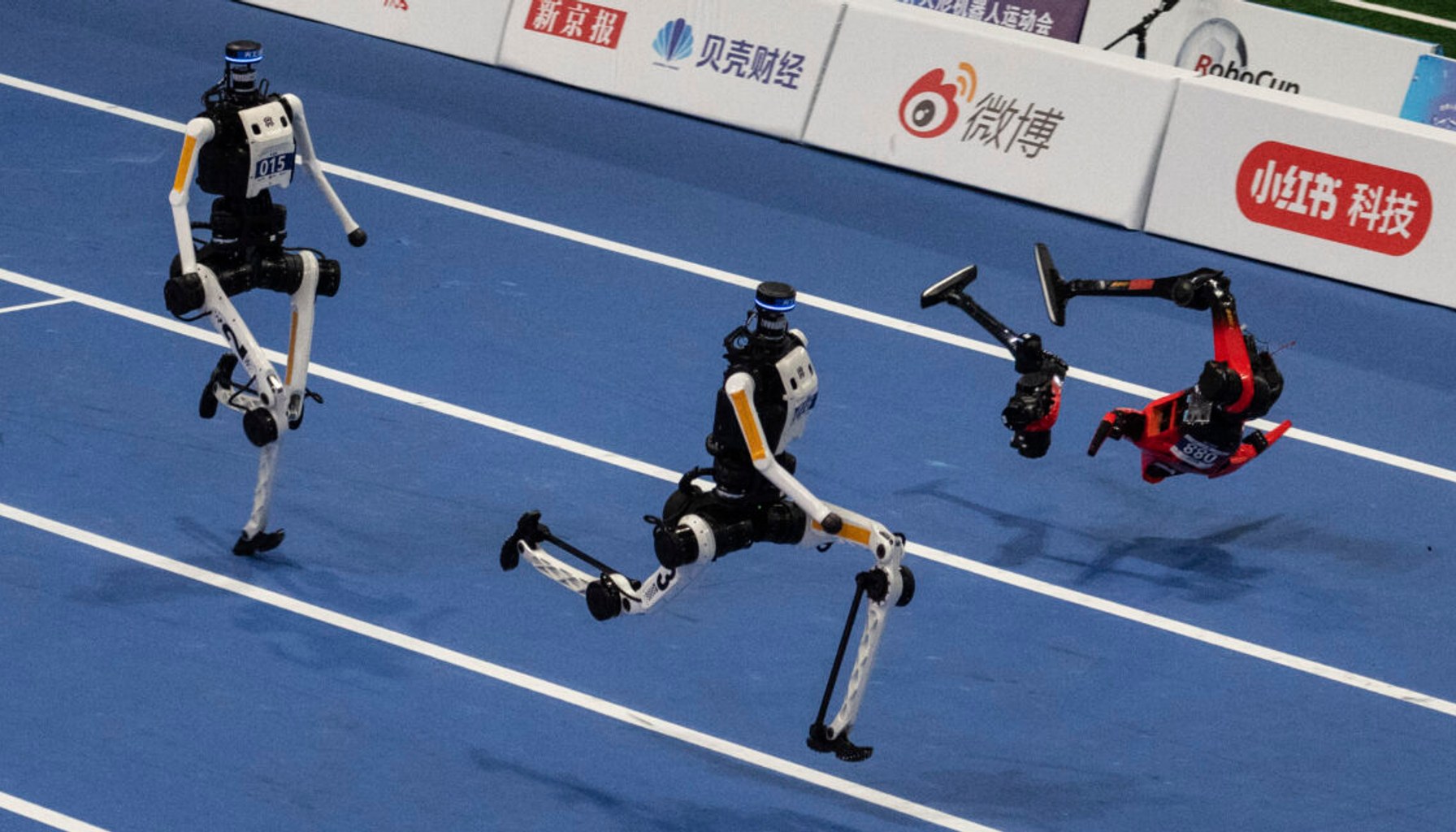
Beijing’s robot games showed faster runners. They also exposed weak stops, falls, and narrow skills.
What changed
At the World Humanoid Robot Games in Beijing, some robots beat human records in the 100-meter sprint and standing high jump, Ars Technica reported.
The games ran from August 22 through 26. Events included running, kung fu, dance, kickboxing, soccer, and table tennis.
Purdue researcher Dipam Patel told Ars that the results show progress in whole-body control. Robots must coordinate joints, arms, legs, and torso to sprint.
That is real engineering progress for a fixed task.
What still breaks
The same videos showed robots hitting barriers and falling because they could not readily stop. Ars reported that some fell apart at the waist, threw sparks, or caught fire.
That gap matters more than a peak speed result.
A runner can be tuned for a straight course and finish line. A deployed machine must stop safely, recover from faults, and avoid harm near people.
Patel told Ars that some firms used different robots for different events. That points to task-specific systems, not general-purpose workers.
Deployment reality
The games are a public benchmark, not proof of broad deployment. Household tasks such as washing and hanging laundry appeared slower than typical human work, according to Ars.
Reliability across repeated runs remains unclear. So do safe stopping, repair needs, runtime, and performance in real workplaces.
For operators, the useful test is not one fast sprint. It is whether the robot completes the same job safely, again and again.
- World humanoid robot games show runners breaking records, bursting into flamesarstechnica.com / Independent source / Published AUG 25, 2026 / Accessed AUG 25, 2026
- XPeng Motors humanoid robot unit Dogotix raises $900Mtherobotreport.com / Independent source / Published AUG 24, 2026 / Accessed AUG 25, 2026