Humanoid Robots Tackle Surgery Hurdles Remain
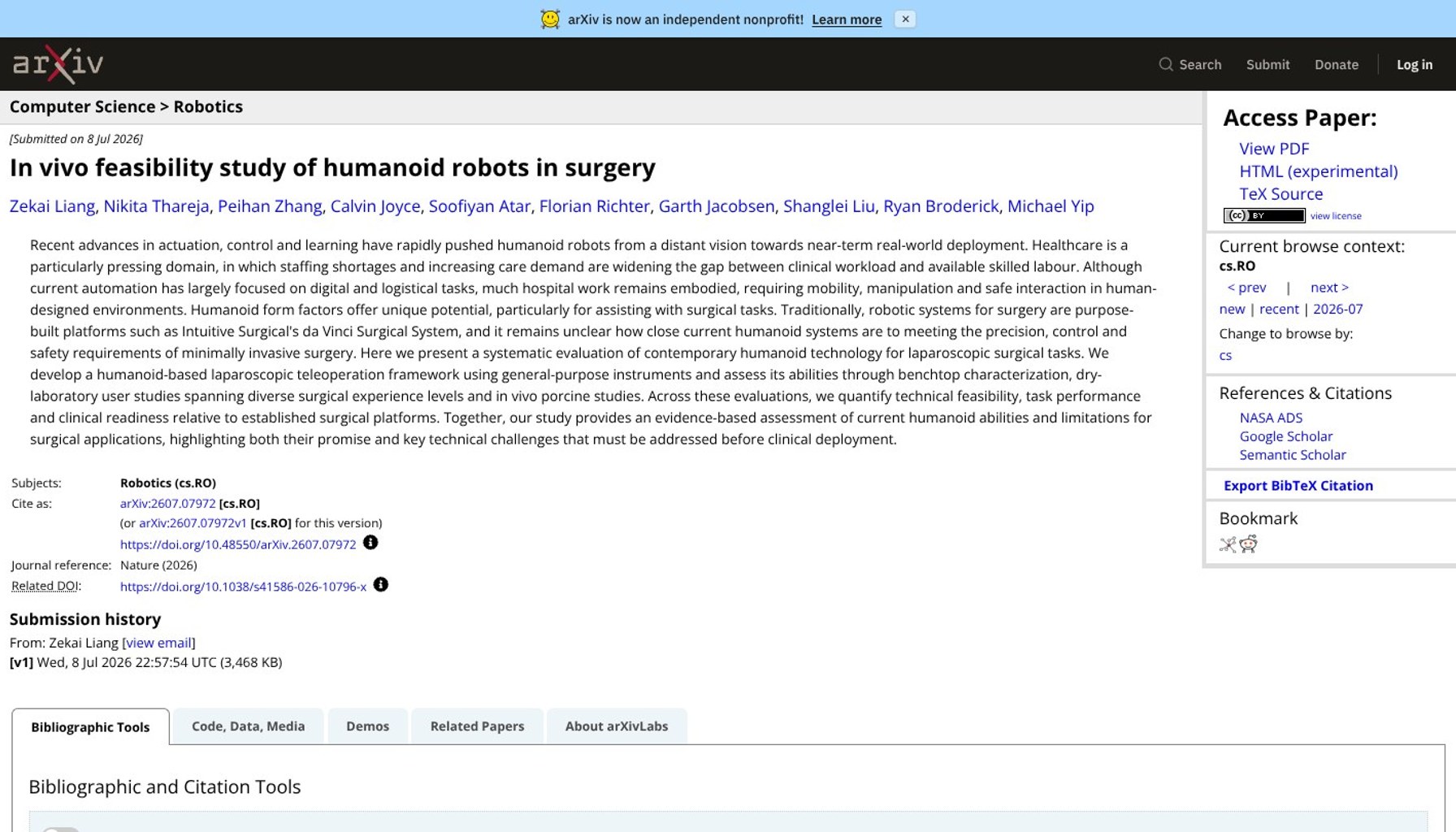
Image / arXiv Humanoid/Bipedal Query
Humanoid robots ran real laparoscopic tasks on live pigs, but they’re not ready for the OR.
A new study lays out the practical steps toward using humanoid form factors for surgical tasks, while also painting a clear picture of what stands between lab demos and a clinically deployable system. The authors built a humanoid-based laparoscopic teleoperation framework that relies on general-purpose instruments rather than a purpose-built robotic end effector, then pushed it through benchtop tests, dry-lab user studies with surgeons of varied experience, and in vivo porcine experiments. Their aim was to quantify technical feasibility, task performance, and clinical readiness in comparison with established platforms such as the da Vinci system, which remains the benchmark for precision and control in minimally invasive surgery.
Testing shows the approach is feasible in controlled settings, and the humanoid frame can perform a range of laparoscopic maneuvers under teleoperation. In dry labs and benchtop tests, the team measured the mechanics of movement, control loops, and instrument handling patterns across users with different surgical backgrounds, providing a baseline for how a humanoid system might adapt to real OR tasks. In vivo porcine studies give a sense of how the platform handles living tissue, dynamic anatomy, and the unpredictable forces that aren’t present in cadaver or bench work. The study documents that while basic task completion is achievable, the current iteration trails traditional dedicated robotic platforms in the very traits clinicians rely on for safety margins and precision.
The authors acknowledge a clear promise for humanoid robots to address staffing shortages and rising care demands by bringing mobility, manipulation, and safe interaction into human-designed environments. But they also lay out the key challenges that stand between a preclinical demonstration and a production-ready tool. The assessment highlights gaps in precision, force control, and safety guarantees when operating with general-purpose instruments in a surgical context. The work emphasizes that the transition from feasibility to clinical readiness requires advances not just in actuation and control, but in integrated workflow, sterility, instrument compatibility, and real-time decision-support compatible with human surgeons.
From an engineering viewpoint, the study underscores several constraints that will shape future development. First, there is a tradeoff between the flexibility of general-purpose instruments and the extreme precision demanded by laparoscopic tasks. Second, control latency, stability of teleoperation, and the potential for unintended instrument interactions pose notable failure modes in live tissue. Third, translating bench and animal results into a hospital-ready protocol will demand rigorous safety architectures, robust calibration across patients, and reliable recovery paths if something goes awry. Finally, integration with operating room logistics, from sterile preparation to surgeon training and maintenance, remains a nontrivial hurdle that could slow adoption even if the technical performance improves.
Industry observers will also watch for how this line of work intersects with regulatory pathways and cost. While a humanoid platform might eventually offer adaptable capabilities across tasks, hospitals will weigh the upside of broader functionality against the overhead of new hardware, software, and the safety case needed for clinical approval. The study’s placement in a lab-to-preclinical trajectory signals that real-world deployment, if it comes, will be gradual, with iterative demonstrations in controlled environments before any large-scale rollout.
Looking ahead, expect the next wave to focus on strengthening control fidelity, adding tactile feedback or haptic cues that help surgeons sense tissue interaction, and expanding the range of laparoscopic tasks tested in vivo. Researchers will likely pursue more diverse tissue models, longer procedure simulations, and standardized benchmarks that can be used across institutions. For investors and operators, the takeaway is clear: the idea is technically credible and increasingly practical to prototype, but substantial work remains to bridge the gap to production-ready clinical use.
- In vivo feasibility study of humanoid robots in surgeryarXiv Humanoid/Bipedal Query / Primary source / Published JUL 08, 2026 / Accessed JUL 10, 2026