IEEE honors robotics pioneer Toshio Fukuda with Emberson Award
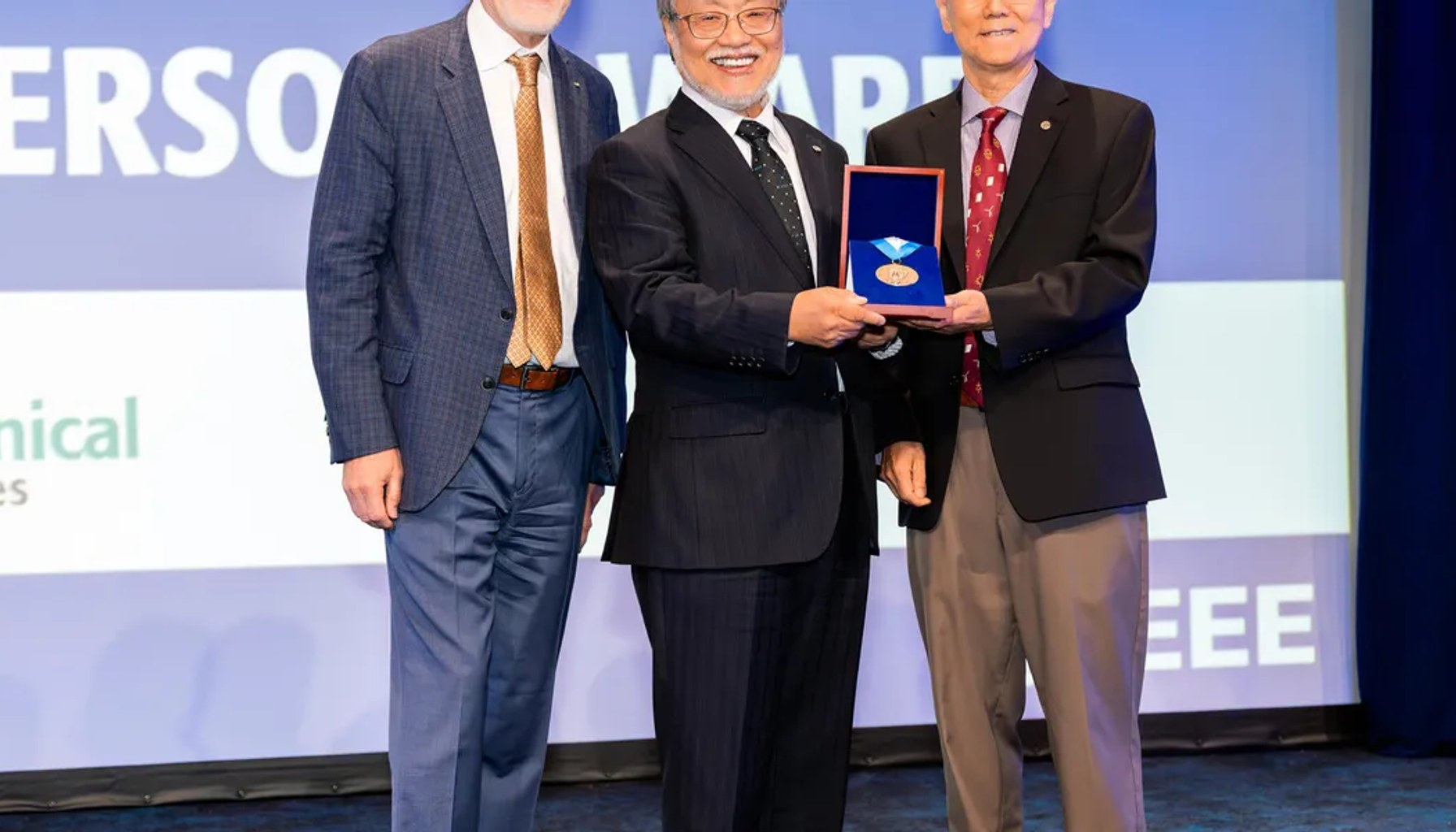
Image / IEEE Spectrum Robotics
More than 2,000 papers and counting, Toshio Fukuda wins the Richard M. Emberson Award.
IEEE Spectrum profiles Fukuda as a towering figure whose work spans biomedical robotics, industrial robots, micro-nano robotics, mechatronics, and AI driven automation. He helped launch the IEEE RSJ International Conference on Intelligent Robots and Systems, known as IROS, a venue that has remained central to the field for decades. He also served as IEEE president in 2020, becoming the first person of Asian descent to hold the role. Today he is vice president of research at the Egypt-Japan University of Science and Technology in Alexandria, where he helps steer a cross-continental research agenda. His long list of honors includes Japan’s Medal of Honor with purple ribbon in 2015 and the Order of the Sacred Treasure in 2022. The Emberson Award, IEEE’s recognition for distinguished service advancing the technical objectives of IEEE, especially in robotics, underscores a career built on spinning laboratory insights into scalable practice.
The award’s emphasis on service rather than a single achievement reflects Fukuda’s broader impact on how the robotics community organizes itself. Documentation indicates his influence extends beyond papers and patents to charting collaboration across disciplines and regions. By shaping conference culture, he helped establish shared benchmarks, open discussion, and a continuing dialogue between researchers and practitioners. In other words, Fukuda’s legacy is as much about the ecosystem that carries ideas from bench to deployment as it is about individual tech breakthroughs.
For engineers watching the field today, Fukuda’s career highlights two key realities of robotics as an engineering system. First, the span across biomedical, industrial, and micro-nano robotics shows that effective robotics relies on modular, interoperable platforms. Systems must support heavy payloads on one end and delicate, nanoscale manipulation on the other, all while preserving safety, reliability, and cost discipline. That kind of versatility demands common interfaces, rigorous testing regimes, and clear governance around risk.
Second, Fukuda’s leadership in IROS and his role in Japan’s Moonshot program, where high ambitions for AI driven robotics were paired with long-horizon policy and funding, spotlight a constant tension in the field: how to turn bold research into durable capability within a business or national program. The Moonshot experience illustrates the incentives, timelines, and risk tolerances that hardware teams must navigate when pursuing ambitious AI enabled automation.
Industry observers should watch for Fukuda’s continuing emphasis on building communities that translate research into deployable practice. The Emberson Award signals a future where IEEE level stewardship helps ensure robotics research matures in ways that are testable, scalable, and safe for real world use. If there is a throughline to his career, it is this: leadership that bridges laboratories, conferences, and corridors of power accelerates robotics from concept to configured capability on the factory floor and beyond.
- IEEE Honors Robotics Pioneer Toshio FukudaIEEE Spectrum Robotics / Research / Published JUL 07, 2026 / Accessed JUL 08, 2026