Orbbec Debuts AI 3D Vision at Automate 2026
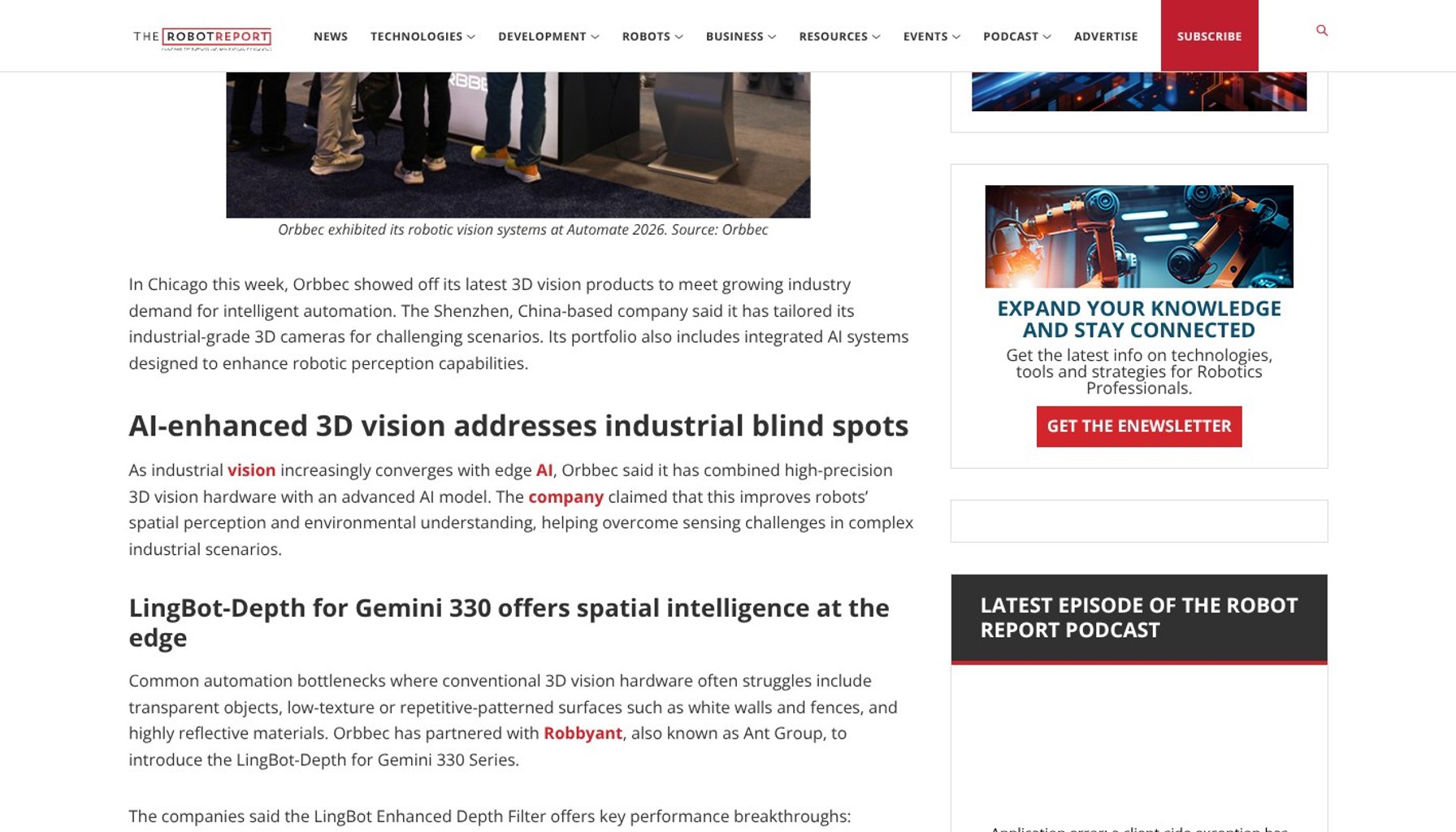
Image / The Robot Report
Orbbec just gave factory robots true depth intelligence. In Chicago this week, the Shenzhen-based company pulled back the curtain on industrial-grade 3D cameras paired with AI software designed to sharpen robotic perception in harsh factory environments. The highlight is a tight pairing of Orbbec’s Gemini 330 depth hardware with an AI processing stack called LingBot, and a collaboration with Robbyant, the Robotic wing of Ant Group.
Orbbec framed the lineup around a practical problem: the bottlenecks that plague 3D vision in industrial settings. Transparent objects, low-texture surfaces like blank walls, repetitive patterns, and highly reflective materials routinely trip up perception pipelines. The LingBot-Depth for Gemini 330 Series is pitched as the solution for those blind spots, delivering spatial awareness at the edge rather than relying on cloud-only processing. The goal, the company said, is to give robots a steadier sense of their surroundings so they can plan and execute manipulations with fewer retries.
A core piece is the LingBot Enhanced Depth Filter. Orbbec said the filter is trained with chip-level, high-precision data drawn from Gemini 330 sensors, and it feeds directly into Robbyant’s in-house vision-language-action models. The aim is to marry robust depth cues with large-model reasoning so a robot can interpret a scene, describe a plan, and act on it in near real time. In practice, that means a robot can better recognize a cluttered bin, decide which item to pick, and execute a sequence of motions with greater reliability.
Robbyant, described as part of Ant Group, is central to the story because the collaboration illustrates a concrete path for deploying large-model perception in manufacturing. The combination invites a tighter loop: high-fidelity depth data on the edge informs the models that drive perception and action, reducing latency and potentially increasing task success rates. Orbbec framed the approach as a way to push more of the inference, and the risk analysis, onto the device rather than across a network, an arc many factories are watching as they scale automation.
One notable capability is flexible dual-mode inference. In theory, operators can switch between modes to balance compute budgets and latency against model fidelity. The implication for integrators and operators is meaningful: you can tune the system for a high-sample-speed picking task in a production line or switch to a more deliberative mode when planning intricate assembly steps, all with depth data guiding the decision space. The practical upshot is a tighter perception-to-action loop at the edge, which can translate into fewer failed picks and less downtime in manual-heavy lines.
Testing shows that depth-informed large models have a tangible impact on manipulation. The company reports that incorporating high-quality depth data into Robbyant’s VLA stack significantly enhances robotic manipulation capabilities and overall operational success rates. In other words, better depth shouldn’t just look smarter on screen; it should move the robot closer to human-like reliability in handling unfamiliar parts and clutter.
For practitioners, the message is both promising and cautionary. Prospective adopters should view this as a path to reduce multi-sensor complexity on the factory floor, but it comes with tradeoffs. Depth data quality remains a function of sensor calibration, lighting, and scene geometry; edge inference demands compatible hardware and thermal budgets; and enterprise deployments must account for integration with existing robotics software stacks and MES data flows. If the Gemini 330-based LingBot stack proves resilient across varied lines, it could become a reference architecture for edge AI in industrial vision, not just a clever lab demo.
What to watch next is real-world performance at scale. If Robbyant’s VLA models paired with LingBot depth filters demonstrate durable gains in pick-and-place, bin-picking, and part identification across multiple lines, expect more OEMs to follow with similar depth-enabled perception stacks. For now, Orbbec has delivered a concrete, engineering-led demonstration of what it takes to move depth perception from a clever sensor into reliable, on-robot decision making.
Sources
- Orbbec shows AI-powered vision systems at Automate 2026The Robot Report / Trade / Published JUN 26, 2026 / Accessed JUN 27, 2026