Robots play 11 on 11 on hardware at RoboCup
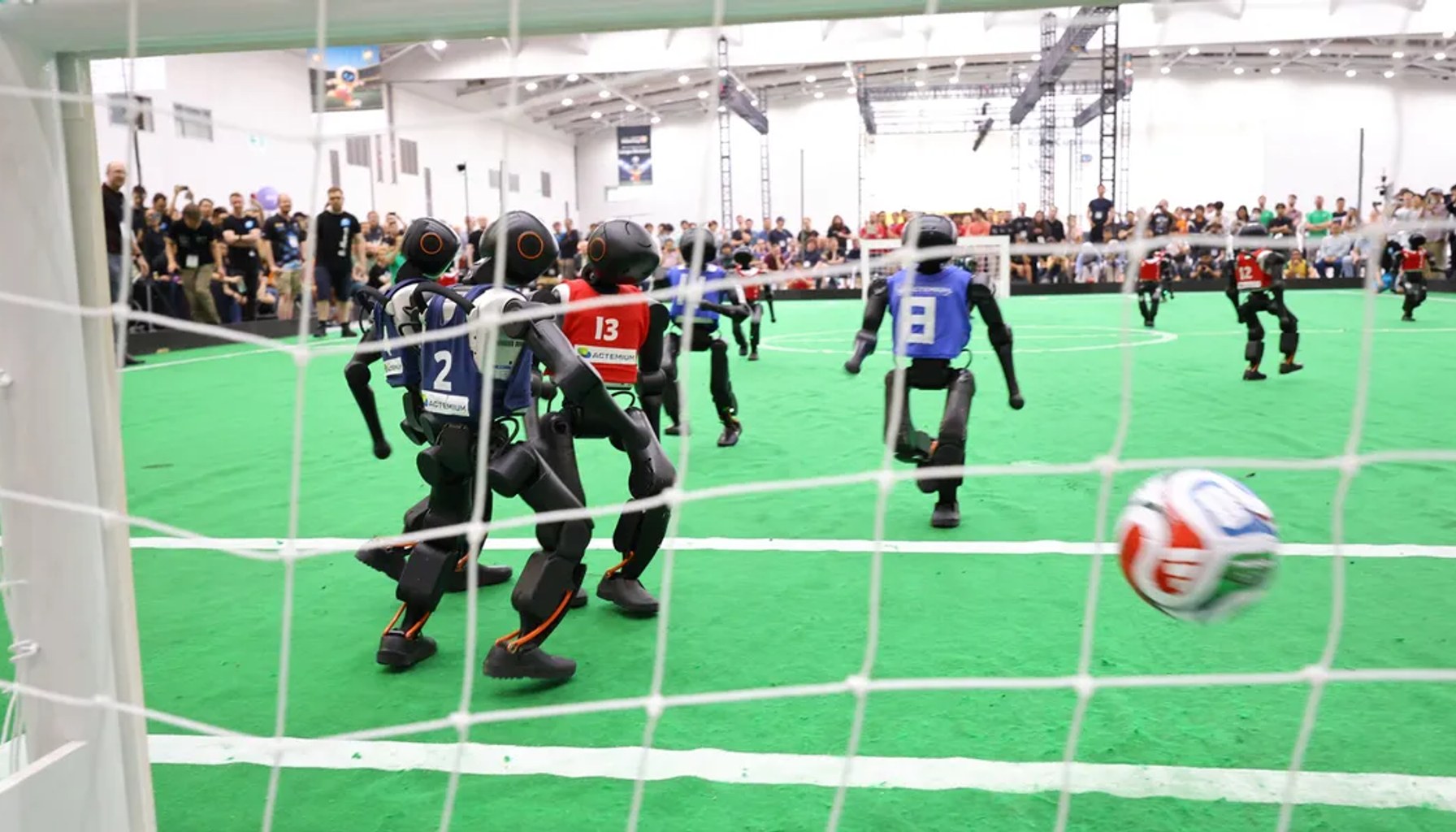
Image / IEEE Spectrum Robotics
Two full humanoid teams just played 11-on-11 on real hardware.
RoboCup 2026 in Incheon, South Korea, delivered a milestone moment for the field: humanoid robots sprinted, chased the ball, and attempted kicks in a full-size, on-field match with real players representing both sides. The spectacle underscored a shift from demonstrations on test rigs to field-ready teamwork among multiple robots, a necessary step toward practical human-robot collaboration in dynamic environments. For engineers watching the match, the event was as much about the constraints of physical hardware as it was about clever software. Testing shows that coordination across dozens of actuated joints, real-time gait stability, and fault tolerance remain the dominant design challenges when you scale from one rover or one drone to a true team sport.
The table stakes are high because the field is not a controlled lab. Perception, planning, and control must all sing in sync while robots contend with occlusion, motion blur from fast play, and the unpredictable motions of opponents. The match made it clear that advances in sensing and state estimation are only as valuable as the planners and controllers that translate that data into a safe, legal kick or a decisive interception. Documentation indicates teams have to manage complex timing and communication across multiple machines to avoid slips, stumbles, or misfires that could tilt a ball or throw a robot off balance. The result is not just a proof of legged locomotion but a demonstration of multi-robot coordination under the pressure of a real game clock.
The event carried the extra thrill of a stadium scene that fans dream of for humanoids. Atlas arrived pitchside at NYNJ Stadium in front of 80,000 people, a moment that highlighted how far the public-facing narrative of robotics has come from lab benches to big stages. While Atlas is a widely watched symbol of humanoid capability, RoboCup makes the point that the real story is the software stack and hardware reliability behind each robot on the field. In practice, the success of a 11-on-11 match hinges on how smoothly perception, planning, and control pipelines stay in lockstep across a team of machines, each with its own battery, sensors, and actuators.
From a practitioner lens, the milestone reframes what matters next in humanoid robotics. First, the hard cap remains energy and torque. Each robot must wield enough drive to accelerate, dodge, and kick while preserving joint health and battery life through the full game. Second, multi-robot coordination is a software engineering problem as much as a mechanical one. Teams must manage tight communication, sensor fusion, and synchronized actuation to prevent misalignment that can cascade into a failed play. Third, robustness to day-to-day wear and tear is a real world constraint, with sudden drops in traction, sensor dropout, or actuator noise capable of flipping a match in a heartbeat. Fourth, the path forward will likely emphasize scalable software architectures and modular hardware that can be upgraded without scrapping entire platforms.
What to watch next is clear. Expect deeper demonstrations of perceptual reliability under stadium lighting, improved gait stability on varied turf under fatigue, and more sophisticated on-field decision making that blends strategy with immediate ball control. The RoboCup trajectory, already visible in hardware advances and increasingly capable end-effectors, will hinge on tightening the loop from sensing to action, then from action to team-wide strategy. If the pace holds, the next milestone might be not just another demonstration, but a production-style cycle where teams routinely field cohesive squads with predictable, coachable behavior on the field.
- Video Friday: A World Cup for RobotsIEEE Spectrum Robotics / Research / Published JUL 10, 2026 / Accessed JUL 12, 2026