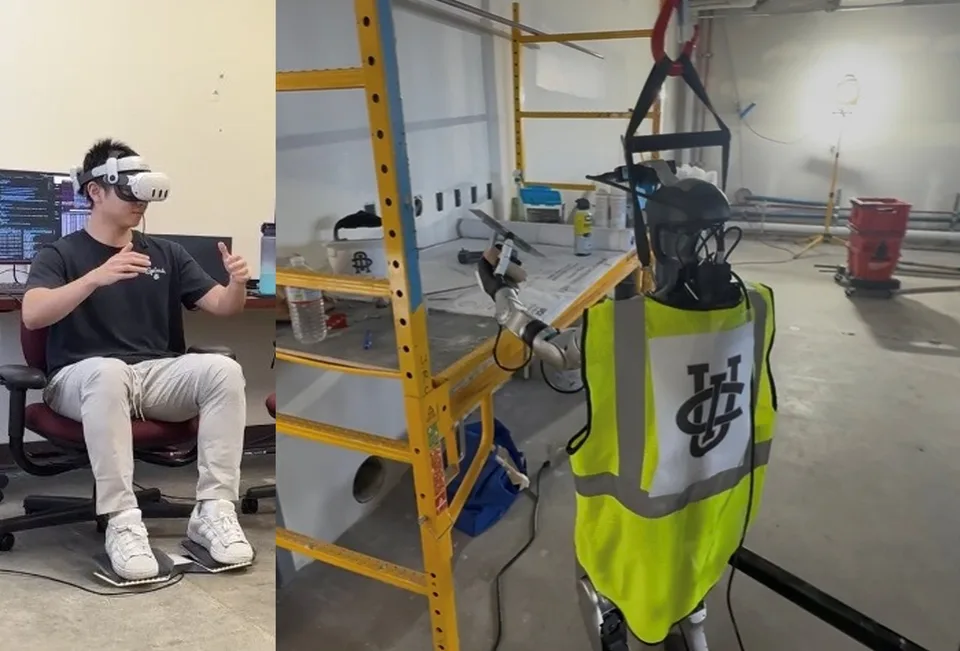
A University of California, Irvine feasibility study used headset tracking and foot pedals, but the robot worked far slower than a person.
The system lets one seated operator control a Unitree G1 humanoid from a workstation. The operator wears a Meta Quest 3 headset that tracks head and hand movements while streaming the robot’s view. GLYDR foot pedals control walking, turning, squatting and standing, leaving the operator’s hands free to manipulate objects.
The University of California, Irvine researchers deployed the robot on an active construction site for two tasks: carrying a hand tool about four meters to a bin and rolling paint across paper. Each task involved two operators, one experienced with virtual-reality interfaces and one without, completing 10 trials each.
The study reported 100% success for tool transport and 80% for painting. But speed was the central problem. Tool transport averaged about 72 seconds by teleoperation, compared with four seconds manually. Painting took 149 seconds remotely versus 47 seconds by hand.
The robot’s grasp was another weak point. Painting failures mainly involved losing or failing to secure the roller brush, showing why hand tracking alone may not provide reliable grip control. The researchers also observed motor overheating during extended sessions, although the study does not establish how long the robot can run before that happens.
The system recorded video, tactile readings, motor data and movement commands for possible future imitation-learning systems—software trained from demonstrations. For now, the work shows a workable way to keep a person in control while moving some physical exposure to the robot, not a production construction system. The next useful test is longer operation across more tools, tasks and jobsites.