Seven axis cobots on AMRs extend warehouse reach
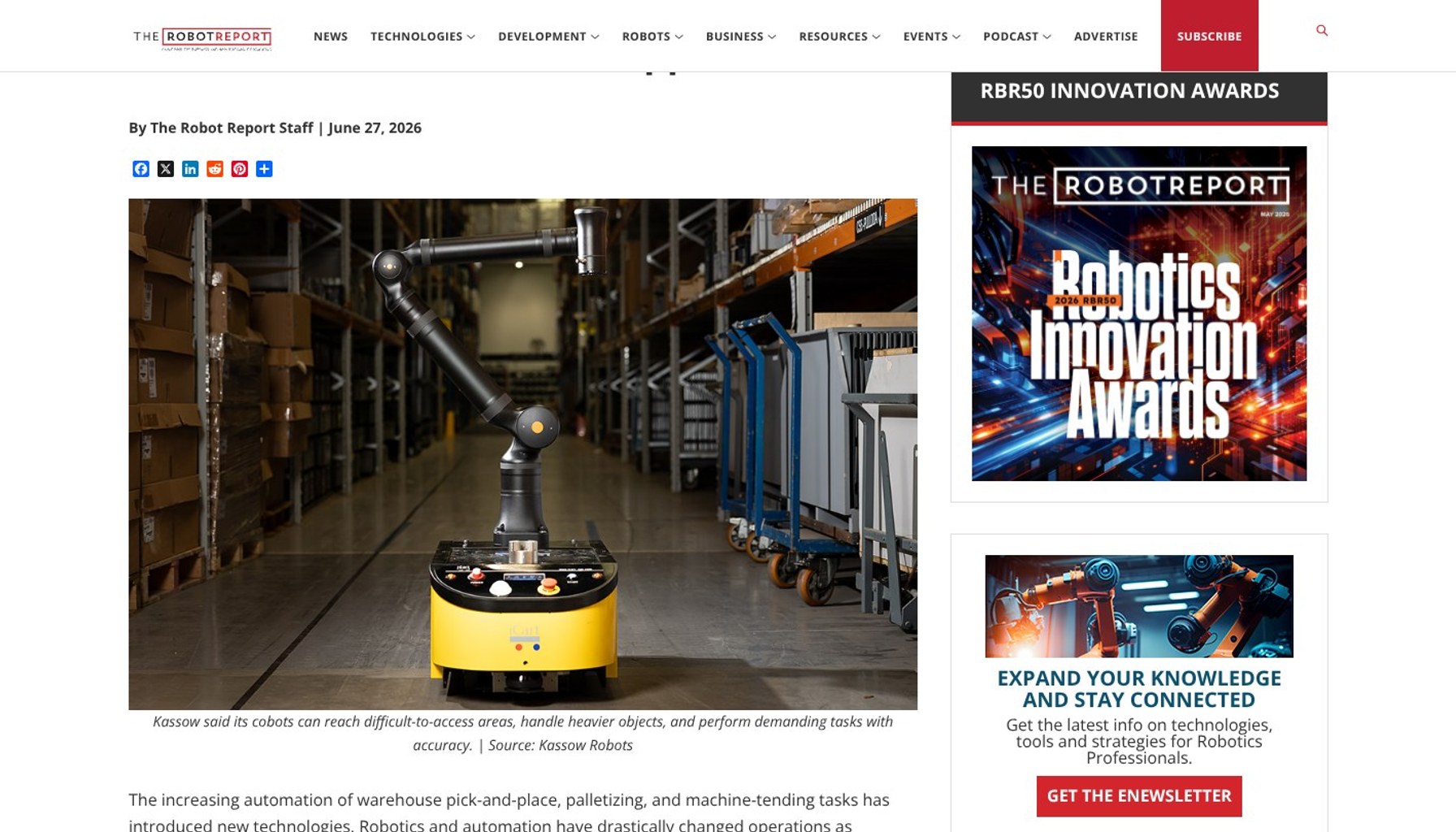
Image / The Robot Report
The company reports that Kassow’s cobots can reach difficult-to-access areas, handle heavier objects, and perform demanding tasks with accuracy, a combination that is reshaping how warehouses think about automation. Testing shows that the push toward integrated mobile manipulation is not just hype; it’s a real shift born of labor shortages and productivity pressures. The automation story, once about fixed stations and linear pick-and-place, has shifted toward compact, adaptable solutions that move with mobility, making it possible to load, offload, and position parts without forcing humans to shuttle between stations.
Some seven-axis models of force- and power-limited arms are gaining popularity because they can be mounted on autonomous mobile robots, enabling a greater range of motion and access into harder-to-reach areas. The integration matters because it tightens the loop between material handling and workspace execution. Cobots on AMRs extend the reach of a single robot cell, letting a single arm perform multiple tasks across a facility without moving the base unit or relocating a workstation. In practical terms, that means easier loading and offloading, cart transportation between stations, and the ability to perform repetitive tasks, including picking, assembly, labeling, and even welding and screwing, alongside mobile navigation.
The broader implication is an architecture shift in warehousing. Cobots integrated onto AMRs reduce the need for multiple cobot and industrial robot arm stations, cutting the number of manual and repetitive touchpoints for workers. The idea is to keep people away from repetitive handles and tight or hazardous positions while preserving throughput. The integrated backdrive on Kassow’s cobots is highlighted as a key enabler, facilitating positioning and programming so technicians can tune a task without reworking the entire layout or workflow. In testing environments, the backdrive has helped shorten setup times and improve precision when changing grippers or tools, a practical win for facilities that run different SKUs through the same line.
Industry observers note that the move to mobile manipulation is more than a novelty; it’s a response to a real operating constraint: space and throughput. Some industrial operators are replacing fixed cobot stations with seven-axis cobot arms mounted on AMRs to regain floor space and reduce handoffs between devices. Kassow’s approach aligns with a broader trend in which the robot bench is effectively embedded into the walk-and-work cadence of the warehouse floor, allowing equipment to “go where the work is” rather than forcing workers to ferry items between distant stations.
What to watch next, from a practitioner’s lens: first, integration fidelity will matter more than the arm’s reach. Expect emphasis on calibration workflows that keep positioning tolerances tight as tasks shift SKU to SKU. Second, power and payload tradeoffs could ripple into routing and battery management on AMRs; seven-axis arms add inertia that may affect travel time and charging schedules. Third, safety and collision avoidance will be an ongoing priority as mobile manipulators share tight aisles with human workers. Finally, ROI hinges on steady throughput gains paired with reduced manual touchpoints; early pilots will need careful data on task completion times and maintenance cadence to prove the business case.
In short, Kassow’s seven-axis cobots on AMRs are not a flashy prototype. They are a practical answer to a very real set of constraints, extending reach, increasing precision, and stitching together loading, transport, and assembly into a single, mobile workflow.
- How compact cobot integration enhances autonomous mobile robot applicationsThe Robot Report / Trade / Published JUN 27, 2026 / Accessed JUN 28, 2026