Beijing AI Chips Startup Lands RMB 1.5B
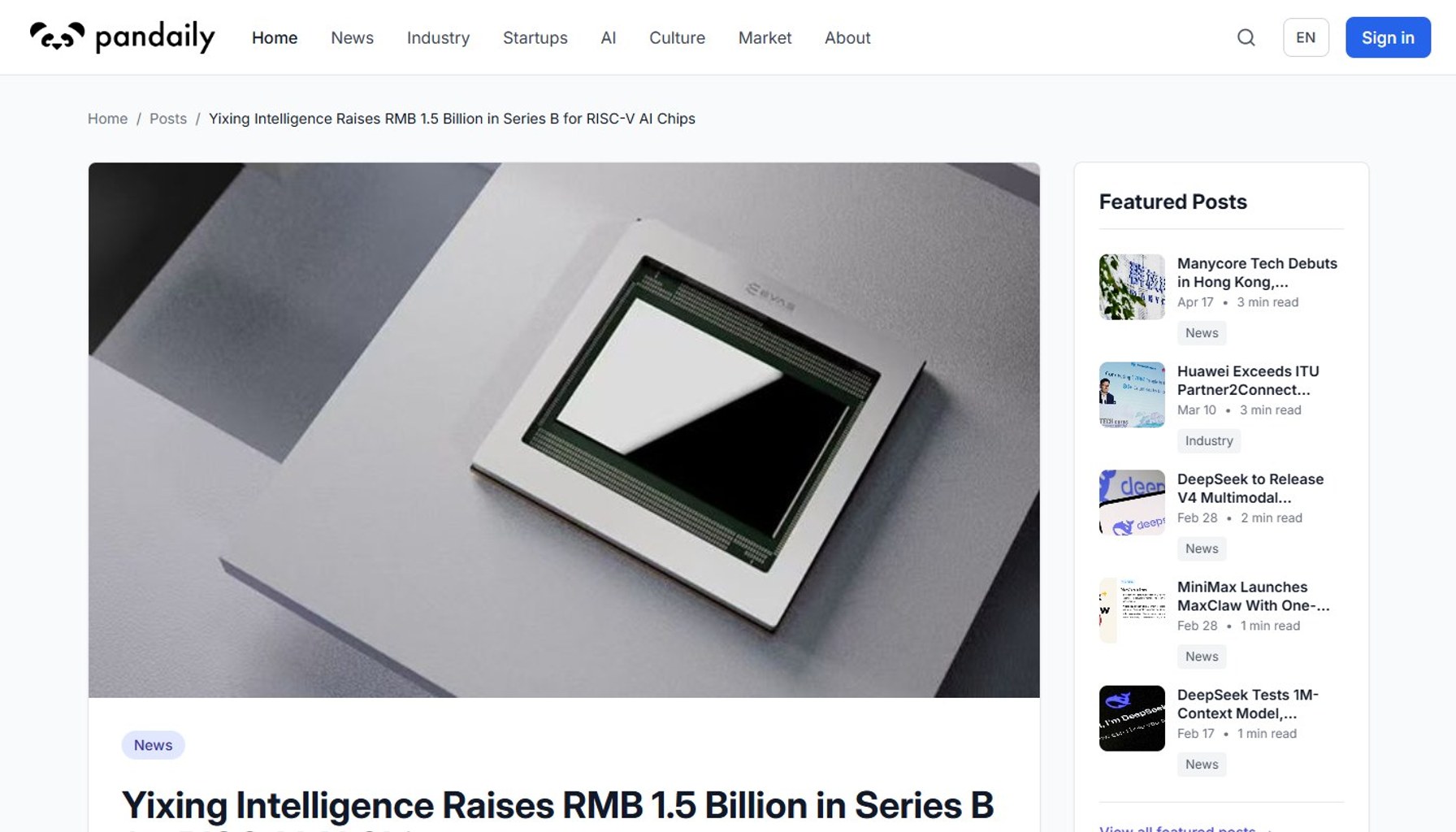
RISC-V AI chips get a major push as Yixing raises RMB 1.5B.
Chinese AI hardware startup Yixing Intelligence announced a RMB 1.5 billion Series B on April 22, 2026, signaling a deeper push into open-standard AI acceleration amid China’s mass-production ambitions. The round was jointly led by Beijing-based industrial investment funds, with participation from multiple institutional investors, according to Aichip’s reporting.
Yixing Intelligence, founded in 2022, centers its product lineup on RISC-V-based AI chips and computing platforms. Its flagship Epoch series targets large language models and deep learning workloads, supporting FP8 precision while staying compatible with lower-precision formats to optimize efficiency and deployment flexibility. The company claims a full-stack approach: chips, PCIe accelerator cards, and server clusters, complemented by a software ecosystem that includes compilers and runtimes. A key element is its proprietary high-speed interconnect enabling scalable multi-node deployments for large-scale AI computing scenarios.
From a policy-to-factory lens, the funding choice highlights two undercurrents shaping China’s chip ecosystem. First, the open RISC-V model—China’s emphasis on domestic, openly specifiable architectures—continues to attract both capital and engineering talent as firms pursue cost efficiencies and supply-chain resilience. Second, state- or state-aligned investors backing a domestic AI-chips player suggest confidence that a domestic open-architecture stack can coexist with, and eventually compete against, foreign accelerators in certain segments of the market, especially for inference workloads and cloud-scale deployments.
Analysts note that mass production in this segment hinges on a tight loop between IP, software ecosystems, and foundry and packaging capacity. Yixing’s emphasis on a full-stack ecosystem—chips plus PCIe accelerators and server clusters, plus compilers and runtimes—reflects a pragmatic path to faster deployment on customer racks. In practice, success will depend on how quickly the Epoch chips scale to repeatable yields at production volumes and how robust its ecosystem is for optimizing models across diverse DL workloads. The funding tranche is intended to accelerate that scale, plus fuel next-generation products and broader ecosystem partnerships.
For global manufacturers watching China’s supply chain tightening, Yixing’s move underscores that China’s AI-hardware ambitions are not limited to large, foreign-accelerator footprints. Instead, there is a clear push to build homegrown, open-architecture options that can plug into domestic servers and data centers without relying entirely on external IP or tooling. This has industry-wide implications: potential price competition in certain inference tiers, a broader alternative supplier base for Chinese OEMs, and a continued push to localize software tooling around new architectures.
Two practitioner takeaways emerge. One, the system-level approach matters: a successful RISC-V AI stack needs not just silicon but a thriving compiler, runtime, and interconnect ecosystem to realize performance and cost benefits at scale. Two, execution risk remains high despite the funding win. Mass production, chip yields, supply of high-speed interconnects, and the ability to maintain a coherent developer ecosystem are all critical to translate Series B momentum into real-on-site deployments across data centers and edge deployments. As Yixing moves toward mass production, watching how its ecosystem expands—especially partnerships with chip fabs, module suppliers, and software developers—will reveal whether this round translates into durable advantage beyond the press release.
In short, the funding is a vote of confidence that China’s RISC-V path—backed by capital and policy-friendly investors—will continue to push more capable, domestically grounded AI acceleration options onto factory floors and data-center racks alike.
- Yixing Intelligence Raises RMB 1.5 Billion in Series B for RISC-V AI Chipspandaily.com / Source role not classified / Published APR 22, 2026 / Accessed APR 22, 2026