Carter Robot Gains Radar and Vision Fusion
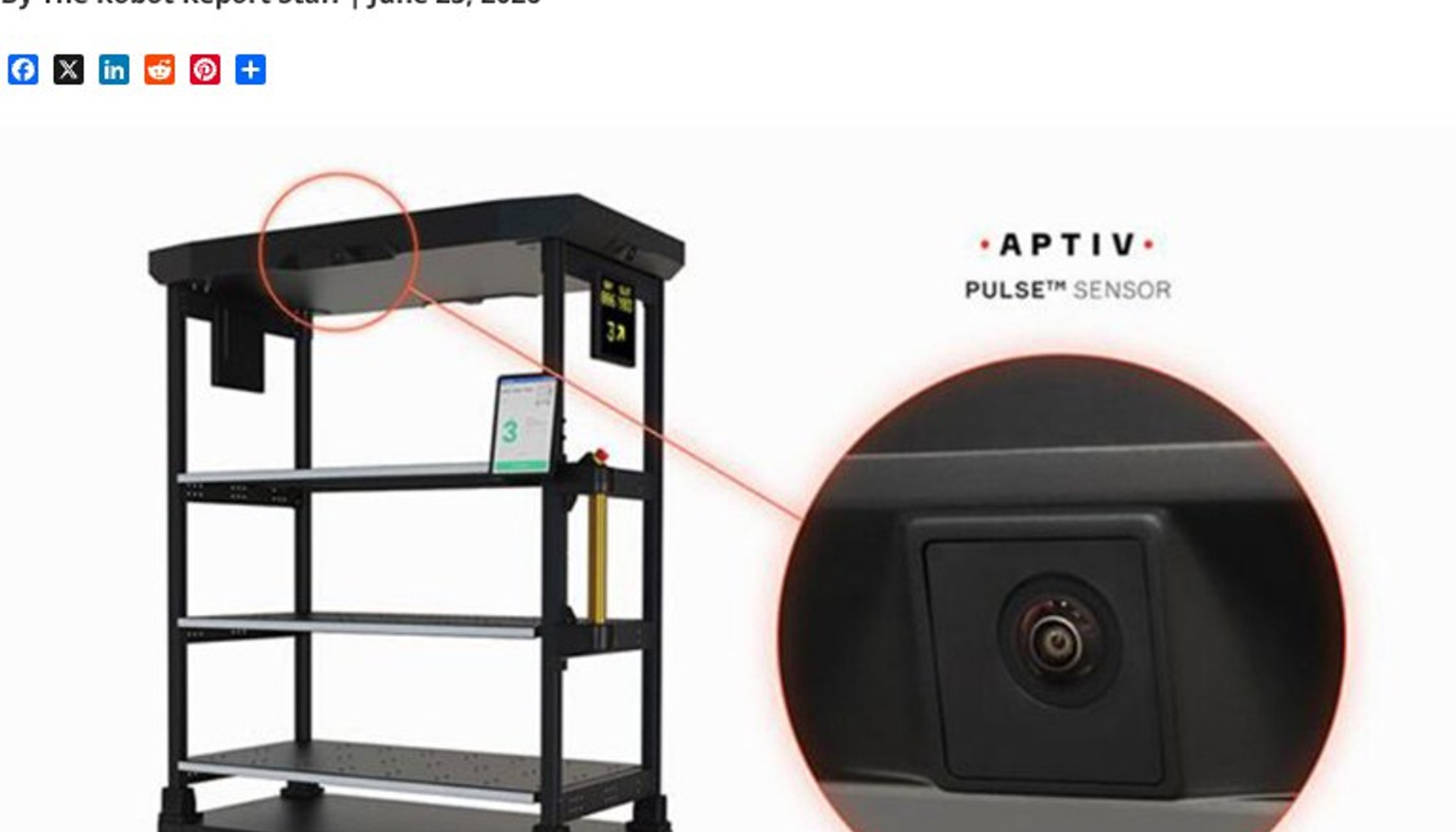
Image / The Robot Report
A warehouse robot now sees with radar as well as cameras.
Robust.AI announced that its Gen 3 Carter collaborative mobile robot will run on Aptiv PLC’s intelligent perception systems, powered by the Aptiv PULSE sensor. The pairing is pitched as a durable answer to the hazards of real world warehouses, manufacturing floors, and cold storage, where dust, glare, moisture, and reflective surfaces can degrade ordinary vision. Deployment data shows that combining radar with high quality camera inputs improves decision making when people, equipment, and obstacles share tight spaces. The case study reports that this sensor fusion enables Carter to operate with greater reliability in dynamic environments where traditional perception often trips up.
At the heart of the update is a software-defined approach that Aptiv and Robust.AI describe as essential for scalable automation. The PULSE sensor brings intelligent perception, AI, and machine learning-based sensor fusion to Carter, creating a perception stack that can reason across multiple modalities. Jay Bellissimo, senior vice president of intelligent systems and president of software and services at Aptiv, framed the rationale by pointing to the needs of real world settings: “Scale adoption of robotics requires safety-critical perception that spans the dynamic conditions experienced in the real world.” The collaboration aims to deliver a more dependable platform for activities like order-fulfillment picking, point-to-point transport, and mobile sorting, without forcing facilities to install new infrastructure.
One benefit Robusto.AI highlights is safer interaction with human coworkers and equipment. By fusing radar with camera feeds, Carter can better distinguish between moving people, stacked pallets, and machinery that shifts in and out of view. This is not just a tech novelty; it is a practical step toward deeper functional safety compliance in the broader market of physical AI. The case study notes that the path toward formal safety certifications is being addressed in parallel with deployment, aligning with industry demand for safety-critical perception across working conditions.
From a practitioner lens, there are clear constraints and tradeoffs. Integration requires harmonizing Aptiv’s perception stack with Robust.AI’s software-defined automation layer, which means careful calibration and software alignment across fleets that may include mixed hardware. While the added robustness is compelling, facilities should plan for the extra data bandwidth and processing requirements that come with sensor fusion. A further constraint is maintenance: radar units and depth-sensitive camera systems demand periodic calibration to preserve accuracy in cluttered environments or highly variable lighting. The result is a more capable Carter, but the total cost of ownership must reflect sensor upkeep alongside the base robot price.
Two more practical angles emerge for teams evaluating this path. First, the approach augments rather than replaces skilled labor; Carter remains a tool to accelerate picking, transport, and sorting tasks while existing staff continue to handle exceptions and quality checks. Second, the reliability gains hinge on consistent environmental conditions. In dusty or reflective warehouses, the radar layer can suppress false positives that plague vision-only systems, but it also introduces potential failure modes if radar reflections misinterpret complex layouts. These risks can be mitigated with robust sensor fusion testing and continuous learning from field data.
Looking ahead, expect further real-world reporting on throughput and cycle times as deployments scale. The case study points toward improved operational stability, but exact cycle times and throughput gains were not disclosed in the release. What is clear is that this combination of Aptiv PULSE and Robust.AI Carter is designed to unlock faster, safer automation in environments where perception is the bottleneck and where safety certifications are increasingly non-negotiable for wide adoption. In the near term, facilities eyeing warehouse automation will watch how this sensor fusion approach translates into smoother handoffs between human operators and autonomous sections of the fleet, and how it scales as yards and warehouses become more automated ecosystems.
- Orbbec shows AI-powered vision systems at Automate 2026The Robot Report / Trade / Published JUN 26, 2026 / Accessed JUN 26, 2026
- Robust.AI chooses Aptiv PULSE sensor for Gen 3 Carter mobile robotThe Robot Report / Trade / Published JUN 25, 2026 / Accessed JUN 26, 2026