Depth Vision Lets Humanoid Dribble Without State Estimation
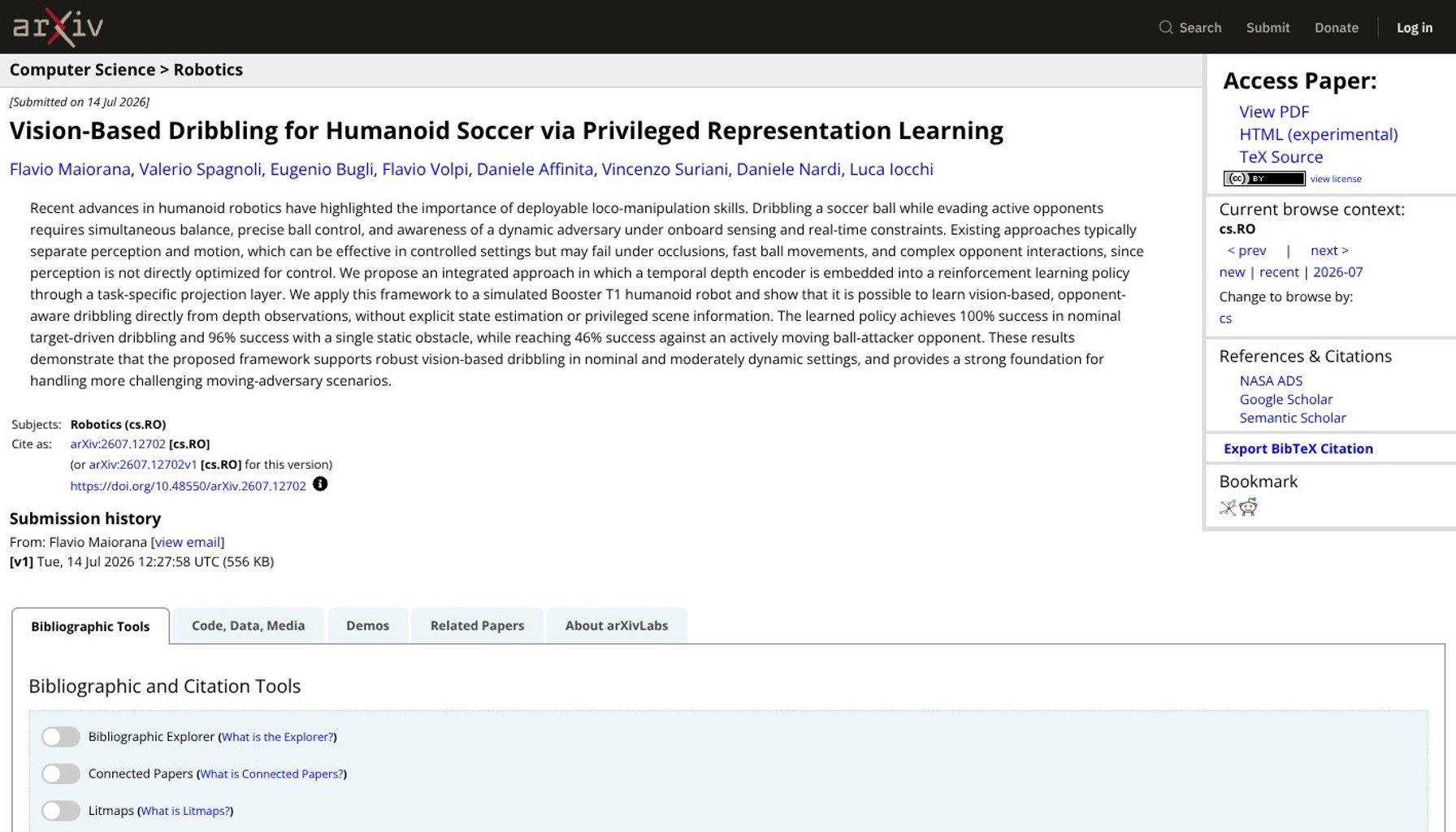
Image / arXiv Humanoid/Bipedal Query
A humanoid soccer bot dribbles using depth-only vision, with no state estimates.
Testing shows a simulated Booster T1 robot learning a policy that integrates a temporal depth encoder into reinforcement learning and can control the ball directly from depth observations, without relying on explicit state estimation or privileged scene data. The study frames the problem as an end-to-end perception and control task, arguing that separating perception from motion can falter under occlusions, fast ball trajectories, and a dynamic opponent. By embedding a depth stream into a task-specific projection layer, the researchers demonstrate that vision becomes a controllable input rather than a passive observation. The result is a more robust handling of on-ball balance and ball placement in a cluttered, adversarial setting that previously forced engineers to build complicated state trackers before actuating a single maneuver.
The team tests the approach on a simulated Booster T1 humanoid, a platform chosen for its humanoid form factor and on-board sensing capabilities. The key claim is not a flashy capability on a real field, but a functional proof-of-concept that perception and motor control can be co-optimized. The reported numbers pinpoint the difference between a nominal, target-driven dribble and more challenging real-world dynamics. In nominal conditions, the policy achieves 100 percent success in reaching a target while dribbling. When a single static obstacle is introduced, success remains high at 96 percent, indicating the depth-based policy can maintain ball control while negotiating simple impediments. The most telling test, however, pits the bot against an actively moving ball-attacker opponent, where success drops to 46 percent. The authors frame this as a strong foundation for tackling more intense moving-adversary scenarios, while candidly acknowledging that real-world dynamics will demand further refinements.
For practitioners, the study underscores several engineering realities. First, the success hinges on on-board depth sensing and real-time computation that can interpret depth frames into control commands without a separate, explicit state estimator. In practice this reduces the cascade of errors that often accompanies perception-to-action pipelines, but it also places tight constraints on sensor selection and processor budgets in a real robot. Second, the approach relies on a training regime that leverages privileged representations during learning but remains agnostic to those privileged cues at run time; in other words, the robot must infer control from depth alone even when richer scene data is available in simulation or offline training. This can improve transferability to hardware, but also means the sim-to-real gap will be a critical hurdle to actual field deployment.
A broader takeaway for operators and investors is that end-to-end vision for loco-manipulation tasks is moving from a curiosity to a design pattern, but with caveats. The numbers show meaningful gains in controlled scenarios, yet the 46 percent success against a moving attacker signals both a hurdle and an opportunity: the real world will demand higher frame-rate perception, faster action cycles, and more diverse adversary behaviors. The paper hints at a path forward: expanding the dynamic scenarios, tightening reward structures, and exploring additional depth cues or lightweight fusion with other sensors, without claiming a hardware-ready leap. In other words, this is a lab-stage milestone that translates into clear engineering bets: improve real-time depth processing, validate sim-to-real transfer, and design robust adversary modeling if the goal is reliable on-field performance.
The work sits at the intersection of perception, control, and sim-to-real engineering. If the approach scales to hardware, it could reduce the burden of maintaining separate tracking modules and enable more agile robotic teammates in practice matches. But for now, the takeaway is precise: depth-based, integrated learning can drive practical dribbling behavior in a humanoid robot, albeit within the constraints of simulation and with obvious steps needed before real-world reliability is demonstrated.
- Vision-Based Dribbling for Humanoid Soccer via Privileged Representation LearningarXiv Humanoid/Bipedal Query / Primary source / Published JUL 14, 2026 / Accessed JUL 15, 2026