FTC Unveils Rules to Curb Deceptive AI Promises
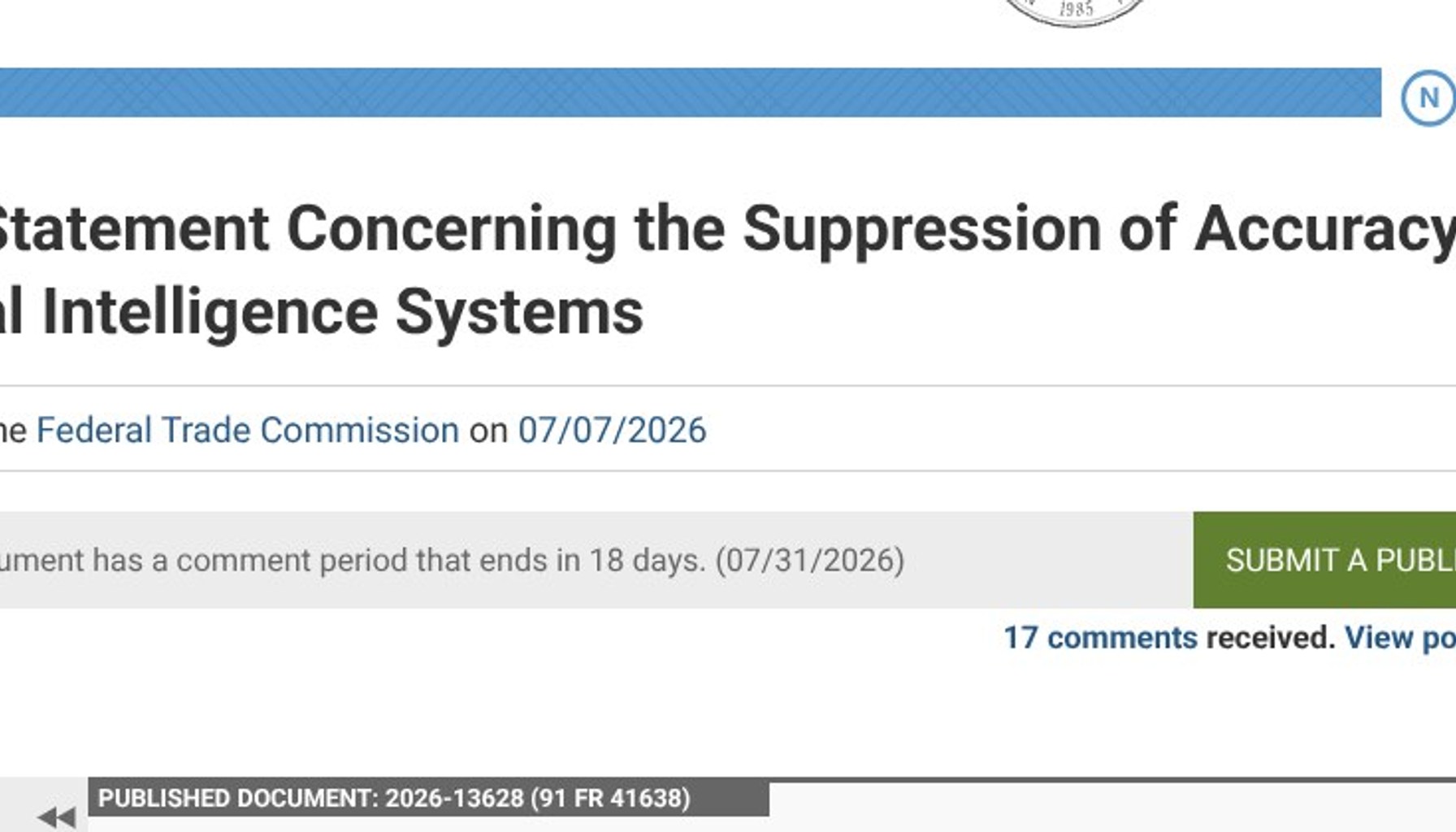
Image / Federal Register FTC AI
The Federal Trade Commission published a policy statement applying the FTC Act’s broad ban on deceptive acts or practices to companies marketing artificial intelligence systems. In a move observers see as a sharpened regulatory focus, the agency says AI vendors could be held accountable not only for what their products do, but for how they describe them to consumers. The filing, published in the Federal Register on July 7, 2026, centers the debate on accuracy and the way AI capabilities are communicated, marketed, and labeled.
At the heart of the policy is the aim to suppress accuracy, considering how an AI system’s outputs may be misrepresented by claims of reliability, precision, or certainty that do not hold up under scrutiny. The policy statement describes deception not only as overt false claims, but also as materials that mislead about an AI system’s true capabilities or the likelihood of error. For compliance teams, this signals a heightened expectation that marketing and product materials reflect actual performance, with careful attention to how results are framed, tested, and disclosed to users.
The document ties the proposed approach to broader national policy discussions about AI and market fairness. It cites the White House Economic Advisors and a January 2026 study, Artificial Intelligence and the Great Divergence, to frame concerns about how AI could affect competition and consumer welfare if misrepresented. In that context, the FTC’s stance is positioned as a guardrail against misalignment between what AI claims promise and what the technology can reliably deliver, especially in consumer-facing applications.
Another layer in the policy concerns the tension between dynamic AI outputs and state law. The filing notes that some firms might steer AI outputs to satisfy shifting regulatory requirements in places like Colorado, where state AI legislation has evolved. This kind of steering, altering results to appear compliant, could itself be deceptive, the policy argues, because it relies on consumer expectations about autonomy and accuracy. The result would be deceptive influence rather than truthful disclosure, triggering enforcement under Section 5.
For compliance officers, the policy statement translates into concrete requirements and risk signals. First, marketing claims about “AI accuracy,” “reliability,” or “automation” should be grounded in demonstrable performance metrics that can be independently verified. Second, disclosures about limitations, risks, and the probability of error should be clear and conspicuous, not buried in fine print. Third, governance around AI claims, including internal testing, validation, documentation, and cross-functional review, will be essential to withstand regulatory scrutiny. In practice, that means tighter controls over what teams can say publicly about AI products, how those claims are tested, and how results are reported to users and regulators alike.
Enforcement under this policy would fall under the FTC’s Section 5 authority. While the notice does not spell out penalties, it signals that deceptive marketing about AI capabilities could invite formal action, injunctive relief, and corrective orders in line with existing consumer protection powers. For tech leaders, this creates a clear incentive to align product marketing with independent validation, to document decision-making around AI outputs, and to prepare for closer scrutiny of AI-related claims in advertising, packaging, and help content.
Industry watchers should expect continuing clarifications as this policy moves from notice to potential final form. As AI becomes more embedded in consumer decisions, the FTC’s guidance on accuracy and deception will shape compliance roadmaps, product labeling, and how teams price and position AI features in the market.
- Policy Statement Concerning the Suppression of Accuracy in Artificial Intelligence SystemsFederal Register FTC AI / Primary source / Published JUL 06, 2026 / Accessed JUL 13, 2026