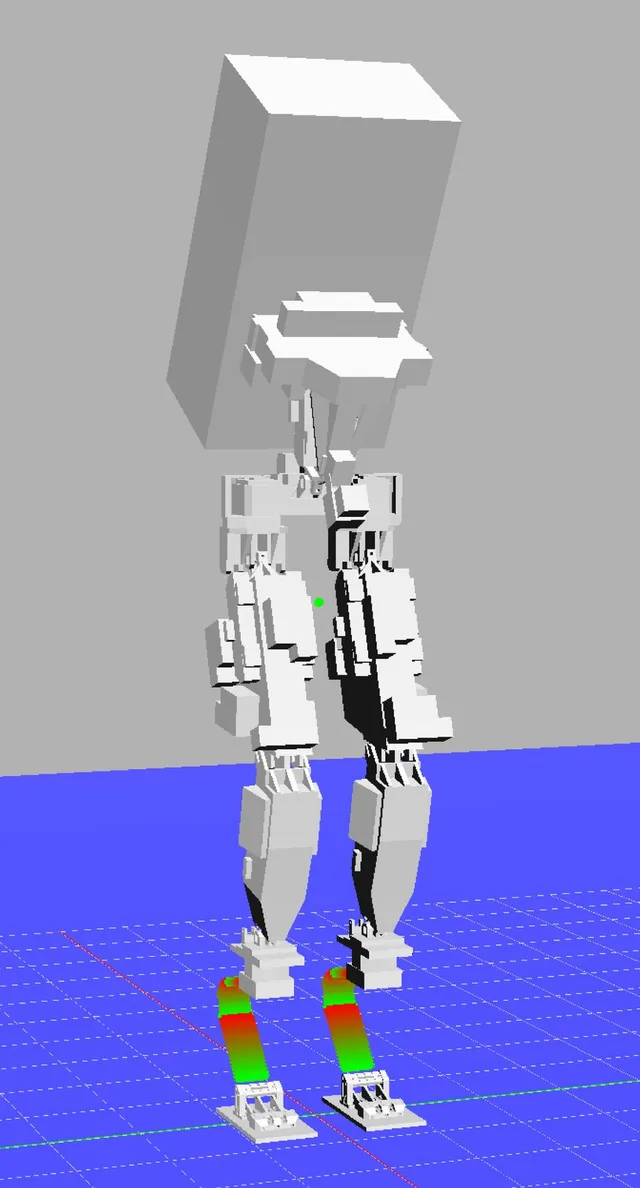
The University of Tokyo framework models bending, gravity, and joint compliance together; walking remains a simulation result.
A University of Tokyo paper proposes a control method for humanoids with passive, flexible leg parts. Instead of treating leg bending as an error after it happens, the method includes deformation in motion planning and balance control.
The model uses piece-wise constant strain, which divides a continuously bending structure into shorter sections with simpler, constant deformation. The controller then calculates joint movements while considering gravity, stored elastic energy, and the robot’s target posture.
That matters because a flexible leg changes the robot’s balance as it bends. The proposed inverse-kinematics method searches for a posture where elastic and gravitational effects work together. A second method adjusts active joint compliance—how readily powered joints give under force—while accounting for the legs’ passive flexibility.
The authors evaluated the approach in forward-dynamics simulations for standing, jumping, and walking. The walking simulation covered nine steps, with one second per step. These results show how the controller might handle deformation during motion, but they are not a physical walking demonstration.
The hardware tests used Hydra, a life-sized, hydraulically driven humanoid measuring 220 centimeters and weighing 77 kilograms. It has 14 degrees of freedom and leaf-spring prostheses at both feet; motion capture measured how those prostheses deformed.
Physical tests covered double-support balance, compliance, and push recovery. In one reported push-recovery experiment, the authors controlled the robot’s center-of-gravity displacement in one horizontal direction within 0.5 centimeter.
The next engineering test is straightforward: physical walking and hopping with varied disturbances and different flexible-leg designs. That would show whether the approach transfers beyond this specific Hydra setup.