cuObject is generally available; SCADA remains a server-building framework with IBM interoperability shown in prototype form.
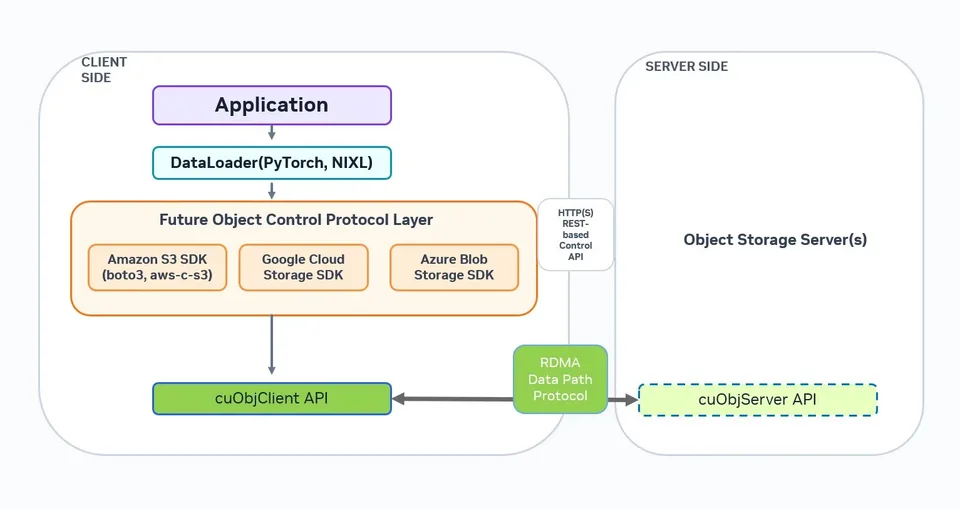
NVIDIA says its cuObject client and server libraries are now generally available for building faster object-storage applications. The libraries provide application programming interfaces and a shared RDMA wire protocol, a networking method that moves data directly between devices while avoiding the server’s usual processor path.
That could reduce provider-specific integration work for AI teams. Training, inference, searches, and database lookups often need data stored in files or objects across cloud and on-premises systems. With cuObject, control messages use HTTPS or TCP, while the larger object data transfers use RDMA.
The other announcement is the NVIDIA SCADA Server Software Development Kit. It gives storage providers tools to build servers that receive requests directly from GPUs, fulfill them using local or remote storage, and return results over RDMA.
NVIDIA says IBM demonstrated this approach with a prototype connecting a SCADA client to an early Storage Scale SCADA server. That is an interoperability demonstration, not evidence of a broadly deployed product.
The practical divide matters. Developers can start using cuObject now, but NVIDIA says the production-ready xio-sig software stack—intended to support shared cuFile and cuObject code—will be shared after it passes conformance tests. The announcement does not provide measured throughput, latency, or CPU-use results, nor does it establish customer deployments.
For infrastructure teams, the next step is testing cuObject against their storage environment and watching xio-sig’s conformance work. SCADA is more directly a partner and storage-vendor project today, with IBM’s prototype showing the intended direction rather than a ready-made customer service.