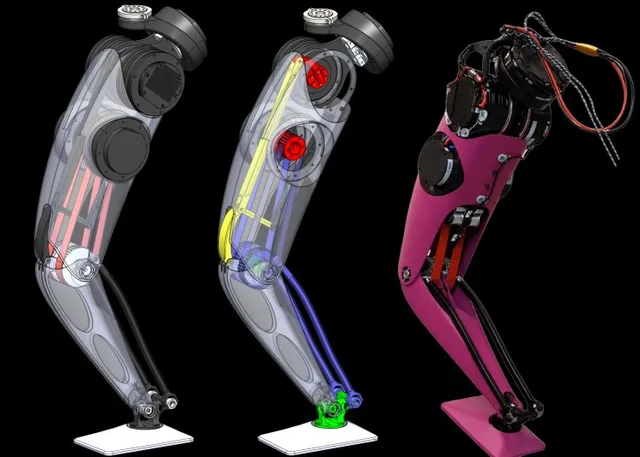
A DFKI and University of Bremen research team tested the mechanism in simulation and on hardware, not a complete humanoid.
A new leg design makes the knee and ankle share mechanical effort instead of treating them as fully separate joints. That could let engineers keep heavy motors near the hip while leaving the lower leg lighter.
The design uses parallel linkages—rigid multi-link mechanisms—for both the knee and ankle. A belt transmission runs through the knee on a fixed 1.6-to-1 reduction. Because the belt follows knee motion, the ankle motors also respond when the knee moves.
That dependency is the key. When the knee bends during swing, the mechanism passively drives the ankle toward dorsiflexion, lifting the foot for clearance. When the knee straightens during stance, it helps drive plantarflexion, the ankle motion used for push-off, according to the authors’ paper on arXiv.
The sharing is not free bandwidth. Knee movement consumes part of the ankle motors’ motion range, and the ankle can have less independent control at some configurations. But the same coupling can redirect actuator capacity where the leg needs it most.
In a reported squat simulation, the peak knee-motor demand fell from 75 newton-meters without coupling to 50.8 newton-meters with it—a 32% reduction under that test’s load and trajectory. In a hardware foot-motion test, peak ankle-motor speeds fell from roughly 14.6–14.8 radians per second to 1.99 and 2.22 radians per second.
The prototype leg weighs about 6.1 kilograms and has six actuated degrees of freedom. The team’s next step is integrating it into a full humanoid while studying belt backlash and friction, so this remains a research mechanism rather than a deployable robot product.