Real time humanoid motion now controllable on the fly
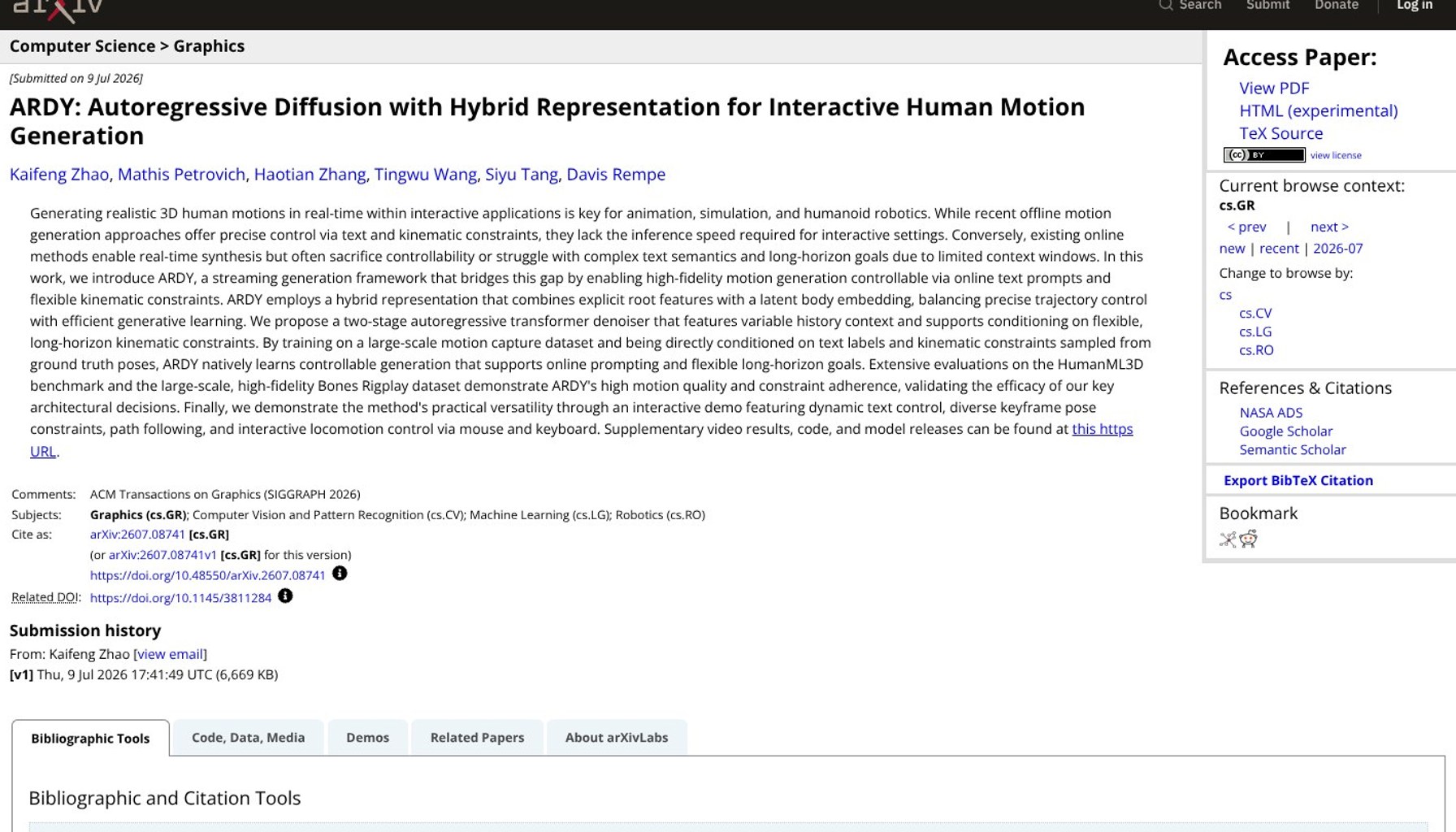
Image / arXiv Humanoid/Bipedal Query
Real time humanoid motion now follows online prompts with precision. Researchers behind ARDY say it enables real time synthesis that respects long horizon goals and text prompts. The breakthrough is not magic but a hybrid representation that ties global trajectory to a latent body model, letting systems stay responsive while still delivering believable poses.
At the heart of ARDY is a hybrid representation that merges explicit root features with a latent body embedding, balancing precise trajectory control with efficient generative learning. In practical terms this means the system can keep a character’s global position and orientation on track while using learned embeddings to fill in the subtleties of limb motion and timing. The result is motion that reads as coherent over longer sequences, rather than choppily reconstituted frame by frame.
Documentation indicates the architecture relies on a two-stage autoregressive transformer denoiser with variable history context to support flexible long horizon goals and conditioning on online text prompts and kinematic constraints sampled from ground truth poses. In other words, ARDY is designed to listen to what you type or select as a target pose and then generate motion that both adheres to those constraints and unfolds plausibly across many steps of motion, rather than resetting with every prompt.
Testing shows ARDY delivers high motion quality and constraint adherence on the HumanML3D benchmark and the Bones Rigplay dataset, according to the researchers. The paper demonstrates that the method can be steered with dynamic text control and a variety of keyframe pose constraints, then translated into path following and interactive locomotion control via mouse and keyboard in an interactive demo. These features were shown in a controlled lab setting, underscoring the method’s potential for animation, simulation, and humanoid robotics where latency and controllability must both be strong.
From a practitioner’s standpoint the design choices address core constraints of real time control. First, the two-stage denoiser and the hybrid root plus latent representation are aimed at keeping inference fast enough for interactivity while preserving the ability to respect long horizon goals. Second, conditioning on text prompts and flexible kinematic constraints suggests a workflow where operators can steer a character toward multi step goals without reauthoring every moment of motion. Third, the reliance on mass motion capture data underscores a need for high quality datasets to maintain generalization when prompts diverge from training scenes. Fourth, the interactive demo signals what to watch next: how smoothly the system can transition between prompts, and how robust it remains when prompts shift mid motion or when constraints tighten or relax.
The ARDY approach sits squarely in a lab and demonstration phase rather than production, but it outlines a concrete path for bringing controllable real time humanoid motion to interactive apps. Industry watchers should note the implicit tradeoffs: achieving low latency with long horizon conditioning often means simplifying or structuring the representation, and drift can emerge if constraints push the model beyond its learned distribution. The payoff, however, is clear; operators can guide realistic motion with natural prompts and constraints, without sacrificing the immediacy that interactive contexts demand. As datasets scale and conditioning mechanisms refine, ARDY points toward a future where real time humanoid motion behaves like a controllable, responsive agent rather than a scripted afterthought.
- ARDY: Autoregressive Diffusion with Hybrid Representation for Interactive Human Motion GenerationarXiv Humanoid/Bipedal Query / Primary source / Published JUL 09, 2026 / Accessed JUL 10, 2026