Rollon Reveals Magnets in Telescopic Rails
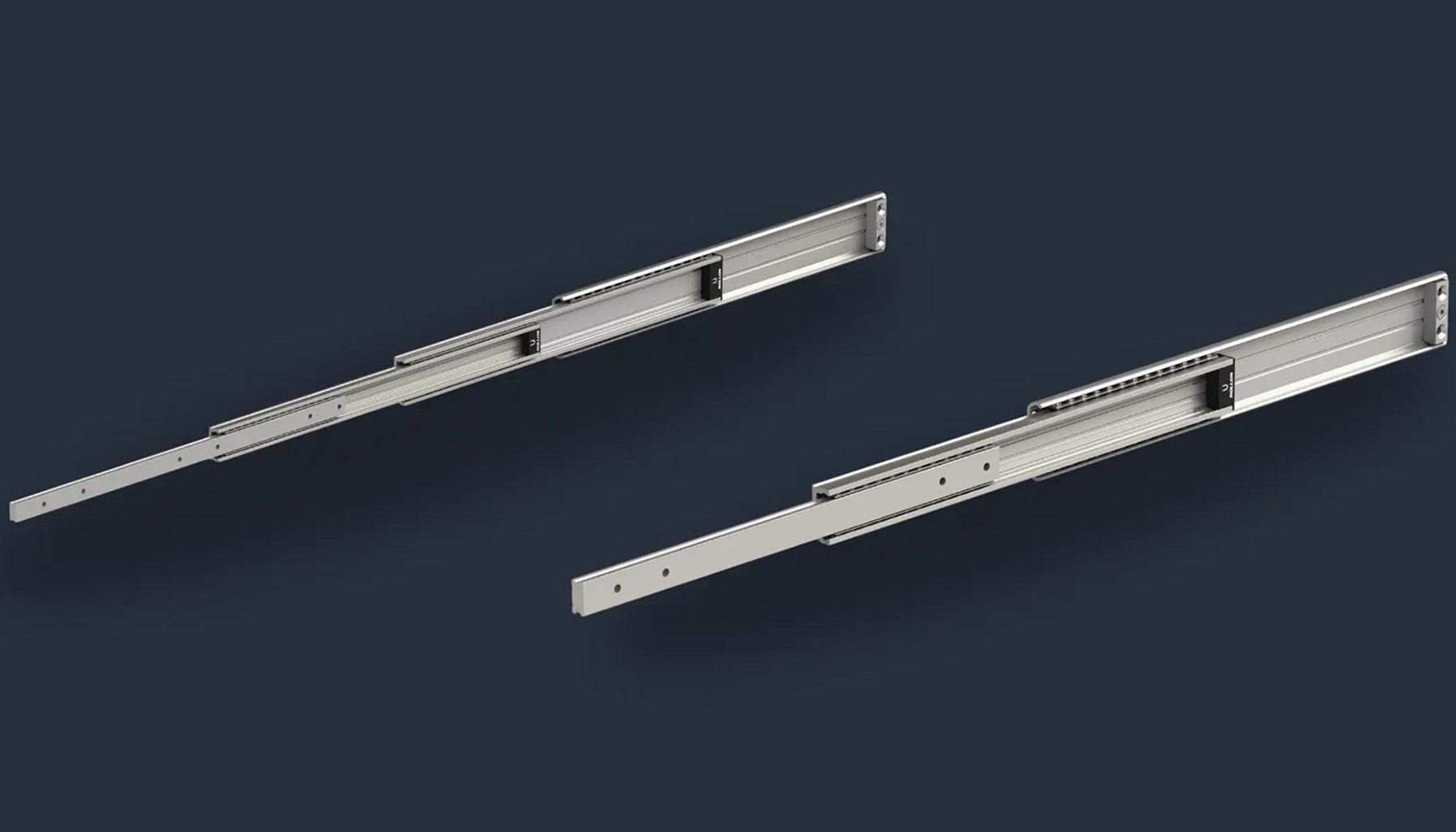
Image / The Robot Report
Rollon’s new MG rails use magnets to control extension and lift more.
Rollon, a long-time maker of linear motion systems, announced two telescopic rail families, the H1C-MG and HVC-MG, that integrate magnets into the rail and end blocks. The magnets are positioned to enable the sequential opening of the rail elements, a feature Rollon says helps with control during extension and boosts overall load capacity. Andrea Tosi, vice president of technology at Rollon, framed the move as extending a proven concept: “After successfully introducing this technology on the HGT range, we are now extending it to additional telescopic rail families.” The magnets are designed to smooth motion, manage higher loads, and improve durability even under aggressive operating conditions.
The new MG version comes in the HVC family for Sizes 54 and 68, and in the H1C family for Size 68. The engineering effort includes a redesigned ball cage with reduced pitch, paired with end blocks that incorporate internal magnets. Rollon says reducing pitch increases the number of balls in the same cage length, yielding higher load capacity without changing overall dimensions. The integrated magnets also support a defined motion sequence during extension, which translates into more predictable movement on automated lines and less operator intervention. In practice, this can translate to more consistent stroke times, reduced stiction, and smoother starts and stops on high-cycle tasks.
For operators weighing the economics of automation, the update is framed around operational performance more than new gadgetry. Deployment data shows that smoother, magnet-guided extension can yield more reliable cycle behavior on repetitive tasks, especially where long, multi-element rails are involved. That reliability matters when lines run at high throughput and where downtime for mechanical adjustments is costly. By increasing the effective load-bearing window and sharpening motion control, the MG rails are positioned to push throughput on applications that rely on rapid, repeatable reach, grab, and retract cycles, including packaging, material handling, and automated assembly cells.
Integration requirements for this upgrade are notably mechanical rather than electrical. The MG rails align with the existing HVC and H1C form factors, retaining mating interfaces to keep installation familiar for plant teams. The magnets live within the rail stack and the end blocks, so the upgrade centers on swapping components and re-sequencing the installation to accommodate the magnet-assisted motion. Operators will still need the usual alignment, preload, and tolerance checks that accompany high-load telescopic rail installations, plus a brief calibration to ensure the intended extension sequence matches the robot or fixture it serves. There’s no indication of new power or sensor wiring for the magnets themselves, which keeps the integration scope focused on mounting and mechanical fit.
From a practitioner’s perspective, a few realities stand out. First, cycle-time gains will hinge on the extent to which a target application suffers from extension-dwell or misalignment during multi-element travel; in steady, high-volume lines, the smoother motion should yield more predictable throughput. Second, the changes emphasize gravity toward robustness: higher load capacity and longer life can reduce maintenance windows, but the magnets introduce a new set of wear patterns to monitor, particularly around the end blocks and cage interface. Third, skilled trades involvement centers on precision assembly and alignment by mechanical technicians or automation integrators, not welders or electrical technicians, since the magnet system operates within the rail hardware itself. Finally, buyers should watch for how these rails perform when retrofitting existing lines versus new automation builds; the compatibility of the defined motion sequence with surrounding control software will influence the speed of deployment and the realized ROI.
Rollon’s move reflects a broader industry shift toward mechanically intelligent subsystems that improve reliability without requiring a wholesale rethink of automation architectures. It’s not a silver bullet, but for operations where every millimeter of repeatable motion matters, integrated magnets in telescopic rails offer a tangible path to steadier throughput and longer component life.
- Rollon launches two telescopic rails with integrated magnetsThe Robot Report / Trade / Published JUL 09, 2026 / Accessed JUL 10, 2026