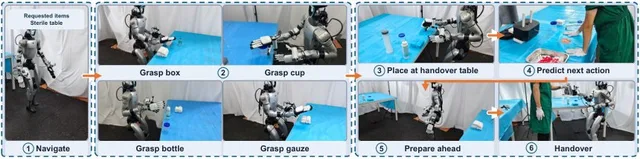
The proposed framework separates uncertain human activity from robot actions, then updates only the unfinished work that no longer fits.
RoboAssist is a research framework proposed in an arXiv paper for long-horizon human–humanoid surgical assistance. The team tested it on a Unitree G1 humanoid with Inspire FTP dexterous hands in simulated scenarios involving object retrieval, transport, and handover—not in patient care.
Its central idea is to keep two tracks separate. One estimates what a person has done or may do next using voice and visual observations. The other contains executable robot tasks, such as fetching an item and handing it to a surgeon.
Evidence gates connect the tracks. A prediction can trigger preparation, but it cannot satisfy a required human-process condition until supporting evidence or explicit confirmation arrives. When a request or condition changes, RoboAssist validates the robot’s current state, retains completed tasks and still-valid pending tasks, then regenerates the affected unfinished remainder.
That differs from full replanning, which regenerates every unfinished task after an update. In the paper’s request-order benchmark, RoboAssist reported 81.25% end-to-end workflow completion across 16 trials, versus 68.75% for FullReplan. The measure includes physical execution, not planning alone. Mean replanning latency fell from 3.62 seconds to 1.20 seconds.
In a separate multi-object test, RoboAssist reported 85.7% success across seven trials. Its safety design combined slower navigation near a protected surgeon area, reactive handover regulation, and independent runtime monitoring that could stop the robot.
These results remain author-reported simulations, with no independent replication or external evaluation. The paper establishes neither regulatory approval nor readiness for surgery; longer, less predictable workflows and clinical safety testing are the necessary next steps.