The research demo combines adjustable gestures with balance control and live facing or pointing, but its strongest result excludes spatial-goal changes.
RoboMMT is a research control system for robots that change a gesture’s timing, size, or motion style while responding to targets nearby. An arXiv paper from the Socially Intelligent Robotics Lab at the University of Stuttgart reports simulation tests on one quadruped and two humanoids, plus a physical demonstration on a Unitree Go2.
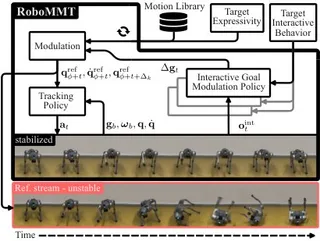
The system has three layers. A motion generator creates adjustable gestures using parameters such as timing, exaggeration, anticipation, and spatial direction. A tracking policy then turns those changing gestures into joint movements while accounting for the robot’s physics.
A separate interaction module changes the gesture’s spatial goal. That can make the robot face a moving target or point toward one. The balance tracker stays active underneath, allowing researchers to add these task-specific behaviors without retraining the main physical controller.
The evaluation covered a 12-joint Unitree Go2, a 20-joint ROBOTIS OP3 humanoid, and a 29-joint Unitree G1 humanoid. In simulation, each robot completed at least 99.3% of 2,048 test streams across the tested expressive-motion range. However, those streams excluded spatial-goal modulation, so the figure is not a complete test of the interactive system.
Controllers trained only on unmodulated gestures completed 50.0% to 70.1% of the same streams. The paper reports that the full system also ran on a physical Go2: a representative sequence lasting more than 90 seconds, with 20 connected movements and outside disturbances, finished without a fall across five trials.
This remains a lab demonstration, not a product people can buy. The authors did not test whether people perceive the movements as expressive or socially effective; that requires a user study.