Acc-CBF-QP safety filter cut reported Unitree H1 constraint violations by 92% in hardware test
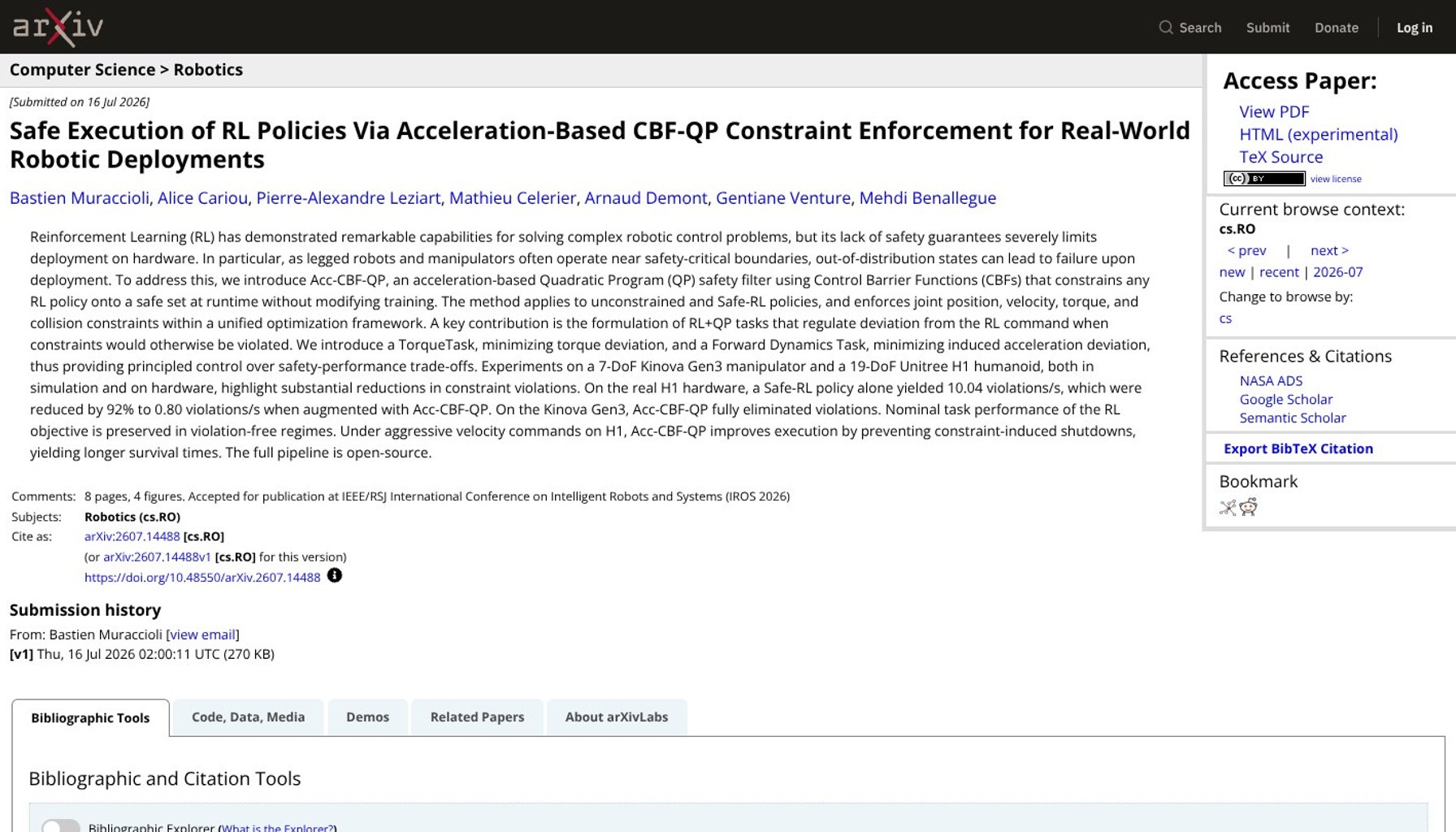
Image / arxiv.org
The arXiv paper describes a runtime layer that modifies unsafe RL commands without retraining the policy, with tests on a 19-DoF humanoid and a 7-DoF industrial-style manipulator.
Researchers have posted an arXiv paper describing Acc-CBF-QP, an acceleration-based safety filter that reduced reported constraint violations on a Unitree H1 humanoid during hardware tests.
The paper reports that a Safe-RL policy running on the 19-DoF H1 produced 10.04 constraint violations per second on real hardware. Adding the Acc-CBF-QP filter reduced that figure to 0.80 violations per second, a 92% reduction. Under aggressive velocity commands, the researchers said the filter prevented constraint-induced shutdowns and allowed the humanoid to operate for longer.
Acc-CBF-QP sits between a reinforcement-learning policy and the robot’s low-level actuation commands. Rather than retraining the learned policy, the system solves a quadratic program at runtime to adjust commands when they would violate defined safety limits. The framework uses control barrier functions to keep the robot within a specified safe set.
The researchers said the filter can enforce joint-position, joint-velocity, torque and collision constraints in one optimization framework. It is designed to work with both unconstrained RL policies and policies trained with Safe-RL methods.
A central engineering issue is how much the safety layer should override the learned controller. The paper describes two optimization tasks for that tradeoff. Its TorqueTask minimizes deviation from the RL policy’s requested torque, while its Forward Dynamics Task minimizes deviation in the acceleration induced by the adjusted command. In normal operating conditions where no constraint is violated, the researchers said nominal RL task performance is preserved.
The team also tested the approach on a 7-DoF Kinova Gen3 manipulator in simulation and on hardware. It reported that Acc-CBF-QP eliminated constraint violations on the Gen3 during its experiments.
For humanoid developers, the practical appeal is that the method does not require a new training cycle whenever safety boundaries change or a deployment exposes behavior outside the policy’s training distribution. A runtime filter could be particularly useful during pilot deployments, where aggressive operator commands, model mismatch and unexpected contact can push a robot into joint, velocity or torque limits.
The reported H1 result remains a laboratory hardware evaluation, not evidence of production reliability. The paper does not establish how the filter performs across a broad fleet, over long maintenance intervals, or in unstructured work environments with varied terrain, payloads and human interaction. Its violation metric also depends on the constraints and test conditions selected by the researchers.
The work has been posted on arXiv, and publication status beyond that posting is not established. No independent experimental replication is available in the supplied record. Still, the reported results point to a concrete control architecture for putting a tighter safety envelope around learned humanoid behaviors without discarding the performance benefits of RL.
- Safe Execution of RL Policies Via Acceleration-Based CBF-QP Constraint Enforcement for Real-World Robotic Deploymentsarxiv.org / Primary source / Published JUL 15, 2026 / Accessed JUL 21, 2026