arXiv paper outlines audio-driven control framework for Unitree G1 humanoid
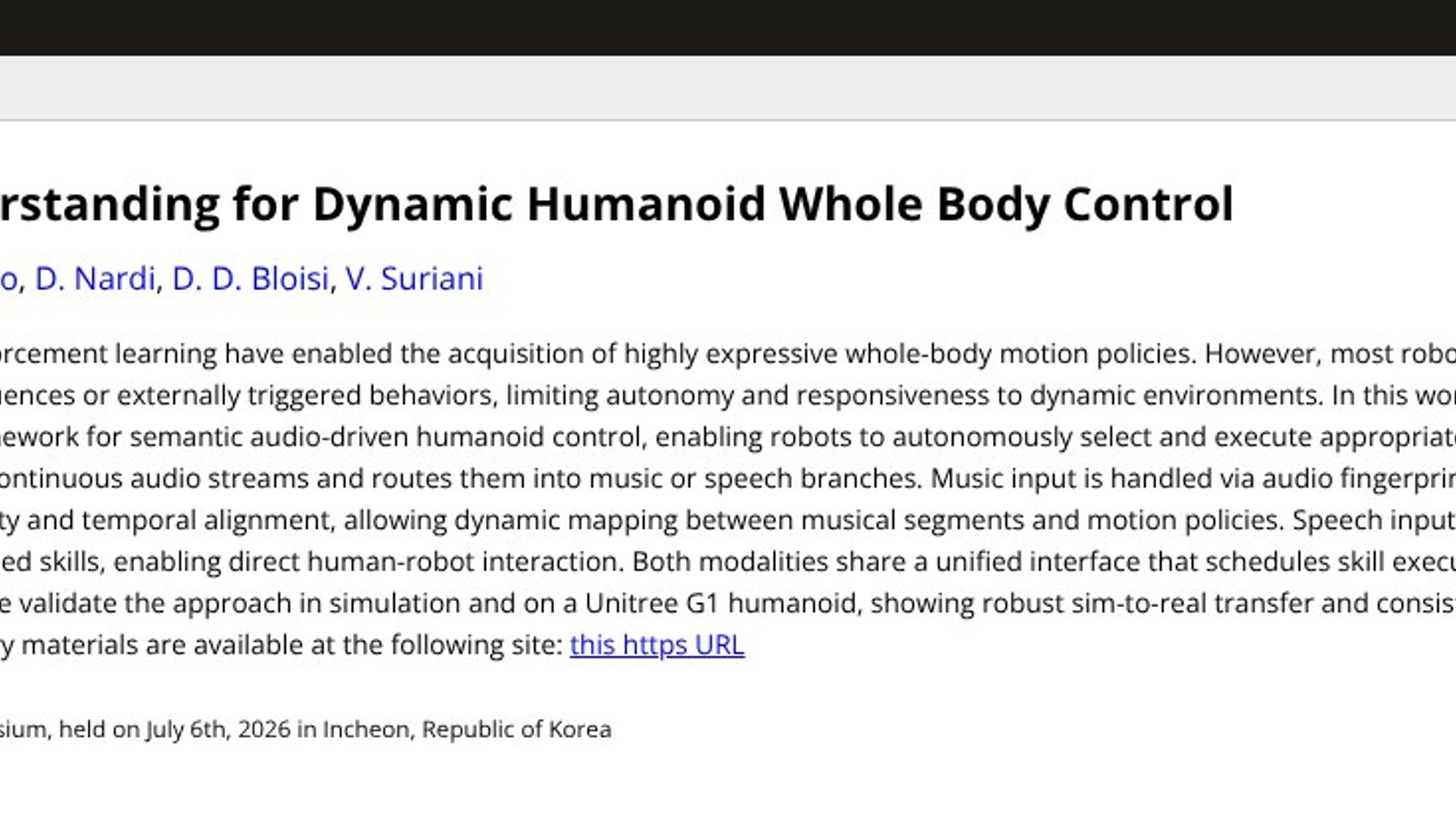
Image / arxiv.org
Researchers say the system routes music and speech into separate interpretation paths, then selects whole-body skills through a shared reinforcement learning control pipeline.
A newly posted arXiv paper describes a framework intended to let humanoid robots select whole-body actions from continuous audio, rather than follow only pre-scripted routines or externally triggered behavior.
The researchers call the system a multi-modal orchestration framework for semantic audio-driven humanoid control. They report validating it in simulation and on Unitree’s G1 humanoid, with what they describe as robust sim-to-real transfer and consistent audio-conditioned policy selection.
The design separates incoming sound into music and speech branches. For music, the framework uses audio fingerprinting and semantic embeddings to identify a track and align the robot with its temporal position. That alignment can then map sections of music to corresponding motion policies.
For speech, the system grounds spoken input in a discrete library of skills learned through imitation. The paper positions that branch as a direct human-robot interaction interface, allowing a person to call for an available behavior through speech rather than selecting it from a conventional robot control panel.
Both branches feed into a unified interface that schedules skills over a reinforcement learning control pipeline. In practical terms, the framework is not presented as a single policy that can generate any motion from arbitrary sound. It is an orchestration layer that interprets audio, chooses from an existing skill library, and sends the selected behavior to the robot’s lower-level controller.
That distinction matters for deployment. Audio-conditioned selection can be useful where a robot already has a reliable set of locomotion, gesturing, or performance skills but needs a more natural trigger mechanism. A music-aware system could synchronize motions to known tracks, while a speech interface could let an operator or nearby user request defined behaviors without relying on prebuilt sequences.
The work remains research-stage. The paper does not provide experimental metrics in its abstract, including task success rates, latency, duration of testing, failure cases, or details on the number and type of skills available to the G1. It also does not establish from the abstract whether every reported Unitree G1 result came from fully physical testing or involved a mix of hardware and simulation.
The authors’ sim-to-real claim is therefore notable but not yet sufficient to assess operating reliability in a noisy environment, with unfamiliar speech, unrecognized music, changing acoustics, or people moving near the robot. Those conditions are central to whether audio can serve as a dependable control input outside a lab or staged demonstration.
The paper was submitted to arXiv on July 15, 2026. Its peer-review status is not established in the submission record.
- Semantic Audio-driven Understanding for Dynamic Humanoid Whole Body Controlarxiv.org / Primary source / Published JUL 15, 2026 / Accessed JUL 21, 2026