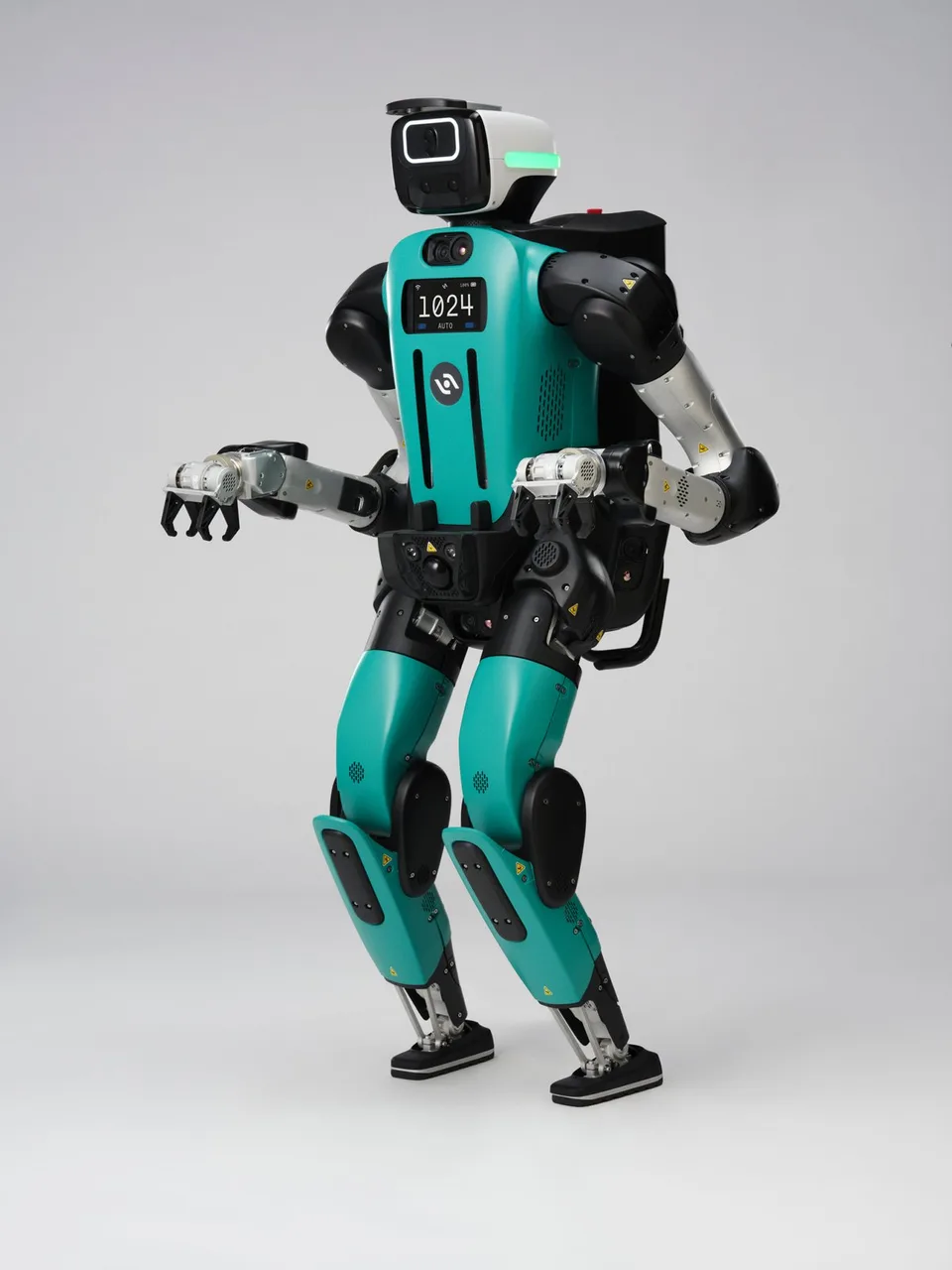
The announced humanoid targets lifting, tool changes, fast charging, and safer work near people. Early access is planned for 2027, not available today.
Agility Robotics says Digit 5 is designed less like a research demonstration and more like equipment for a working facility. The company unveiled the new humanoid robot on September 15, describing changes to its legs, batteries, manipulation tools, and safety systems.
Agility expects early access to begin in the first half of 2027. It expects general availability for manufacturing, warehouse, and distribution operators by the end of that year, according to The Robot Report.
That makes Digit 5 a planned industrial product, not a robot people can buy today. The announcement also does not establish that the new model has entered paid or scaled deployment.
Designing around the building
A robot that completes one task in a demonstration may still fail as a production machine. It must fit facility aisles, reach work areas, recharge without disrupting operations, and operate safely around employees.
Jonathan Hurst, Agility’s co-founder and chief robot officer, told The Robot Report that the company now designs around those constraints. Customer requirements such as aisle sizes, charger locations, and facility workflows became hundreds of engineering requirements, he said.
That changes the engineering question. Instead of asking only whether Digit can move a bin, engineers must ask how it will operate throughout a facility and fit into the existing work process.
Agility says Digit 5 will expand beyond the tote-based material handling that has been Digit 4’s main focus. Planned tasks include removing goods from pallets, tending machines, preparing and sequencing kits, inspecting items, and placing finished goods onto pallets.
Those tasks cover several points in a facility’s workflow. The goal is a robot that can support more than one station, although the announcement does not provide independent task-performance results for Digit 5.
Legs built for lifting
Digit 5 replaces the earlier model’s backward-facing, ostrich-like knees with more human-like legs. Hurst said the old design favored walking and running, while the new configuration emphasizes lifting heavy objects and repeatedly getting down to the floor.
The legs use proprietary cycloidal actuators, a type of mechanical drive. Agility says Digit 5 can repeatedly lift loads weighing up to 50 pounds, or 22.7 kilograms.
Digit 5 also has padded knees and can squat into a stable position. Agility says the robot can sit on the ground and turn off its motors when someone approaches. The company presents that stable, powered-down position as part of its safety strategy.
The redesign also changes the robot’s size. Digit 5 weighs 284 pounds and stands 5 feet 11 inches tall. Its reach extends to 7.2 feet, compared with 5.5 feet for Digit 4, according to Agility.
Those dimensions become part of every facility decision. Operators would need to consider floor space, access routes, work heights, and where the robot can safely stop.
Less time waiting for a charger
Agility says Digit 5 can operate for 90 minutes and fully recharge in nine minutes using its autonomous charger. That creates a claimed 10-to-1 operating-to-charging ratio, up from 2-to-1 for Digit 4.
The company says this could allow Digit to work for more than 20 hours in a 24-hour day. That figure describes Agility’s proposed operating approach, not an independently verified production result.
Fast charging could give an operator more ways to schedule the robot. For example, the system might charge during planned pauses in work. Whether that fits a particular facility would depend on the robot’s workload, charger location, and production schedule.
Operators would still need to see how the charging system performs during sustained production. Charging speed alone does not show how many tasks the robot completes, how often people must help it, or what facility infrastructure it needs.
Tools instead of a perfect robot hand
Agility is not trying to give Digit 5 a general-purpose human hand. Hurst told The Robot Report that commercially available hands are not good at every industrial job.
Digit 5 instead uses a two-fingered gripper and a swappable tool design. Its tools attach through standard mounting flanges, allowing the gripper or another end-effector—the tool at the end of the robot’s arm—to change for a particular job.
That approach treats manipulation as a tooling problem. One tool can be suited to bins, while another may be designed for a different factory task.
Agility said its current manipulator can lift 25-kilogram bins and perform complex manipulation with them. That is a company claim; the announcement does not provide independent measurements of speed, success rate, or long-term durability.
Safety is part of the robot
Agility says Digit 5 is intended to work near people without physical safety barriers. Its system uses multiple sensor technologies and proprietary artificial-intelligence software to monitor for nearby workers.
When a person approaches, Agility says Digit can avoid the person, stop, or move into a seated position. The company also says visual and auditory cues communicate the robot’s intent.
An independent safety controller provides another layer. According to Agility, the controller oversees the robot’s response after people are detected within an unsafe distance and triggers the appropriate safety action. The source does not say that the controller itself detects people.
This safety design reaches across the entire machine. Hurst said it involves the robot’s electrical and mechanical systems, sensors, computing, and physical behavior rather than a separate safety feature added at the end.
The practical test is still ahead: whether these claims hold up in real facilities and through the required industrial certification and regulatory processes. Agility says it plans future commercial availability in the European Union and United Kingdom, where it expects Digit 5 to carry the required European and additional regulatory marks.
For operators, the useful question is not whether Digit 5 looks more human. It is whether the complete system—robot, charger, tools, facility layout, safety controls, and support process—can perform useful work reliably through a real shift.