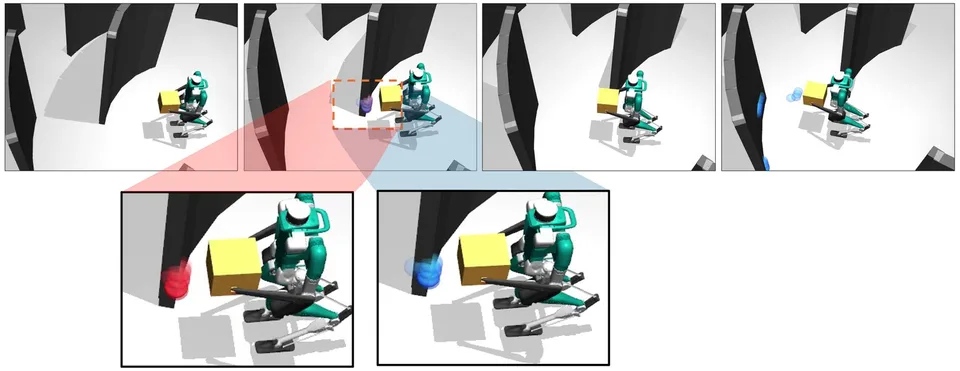
Oregon State researchers demonstrated the learned layer on Digit V3, but only as a qualitative physical test.
RECAL helps a humanoid avoid obstacles without replacing the whole-body controller—the system that converts motion targets into stable joint movements. Researchers at Oregon State University’s Collaborative Robotics and Intelligent Systems Institute describe it as a learned wrapper that changes unsafe commands before the existing controller receives them.
The layer builds an egocentric point cloud, a three-dimensional map from the robot’s viewpoint, using two Intel RealSense D455 depth cameras mounted near Digit V3’s chest and pelvis. It compares that scene with geometry for the robot and held objects. Its encoder uses 37 query points, including body keypoints, carried-object corners, and hand-object points, so it can connect a nearby obstacle to the specific robot part at risk.
RECAL then balances two goals: follow the requested motion when it is safe, or alter the command near a blockage. In configured frozen-arm modes, the controller prioritizes preserving end-effector positions and can adjust the base instead. With adaptive arms, it can adjust arm targets as well. The existing controller still manages balance and whole-body motion.
In simulation, the authors report a medium-difficulty collision-free rate of 0.93 for both adaptive-arm and frozen-arm locomotion. Other medium results were 0.98 for object carrying, 0.86 for stationary reaching, and 0.78 for reaching while holding an object.
The team also demonstrated all five task types on a physical Digit V3: adaptive-arm locomotion, frozen-arm locomotion, object carrying, stationary reaching, and reaching with an object. The paper calls this qualitative evidence; some demonstrations included light contact, and it reports no physical trial counts, duration, or failure rate.
RECAL currently assumes static, flat ground and limited camera coverage, leaving some overhead and rear obstacles unseen. It is a research demonstration, not yet evidence of reliable collision avoidance around moving obstacles or uneven terrain.