AI Agents Gain Live UI with AG-UI Protocol
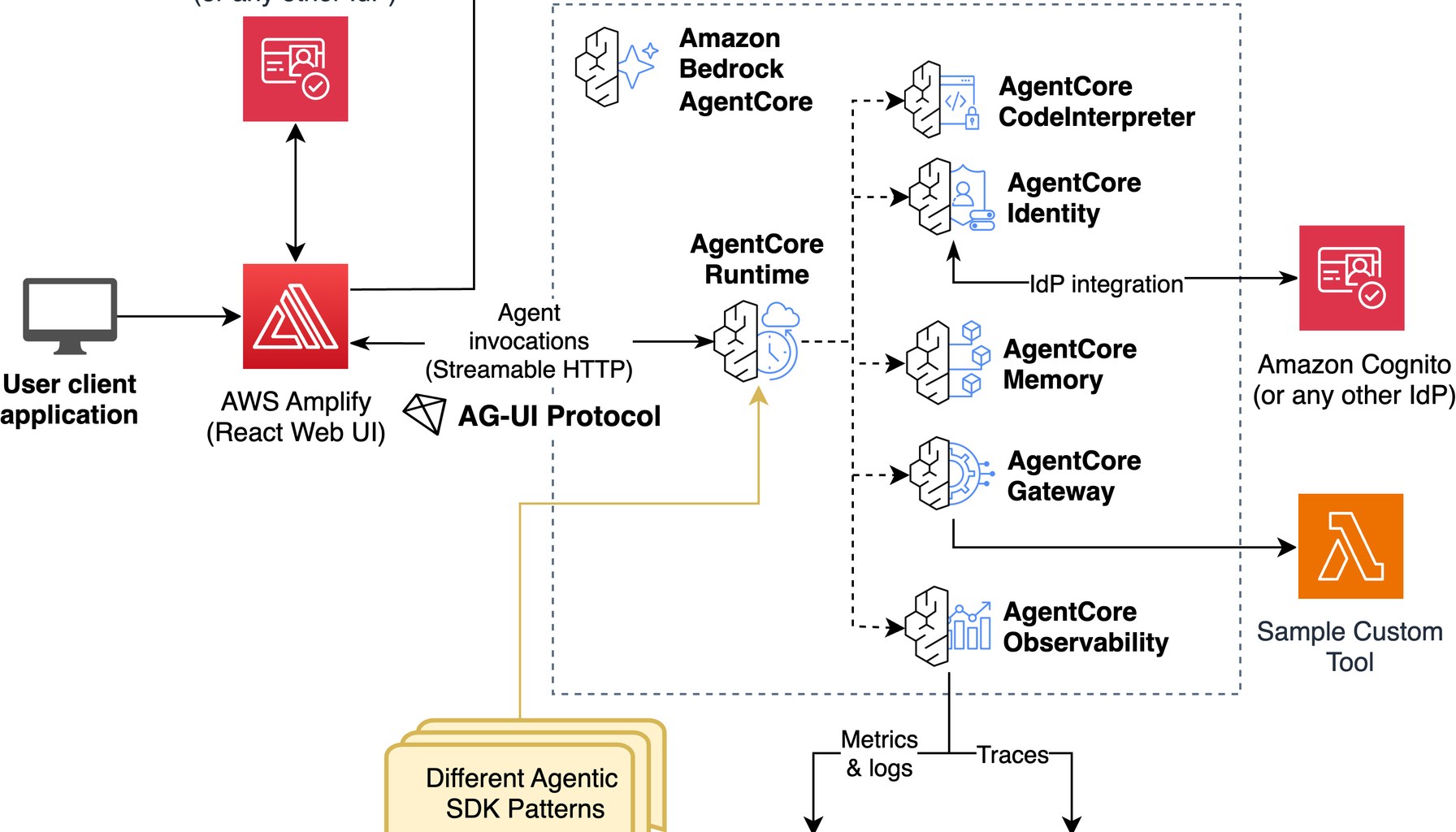
Image / AWS Machine Learning
Generative AI agents can now render interactive charts inside chats. The new AG-UI protocol lets agent backends talk to frontends in a standard, framework-agnostic way, enabling live UI elements, shared state, and human-in-the-loop prompts without forcing teams into a single stack.
The gist is simple but powerful: AG-UI is an open protocol that connects agents to users, decoupling the code that runs the agent from the code that renders the interface. It works across multiple agent frameworks (Strands Agents, LangGraph, CrewAI) and frontend libraries (React, Angular, Vue). Amazon Bedrock AgentCore acts as the hosting and execution surface, with AG-UI acting as a transparent bridge when you deploy an agent container with the protocol flag. The result is a backend that can push dynamic events to a frontend in real time, whether that means an inline chart, a shared canvas updating in parallel with collaborators, or a pause for a user approval mid-execution.
The team reports that the system supports a spectrum of interactive capabilities beyond simple chat. For example, an agent can render an inline chart within the chat, update a shared canvas as collaborators work, or halt a task to solicit a human decision. This is powered in part by Bedrock AgentCore Runtime, designed as a secure, serverless environment optimized for running agents or tools at scale. AgentCore integrates several protocols to connect with tools, agents, and users, and AG-UI specifically handles the user-facing side of the interaction. In practice, the agent and the user stay decoupled, allowing engineers to optimize each side independently.
Industry practitioners will note that this unlocks a new class of agent experiences that previously required bespoke frontends or bespoke tool integrations. The blog walks through the Fullstack AgentCore Solution Template (FAST) to show how to assemble interactive agent frontends on Bedrock AgentCore, and it highlights CopilotKit as an extension that enriches the experience with generative UI, shared state, and human-in-the-loop interactions. The approach keeps security and scalability front and center, leveraging AgentCore Runtime’s serverless hosting and its ability to interoperate with different model contexts and tool connections.
From an engineering standpoint, the most important constraint is decoupling. By letting backends and frontends communicate through a defined protocol, teams can mix and match their preferred stacks on either side. The paper shows how this decoupling can speed iteration: you swap a UI library without rewriting agent logic, or you refine agent prompts without reworking the user interface. The team reports that this separation reduces cross-domain churn and makes it easier to adopt new models and tools as they come online.
But there are tradeoffs to manage. Introducing a generative UI protocol adds a layer of asynchronous event handling and shared-state management. Teams must design robust event contracts, ensure idempotent actions, and establish clear timeouts for human-in-the-loop decisions. Latency and ordering become visible failure modes; if the UI lags behind the agent’s decisions or if state drift occurs across collaborators, the experience can degrade quickly. Practitioners should plan for observability hooks, deterministic UI update rules, and graceful fallbacks when the agent cannot push updates in real time.
Looking ahead, early adopters will watch for broader support across toolkits and models, and for real-world benchmarks of latency, reliability, and developer productivity. The approach signals a shift from monolithic AI interfaces toward modular, interactive, tool-augmented assistants that can operate at scale without tying teams to a single frontend or backend framework.
The paper shows a path toward richer AI-assisted workflows that feel native to users, not scripted around a single chat box. The team reports that AG-UI enables a practical balance between powerful agent capabilities and responsive, user-centered interfaces that can evolve with minimal risk to existing infrastructure.
- Build generative UI for AI agents on Amazon Bedrock AgentCore with the AG-UI protocolAWS Machine Learning / Primary / Published JUN 30, 2026 / Accessed JUN 30, 2026