Anthropic Claude Sonnet 5 Lands on AWS Bedrock
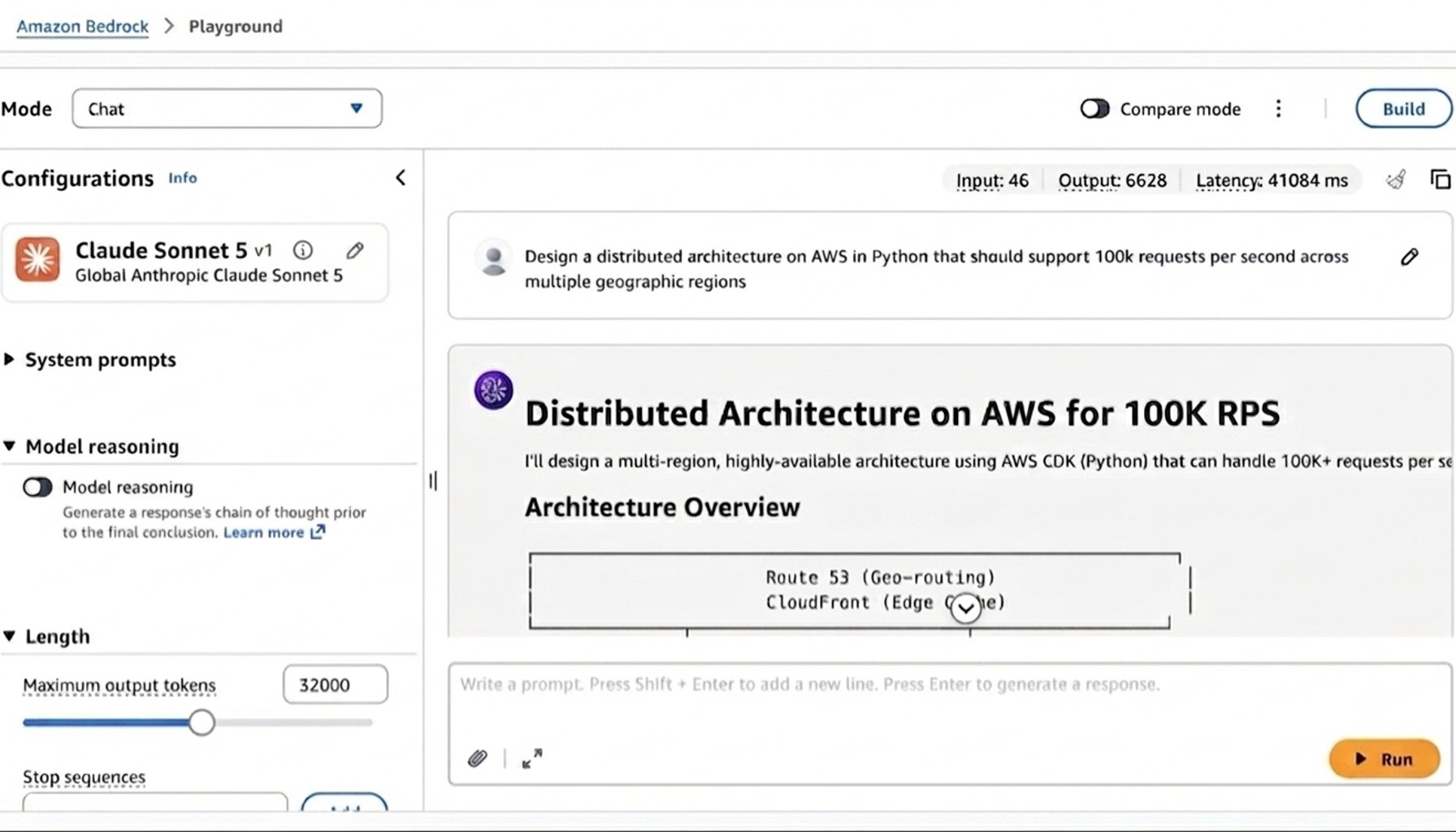
Image / AWS Machine Learning
Anthropic's Claude Sonnet 5 lands on AWS Bedrock delivering near Opus intelligence at Sonnet pricing.
The release marks the latest step in Anthropic's drive to make top tier AI capabilities available at enterprise scale without the Opus price tag. Claude Sonnet 5 is described as Anthropic's most capable Sonnet model yet, designed for coding, agentic tasks, and everyday professional work, while preserving a familiar API and the same API surface teams already use with Bedrock. In practical terms, this means organizations can build, test, and deploy in their existing AWS environments with enterprise security and regional data residency, while leaning on Sonnet 5 for stronger reasoning and reliability at scale. The vendor emphasizes that Sonnet 5 can hold a plan across stages, track what has been done, and resolve issues with fewer rounds of correction, reducing the iteration burden that slows production workflows. For teams balancing capability with cost, Claude Sonnet 5 promises a middle ground: near Opus intelligence without the premium price, with Opus reserved for the most demanding reasoning tasks.
From an engineering standpoint the headline is less about novelty and more about how the product aligns with production realities. The move leverages Bedrock and Claude Platform on AWS to unify model access with existing enterprise tooling, billing, and authentication, so organizations can operate under a single governance surface. That matters because the transition from experimentation to production hinges on compatibility, reliability, and predictability at scale. The post frames Sonnet 5 as a pragmatic upgrade for teams that want stronger coding, better agentic reliability, and robust everyday performance, without the cost and latency penalties that can stall large deployments.
The resilience lens is equally important for practitioners watching the rollout. AWS's own guidance on resilience for LLM inference emphasizes four intertwined dimensions: availability, response time, cost, and throughput. Across production stacks, availability means staying online during model, region, or provider disruptions; response time is often measured in time to first token and time to last token; cost tracks per token and per request alongside routing choices; throughput covers how many concurrent requests and tokens per second the system sustains. The guidance also notes that cross region routing can boost availability and throughput but may affect response times. In other words, a production deployment built atop Claude Sonnet 5 on Bedrock should plan for failover across regions, quota isolation to prevent noisy neighbors, and careful cost aware routing as models and quotas evolve.
For teams building agentic systems or coding assistants, the integration story matters as much as model capability. Claude Sonnet 5 is available through Amazon Bedrock and Claude Platform on AWS, meaning you can access the same APIs and console experience while staying within AWS workflows, security controls, and authentication. The practical takeaway is clear: reduce integration friction, avoid new IAM schemas, and simplify monitoring and cost accounting by leveraging a single cloud centric deployment model. Parameter counts for Sonnet 5 were not disclosed in the public materials, so teams should rely on observed behavior around latency, planning fidelity, and the number of correction rounds rather than assuming any fixed size.
What to watch next is straightforward. Expect ongoing evaluation of model availability and cross region performance as production workloads scale, especially for multi region deployments or across provider queues. Watch how Sonnet 5 performs in real coding and agent tasks at enterprise scale, and how Bedrock resilience patterns evolve to balance TTFT, TTLT, and cost under load. If the combination holds, this could become a standard path for enterprise AI pilots moving into production, delivering stronger reliability and socialized governance without breaking the bank.
- Introducing Claude Sonnet 5 on AWS: Anthropic’s most capable Sonnet modelAWS Machine Learning / Primary / Published JUN 30, 2026 / Accessed JUN 30, 2026
- Implementing resilience patterns with Amazon Bedrock and LLM gatewayAWS Machine Learning / Primary / Published JUN 30, 2026 / Accessed JUN 30, 2026